
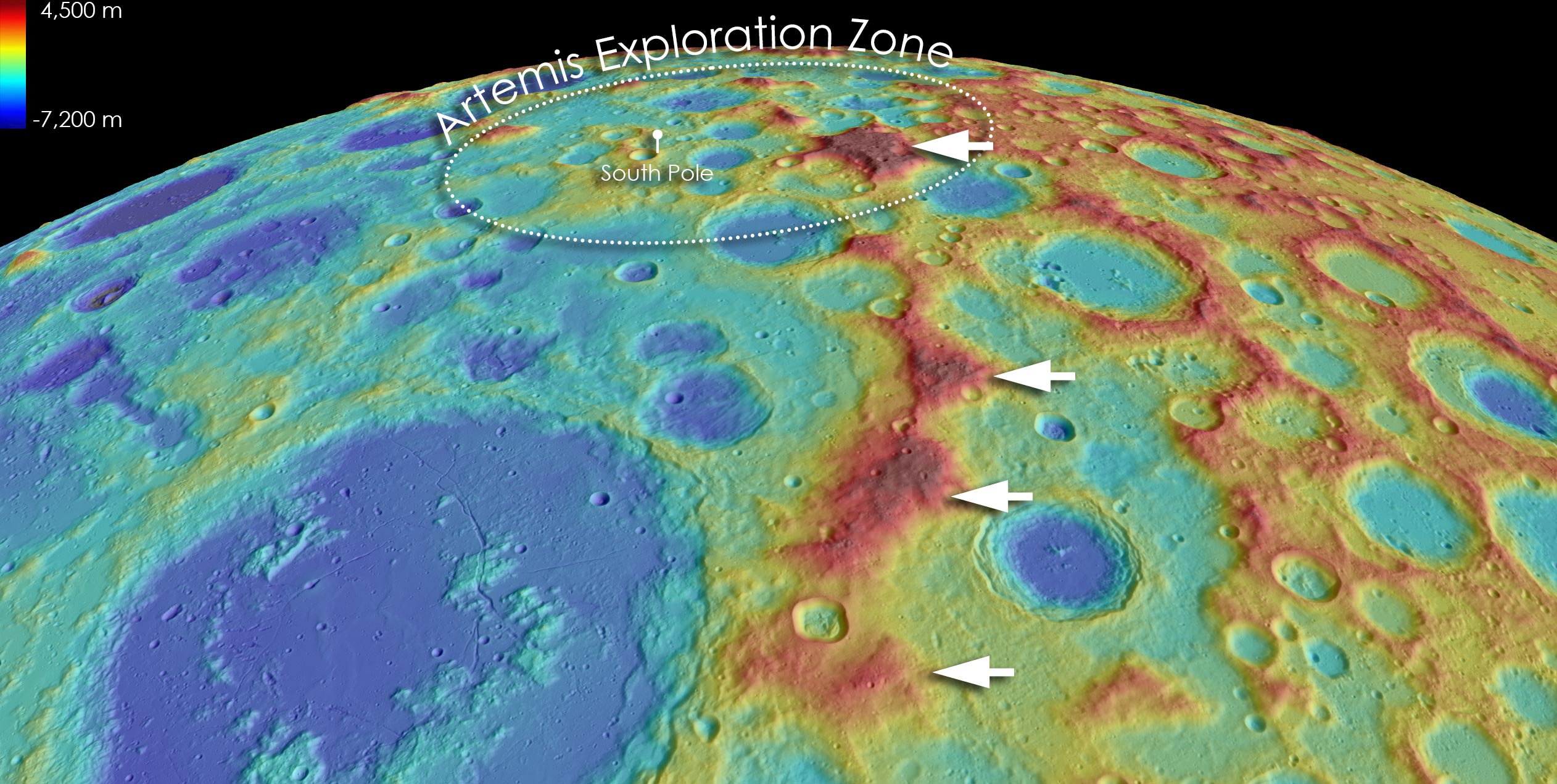
Scientists have long thought that the South Pole-Aitken basin was formed by a shallow-angle impact, but new research suggests otherwise.
A study using NASA’s Lunar Reconnaissance Orbiter data found evidence of a more direct impact, creating a rounder crater and distributing deep lunar materials more evenly. This finding could greatly influence NASA’s Artemis missions, as astronauts may have access to mantle materials that could reveal secrets about the moon’s origins and the early solar system.
The Moon’s Oldest Time Capsule
The South Pole-Aitken basin is the largest and oldest known crater on the Moon, a massive impact site dating back four billion years. This ancient geological scar acts as a time capsule, preserving clues about the Moon’s early history.
For years, scientists believed the basin was shaped like an oval or ellipse, suggesting it was created by an object striking the Moon at a shallow angle, similar to a rock skipping across water. Under this theory, only minimal debris from the impact would have spread to the lunar South Pole, the planned landing site for NASA’s upcoming Artemis missions.
A Game-Changing Discovery
However, a new study led by the University of Maryland and published in Earth and Planetary Science Letters challenges this idea. The research suggests the impact was much more direct, creating a rounder crater than previously thought. This discovery reshapes our understanding of the Moon’s formation and could have major implications for future NASA missions.
“It’s challenging to study the South Pole-Aitken basin holistically due to its sheer enormousness, which is why scientists are still trying to learn its shape and size. In addition, four billion years have passed since the basin was originally formed and many other impacts have obscured its original appearance,” explained the study’s lead author, Hannes Bernhardt, an assistant research scientist in UMD’s Department of Geology. “Our work challenges many existing ideas about how this massive impact occurred and distributed materials, but we are now a step closer to better understanding the moon’s early history and evolution over time.”
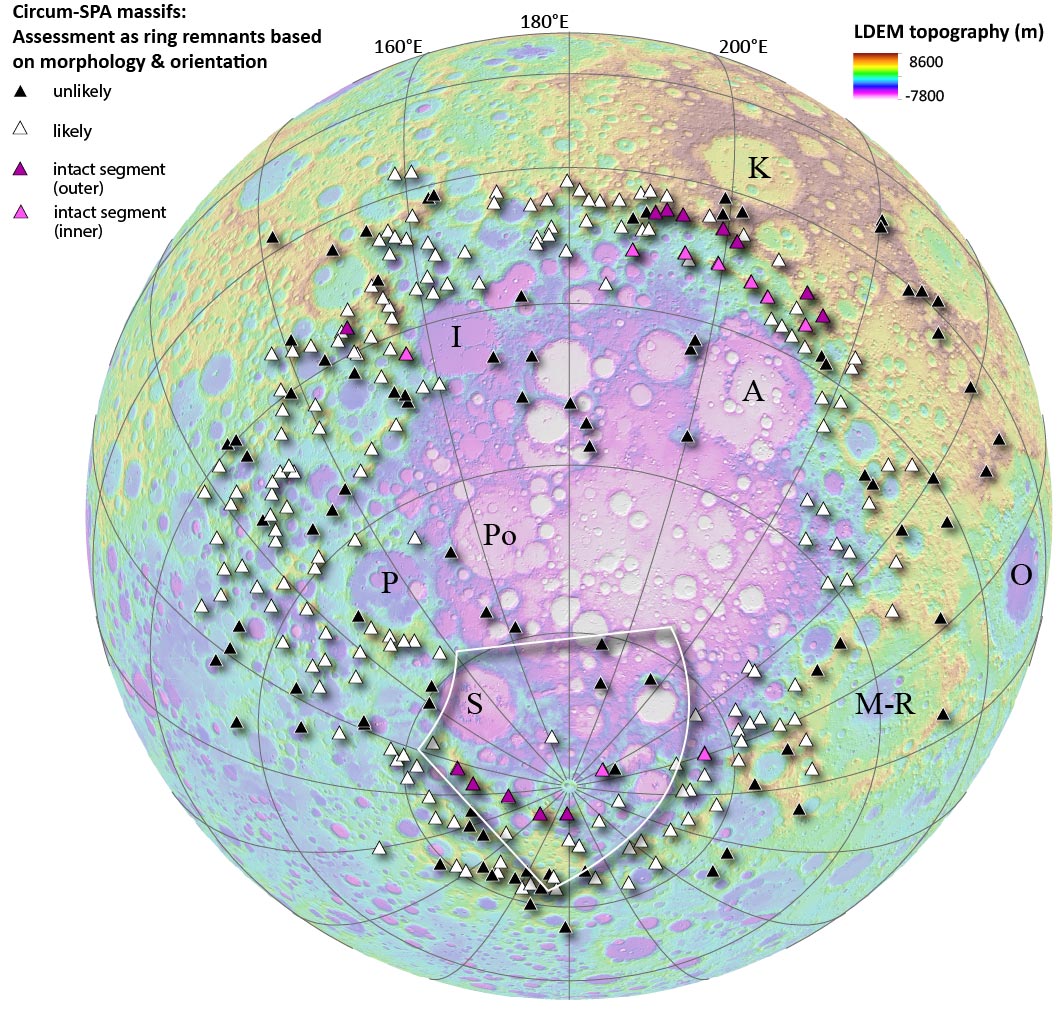
Credit: Hannes Bernhardt, University of Maryland.
High-Tech Clues from Ancient Mountains
Using high-resolution data from NASA’s Lunar Reconnaissance Orbiter, Bernhardt and his team developed an innovative approach to understanding the South Pole-Aitken basin’s complex structure. They identified and analyzed over 200 mountain formations scattered around the basin, geologic features that the team suspected were ancient remnants of the original impact. From the distribution and shapes of those mountain-like features, the team realized that the impact should have created a more circular crater from which significant chunks of planet-forming material were dispersed across the moon’s surface including the South Pole region.
A Rounder Crater and Its Big Implications
“A rounder, more circular shape indicates that an object struck the moon’s surface at a more vertical angle, possibly similar to dropping a rock straight down onto the ground,” Bernhardt said. “This circular impact implies that debris from the impact is more equally distributed around it than was originally thought, which means that Artemis astronauts or robots in the South Pole region may be able to closely study rocks from deep within the moon’s mantle or crust—materials that are typically impossible for us to access.”
Lunar Rocks: Keys to the Moon’s Origins
These lunar rocks could provide crucial insights into the moon’s chemical composition and help validate theories about how the moon may have been created from a massive collision between Earth and another planet-sized object. Recently India’s Chandrayaan 3 rover detected minerals indicative of impact debris coming from the mantle close to the South Pole, supporting the UMD team’s theory about a more vertical impact forming a circular basin that would be required to spray such material in that area.
Preparing for Artemis and Beyond
Bernhardt believes that his team’s research provides critical information for future moon missions, helping mission planners and astronauts identify areas to explore and what materials they may encounter. A thick layer rich in materials from the lower crust and upper mantle could offer unprecedented access to the moon’s complex geological history, potentially shedding light not just on the moon’s formation but also on the transformative events that shaped our solar system.
“One of the most exciting implications of our research is how it is applicable to missions to the moon and beyond,” Bernhardt said. “Astronauts exploring the lunar South Pole might have easier access to ancient lunar materials that could help us understand how the moon and our solar system came to be.”
Reference: “Numeric ring-reconstructions based on massifs favor a non-oblique south pole-Aitken-forming impact event” by Hannes Bernhardt, Jessica M. Walsh, Leon M. Schröder, Jaclyn D. Clark, Megan R. Henriksen and Christopher S. Edwards, 28 November 2024, Earth and Planetary Science Letters.
DOI: 10.1016/j.epsl.2024.119123
This study was supported by the NASA Lunar Reconnaissance Orbiter Camera (LROC) project and initiated by Northern Arizona University’s Jessica Walsh, who tragically passed away before the publication of the study. Other co-authors include UMD Geology Assistant Research Scientist Jaclyn Clark, AlgebraX gmbH’s Leon Schröder, Intuitive Machines’ Megan Henriksen, and Northern Arizona University’s Christopher Edwards and Jessica Walsh.
Never miss a breakthrough: Join the SciTechDaily newsletter.
Follow us on Google and Google News.
1 Comment
A rude penetration it was…