
New research reveals that a significant drop in crop diversity due to temperature increases exceeding 1.5°C could have a profound impact on global food security.
Global warming is already impacting daily life, fueling storms, floods, wildfires, and droughts worldwide. As temperatures rise, up to one-third of global food production could be threatened. A recent study in Nature Food provides a clearer understanding of where and how climate change will affect food production.
Researchers from Aalto University analyzed the effects of rising temperatures, changing precipitation patterns, and increasing aridity on 30 major food crops globally. Their findings indicate that low-latitude regions will suffer the most severe consequences, with up to half of their crop production at risk as climate conditions become unsuitable. Additionally, these regions will experience a significant decline in crop diversity, further threatening food security.
“The loss of diversity means that the range of food crops available for cultivation could decrease significantly in certain areas. That would reduce food security and make it more difficult to get adequate calories and protein,” says Sara Heikonen, the doctoral researcher who led the study.
Up to half of the world’s food crop production may be affected
Warming will severely decrease the amount of global cropland available for staple crops – rice, maize, wheat, potato, and soybean –– which account for over two-thirds of the world’s food energy intake. In addition, “tropical root crops such as yam, which are key to food security in low-income regions, as well as cereals and pulses are particularly vulnerable. In sub-Saharan Africa, the region which would be impacted most, almost three quarters of current production is at risk if global warming exceeds 3°C,” Heikonen says.
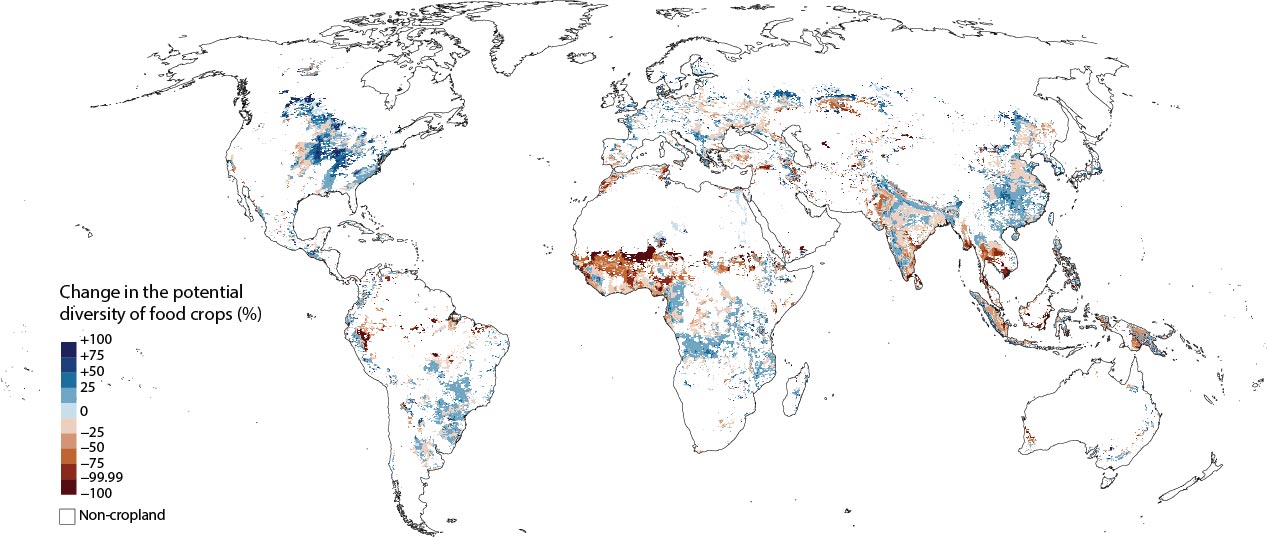
By contrast, mid- and high-latitude areas will probably retain their productive land overall, though zones for specific crops will change. These areas are also likely to see an increase in crop diversity. “For example, the cultivation of temperate fruits, such as pears, could become more common in more northerly regions,” says Heikonen.
However, even if climatic conditions are favorable, other factors could hamper agriculture in these areas, says the study’s senior author, Professor Matti Kummu. “We showed that there’s climatic potential but, for example, warming might bring new pests and extreme weather events, which our model doesn’t include. So the situation isn’t really that black and white.”
Options for adaptation and mitigation
Many of the low-latitude regions threatened most by warming are already vulnerable in numerous ways. They face problems with food sufficiency, and economic and systemic forces make them less resilient than northern countries. Nevertheless, Kummu sees ways that these regions could, at least partly, meet the challenge.
“In many low latitude areas, especially in Africa, the yields are small compared to similar areas elsewhere in the world. They could get higher yields with access to fertilisers and irrigation as well as reducing food losses through the production and storage chain. However, ongoing global warming will add a lot of uncertainty to these estimates, and probably even more actions are needed, such as crop selection and novel breeding,” he says. “But I always say that the modeling and analysis is the easy part – understanding how to make the changes happen is the hardest part.”
While policy-makers in low-latitude countries should work to close those gaps, in mid- and high-latitude regions farmers and policy-makers need more flexibility, says Kummu. Warming will likely change which crops are grown in those areas, and further changes will come from the array of pressures on the global food system. Coping with those changes will require the ability to adjust and adapt as the consequences of climate change unfold.
“If we want to secure our food system in the future, we need to both mitigate climate change and adapt to its effects,” says Heikonen. “Even if the biggest changes are in equatorial regions, we will all feel the effects through the globalized food system. We need to act together to address these problems.”
Reference: “Climate change threatens crop diversity at low latitudes” by Sara Heikonen, Matias Heino, Mika Jalava, Stefan Siebert, Daniel Viviroli and Matti Kummu, 4 March 2025, Nature Food.
DOI: 10.1038/s43016-025-01135-w
Never miss a breakthrough: Join the SciTechDaily newsletter.
Follow us on Google and Google News.
4 Comments
““If we want to secure our food system in the future, we need to both mitigate climate change and adapt to its effects,” says Heikonen.”
——-
No, we do not.
The future of farming is indoor, vertical farming, where the environment can be 100% controlled. What may be happening outside the farm buildings is of little consequence. Huge amounts of land will be returned to the environment to develop naturally.
For example:
https://www.frontiersin.org/journals/science/articles/10.3389/fsci.2024.1411259/full )
Except the vertical farming is a bit of a scam.
Unlike yourself, who is a total scam. If you are going to make an accusation, then back it up. Or go back to X.
Orrrrr just enforce borders to let population growth level off.