
Unprecedented Elasticity in Female Locusts’ Nervous System
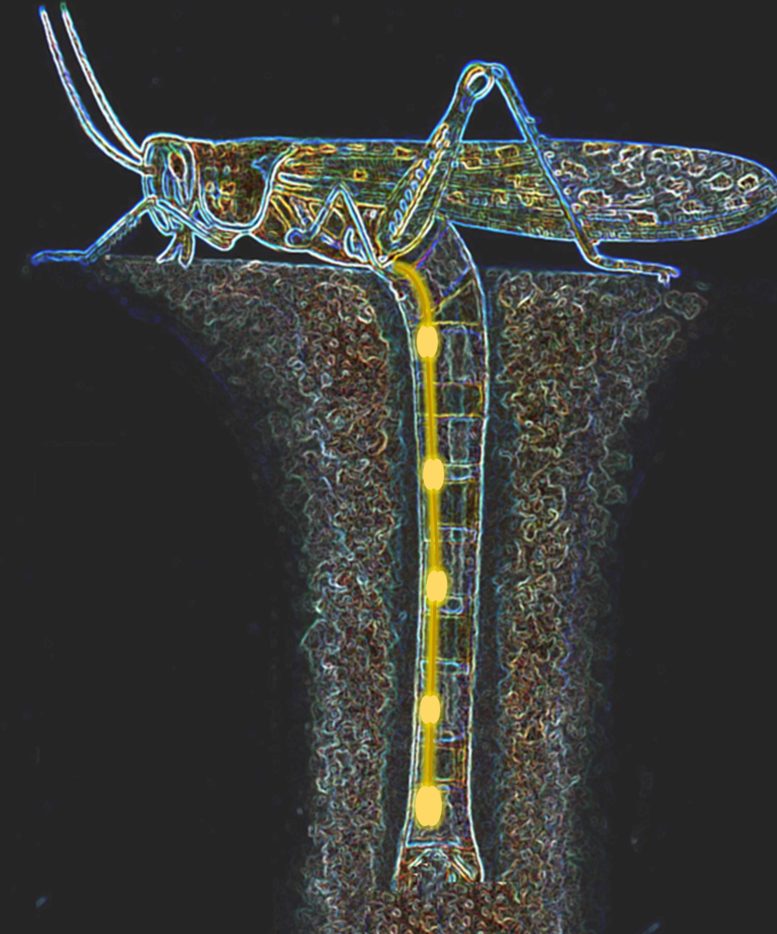
- The female locust’s digging ability allows her to bury her eggs in a safe location by extending her abdomen, including her nervous system, to two to three times its size – similar to a superhero in a movie.
- The researchers: “This ability is almost inconceivable from a morphological point of view, and as far as we know it has almost no equal in nature.”
A recent study conducted by Tel Aviv University has uncovered that the female locust possesses extraordinary abilities. The research found that the female locust’s central nervous system has elastic properties, enabling her to elongate up to two or three times her original size when laying her eggs in the ground, without any permanent damage.
“We are not aware of a similar ability in almost any living creature,” said the researchers. “Nerves in the human nervous system, for example, can stretch only up to 30 percent without tearing or being permanently damaged. In the future, these findings may contribute to new developments in the field of regenerative medicine, as a basis for nerve restoration and the development of synthetic tissues.”
A new study reveals that the female locust’s central nervous system has elastic properties, allowing her to stretch up to two or three times her original length when laying her eggs in the ground, without causing any irreparable damage. Credit: Tel-Aviv University
The study was conducted by a team of Tel Aviv University researchers led by Dr. Bat-El Pinchasik of the School of Mechanical Engineering in the Fleischman Faculty of Engineering and Prof. Amir Ayali of the School of Zoology in the Wise Faculty of Life Sciences. The research was recently published in the journal iScience.
The Remarkable Egg-Laying Process of Female Locusts
Dr. Pinchasik explains: “When the female locust is ready to lay her eggs, she digs a hole in the ground that will offer them protection and optimal conditions for hatching. For this purpose, she is equipped with a unique digging apparatus, consisting of two pairs of digging valves which are located at the tip of the abdomen, on either side of the ovipositor (a tube-like organ used for laying eggs). As she digs, the female extends her body, until sensors located along its length signal that she has reached a suitable point for depositing her eggs. Thus, an adult female, whose body length is about four to five centimeters, may, for the purpose of laying her eggs, stretch her body to a length of 10-15 centimeters (4-6 inches), then quickly return to her normal length, and then extend again for the next egg-laying.”
Professor Ayali: “The superpower of the locust is almost something out of science fiction. There are only two other known examples in nature of a similar phenomenon: the tongue of the sperm whale, and a certain type of sea snail whose nervous systems are able to extend significantly due to an accordion-like mechanism they have. We sought to identify the biomechanical mechanism that gives the female locust its wonderful ability.”
Mechanism Behind Locust Elasticity
In the study, the researchers removed the central nervous systems from female locusts and placed them in a liquid simulating their natural environment, under physiological conditions similar to those inside the body. Using highly sensitive measuring instruments, they measured the forces needed to extend the nervous system. Dr. Pinchasik: “Contrary to previous hypotheses and examples we are familiar with, we did not find any accordion-like mechanism. We discovered that the nervous system of the female locust has elastic properties, which enable it to elongate and then return by itself to its original state, ready for reuse, without any damage caused to the tissue. This finding is almost incomprehensible from a biomechanical and morphological point of view.”
Professor Ayali concludes: “In our study, we found that the central nervous system of the adult female locust is elastic and is able to stretch two to three times its original length and then return to it, without any damage being caused. This is an incredible ability that we don’t know of in any other animal. In further studies, we will investigate the matter in depth, with the aim of identifying the specific mechanism that enables this unique feature. We hope that in the future our findings will help to develop synthetic tissues with a high level of flexibility, and to restore nerves in regenerative medicine therapies.”
Reference: “The biomechanics of ultra-stretchable nerves” by Rakesh Das, Amir Ayali, Moshe Guershon, Amjd Ibraheem, Eran Perlson and Bat-El Pinchasik, 8 October 2022, iScience.
DOI: 10.1016/j.isci.2022.105295
Never miss a breakthrough: Join the SciTechDaily newsletter.
Follow us on Google and Google News.
1 Comment
These discoveries can contribute to new developments in regenerative medicine, as a basis for nerve restoration and the development of synthetic tissues; alleluia!
“But ask the animals and they will teach you.” ~Job 12:7