
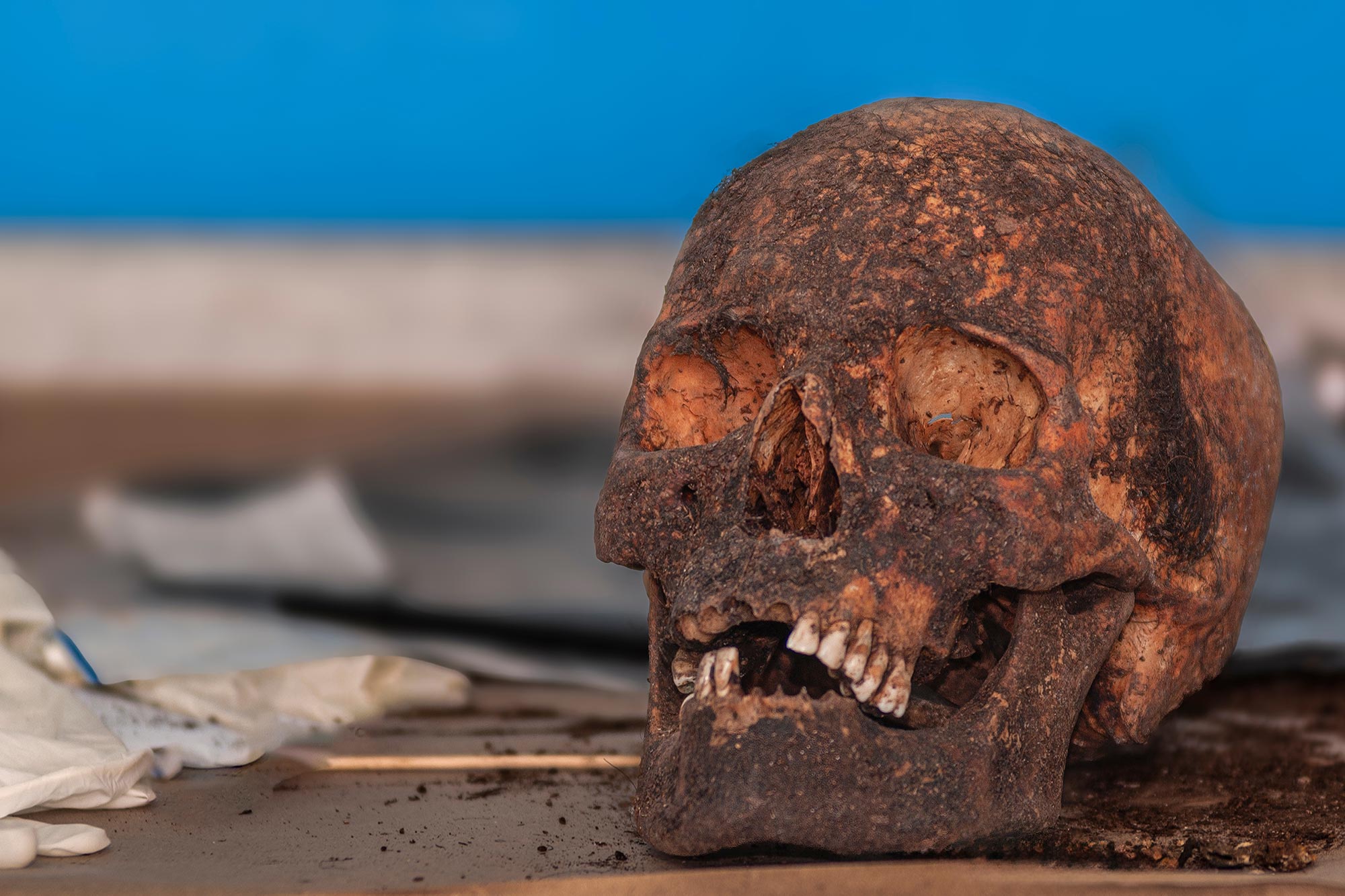
Teeth can act as detailed biological records, preserving evidence of health, diet, and stress experienced throughout a person’s life.
Teeth can reveal far more than age or appearance.
In a recent study published in the open-access journal PLOS One, researchers report that dental remains from Iron Age Italy preserve detailed evidence of how people grew, what they ate, and how their bodies responded to early-life challenges. The research was led by Roberto Germano of Sapienza University of Rome, Italy, and focuses on individuals who lived more than 2,500 years ago.
Reconstructing everyday life in ancient societies is difficult because most biological evidence disappears long after death. Teeth are a rare exception. Once formed, dental tissues do not remodel, allowing them to permanently record disruptions to growth and long-term dietary habits. By applying a combination of microscopic and chemical techniques, the research team examined teeth from the Iron Age site of Pontecagnano, dating to the 7th and 6th centuries BC, to explore both childhood development and adult subsistence.
Childhood Stress and Early Development
The study analyzed growth patterns in 30 teeth from 10 individuals, focusing on differences between canines and molars. These comparisons allowed the researchers to reconstruct growth trajectories during the first six years of life.
Subtle markers in the dental tissue point to brief stress episodes occurring around one year and again near four years of age, periods that often coincide with major dietary and behavioral transitions in early childhood. Such changes can increase susceptibility to infection and nutritional stress, leaving lasting traces in tooth structure.
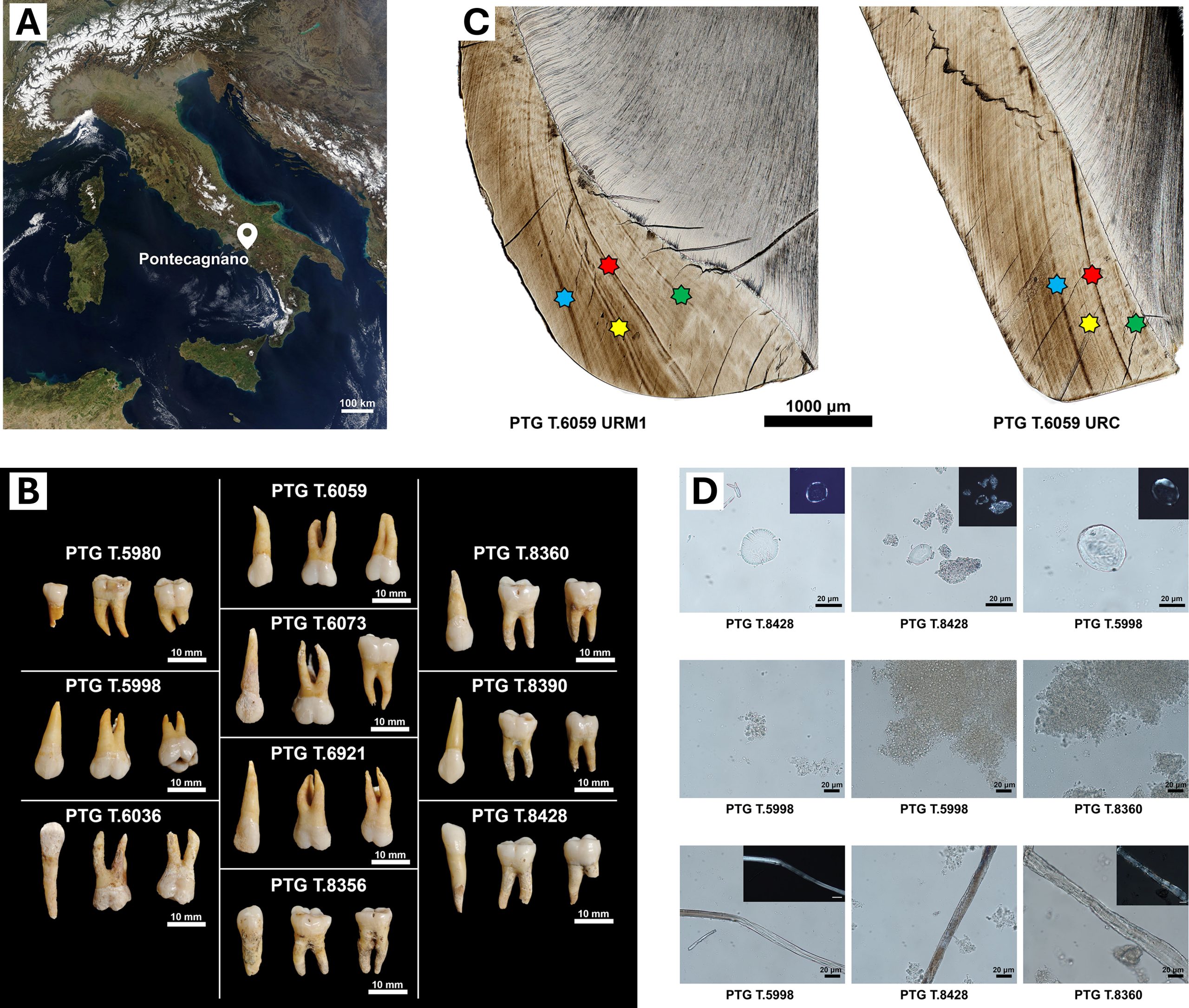
Evidence of adult diet came from the analysis of dental plaque, also known as calculus, which can trap microscopic food residues during life. The samples contained remains of cereals, legumes, carbohydrate-rich plants, and fermented foods.
Together, these findings suggest a diet that was both varied and well integrated into broader Mediterranean food traditions. Previous research has linked this dietary diversity to increased trade and cultural exchange, and the new dental evidence provides direct biological support for those interpretations.
Interpreting a Small but Detailed Sample
This study provides the first histological data from the Iron Age community of Pontecagnano, and proof of concept that combined dental analyses can provide detailed insights into ancient life histories.
Given the small number of individuals analyzed, the results of this study should not be interpreted as representative of the broader population and are better seen as detailed insights into individual life histories. The authors suggest that future study involving larger samples and additional techniques such as isotopic analysis will dramatically improve our understanding of ancient communities.
Roberto Germano adds: “The teeth of Pontecagnano’s Iron Age inhabitants opened a unique window onto their lives: we could follow childhood growth and health with remarkable precision and identify traces of cereals, legumes, and fermented foods in adulthood, revealing how this community adapted to environmental and social challenges.”
Alessia Nava adds: “The study of the histomorphometry of deciduous and permanent teeth from individuals found in ancient necropolises makes it possible to go beyond the narrow focus on the period close to their death and brings to the forefront the life of each of them during their early years. This and other modern approaches represent a major technological and disciplinary advancement that is revolutionizing the study of the biocultural adaptations of past populations.”
Emanuela Cristiani adds: “In the case of Pontecagnano, the analysis of dental calculus revealed starch granules from cereals and legumes, yeast spores, and plant fibers, providing a very concrete picture of the diet and some daily activities of these Iron Age communities, and offering strong evidence of the regular consumption of fermented foods and beverages.”
Reference: “Health and lifestyle in the Iron Age Italian community of Pontecagnano (Campania, Italy, 7th-6th century BCE)” by Roberto Germano, Owen Alexander Higgins, Emanuela Cristiani, Alessia Galbusera, Carmen Esposito, Dulce Neves, Carmine Pellegrino, Alessandra Sperduti, Giorgio Manzi, Luca Bondioli and Alessia Nava, 14 January 2026, PLOS ONE.
DOI: 10.1371/journal.pone.0338448
Funding: Carmen Esposito (CE) was supported by the European Union’s Horizon Europe programme under the Marie Skłodowska Curie Actions Postdoctoral Fellowship, Grant Agreement No. 101065320 (TULAR). Dental calculus analyses were carried out in a laboratory funded by the European Research Council (ERC) Starting Grant HIDDEN FOODS, Grant Agreement No. 639286 (PI: Emanuela Cristiani, EC). Alessia Nava (AN) received funding from the European Research Council (ERC) under the European Union’s Horizon Europe programme, Grant Agreement No. 101077348 (MOTHERS; project website: https://www.erc-mothers.eu/). Roberto Germano (RG) received support from the Environmental Biology Doctoral School, Sapienza University of Rome.
Never miss a breakthrough: Join the SciTechDaily newsletter.
Follow us on Google and Google News.