
Shapeshifting animals reveal evolution’s race to keep up with a rapidly warming world.
Climate change is not only a human problem; animals have to adapt to it as well. Some “warm-blooded” animals are shapeshifting and getting larger beaks, legs, and ears to better regulate their body temperatures as the planet gets hotter. Bird researcher Sara Ryding of Deakin University in Australia describes these changes in a review published on September 7th in the journal Trends in Ecology and Evolution.
“A lot of the time when climate change is discussed in mainstream media, people are asking ‘can humans overcome this?’, or ‘what technology can solve this?’. It’s high time we recognized that animals also have to adapt to these changes, but this is occurring over a far shorter timescale than would have occurred through most of evolutionary time,” says Ryding. “The climate change that we have created is heaping a whole lot of pressure on them, and while some species will adapt, others will not.”
Ryding notes that climate change is a complex and multifaceted phenomenon that’s been occurring progressively, so it is difficult to pinpoint just one cause of the shapeshifting. But these changes have been occurring across wide geographical regions and among a diverse array of species, so there is little in common apart from climate change.
Strong shapeshifting has particularly been reported in birds. Several species of Australian parrot have shown, on average, a 4%–10% increase in bill size since 1871, and this is positively correlated with the summer temperature each year. North American dark-eyed juncos, a type of small songbird, had a link between increased bill size and short-term temperature extremes in cold environments. There have also been reported changes in mammalian species. Researchers have reported tail length increases in wood mice and tail and leg size increases in masked shrews.
Evolution in Action: From Bills to Ears
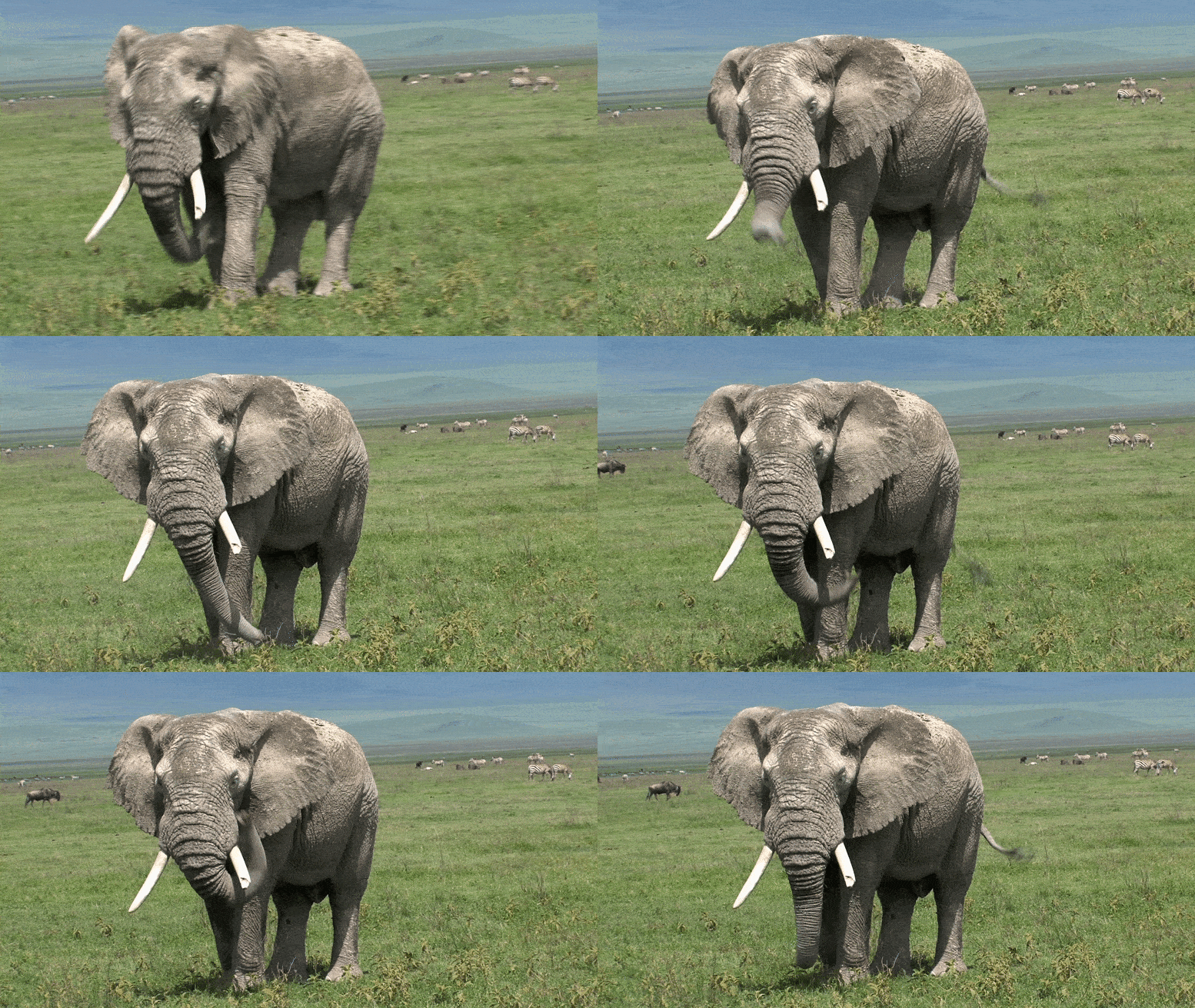
“The increases in appendage size we see so far are quite small—less than 10%—so the changes are unlikely to be immediately noticeable,” says Ryding. “However, prominent appendages such as ears are predicted to increase—so we might end up with a live-action Dumbo in the not-so-distant future.”
Next, Ryding intends to investigate shapeshifting in Australian birds firsthand by 3D scanning museum bird specimens from the past 100 years. It will give her team a better understanding of which birds are changing appendage size due to climate change and why.
“Shapeshifting does not mean that animals are coping with climate change and that all is ‘fine,’” says Ryding. “It just means they are evolving to survive it—but we’re not sure what the other ecological consequences of these changes are, or indeed that all species are capable of changing and surviving.”
Reference: “Shape-shifting: changing animal morphologies as a response to climatic warming” by Sara Ryding, Marcel Klaassen, Glenn J. Tattersall, Janet L. Gardner and Matthew R.E. Symonds, 7 September 2021, Trends in Ecology & Evolution.
DOI: 10.1016/j.tree.2021.07.006
The authors received financial support from the Australian Research Council Discovery Project, an Australian Research Council Future Fellowship, and a Natural Sciences and Engineering Research Council of Canada Discovery Grant.
Never miss a breakthrough: Join the SciTechDaily newsletter.
Follow us on Google and Google News.
2 Comments
Don’t take long to sling it do ya? Your brain shape shift into anything bigger than a thimble? So, how many animals did you capture & measure before & after this Global Warming event started taking place? No wonder no one but your pod people follow & believe your bilge!
“The increases in appendage size we see so far are quite small—less than 10%—so the changes are unlikely to be immediately noticeable,”
Does this pass the smell test? There has been approximately a 1 deg C AVERAGE global temperature change in the last century. Most of that has been in Winter and nighttime lows, with a strong bias coming from the Arctic. The average increase in mid-latitude and tropical ecosystem high temperatures has been less than 1 deg C. Most of that occurred before the 1940s. So, something like a 5% change in Summer temperatures, on the Celsius scale, are causing a 10% change in animal morphology? The temperature change is much less than 1% on the absolute (K) temperature scale! I can’t wait to see what is going to happen to the polar bears where the temperatures are supposedly changing at a rate 3X the global average.
As is usual for articles relating to climatology, there is no mention of the uncertainty range for measurements, nor are alternative hypotheses offered as possible explanations.