
Close Menu
    Facebook X (Twitter) Instagram
    SciTechDaily
    • Biology
    • Chemistry
    • Earth
    • Health
    • Physics
    • Science
    • Space
    • Technology
    Facebook X (Twitter) Pinterest YouTube RSS
    SciTechDaily
    Home»Health»Antibody-Secreting Cells in the Lung Can Prevent Respiratory Infections From Becoming Severe
    Health

    Antibody-Secreting Cells in the Lung Can Prevent Respiratory Infections From Becoming Severe

    By Boston University School of MedicineJune 1, 2021No Comments3 Mins Read
    Facebook Twitter Pinterest Telegram LinkedIn WhatsApp Email Reddit
    Share
    Facebook Twitter LinkedIn Pinterest Telegram Email Reddit
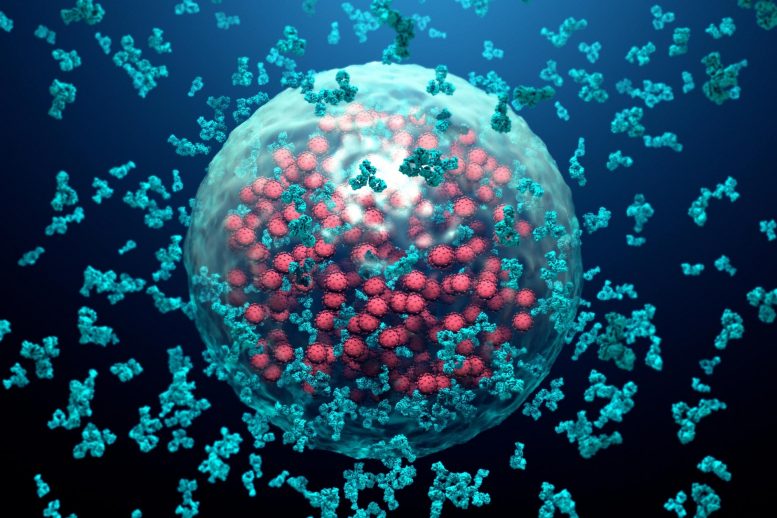
    Antibodies Destroy an Infected Cell
    Researchers discovered lungs possess their own specialized immune system, distinct from the immune system in the rest of the body.

    Understanding how antibodies and antibody-secreting cells can fight against lung infection will provide new directions for improving vaccines to prevent severe respiratory infection and for designing treatments that cure respiratory infections.

    Only a small subset of people who get a lung infection go on to become very sick, yet who will become severely ill or why is unclear. This is now widely recognized in the context of COVID-19, where most people have mild or no illness while others with the same infection become extremely sick or even die.

    Researchers now have discovered that after recovering from a respiratory infection, new cells get deposited in lung tissue, persist there, and then become antibody-secreting cells very quickly if the lungs later get re-infected by something similar.

    “It is increasingly clear that our lungs contain their own specialized immune system, different from the immune system throughout the rest of the body,” explained corresponding author Joseph Mizgerd, ScD, professor of medicine, microbiology, and biochemistry at Boston University School of Medicine.

    Antibody-Secreting Cells Protect Against Pathogens

    Mizgerd and his team studied a combination of infections in experimental models and analyses of cells collected from human lungs. “We found lungs that had recovered from infections had new cells that were not there before infection, capable of quickly producing antibodies when stimulated. We showed that antibodies in the lungs helped fight microbes and removing the cells making these antibodies compromised lung defense against respiratory pathogens,” Mizgerd said.

    According to the researchers, differences in lung-specific antibodies and antibody-secreting cells may be one of the important factors determining who will become very ill or instead experience mild or even no symptoms when infected by a respiratory pathogen. “With a better understanding of the components of lung immunity that prevent severe infections, we will be able to identify who is prone to severe disease when infected,” he added.

    Mizgerd believes that immunity that is lung-localized differs from more conventional types of immunity in that it tends to prevent severe disease instead of preventing infection altogether and it tends to be effective against a wider range of microbes instead of against only one single virus or bacteria. “Leveraging this knowledge may provide opportunities to develop novel types of vaccines that prevent severe disease caused by a broader spectrum of microbes, such as for all coronaviruses or all influenza viruses.”

    These findings appear online in the Journal of Clinical Investigation.

    Reference: “Lung-resident memory B cells protect against bacterial pneumonia” by Kimberly A. Barker, Neelou S. Etesami, Anukul T. Shenoy, Emad I. Arafa, Carolina Lyon de Ana, Nicole M.S. Smith, Ian M.C. Martin, Wesley N. Goltry, Alexander M.S. Barron, Jeffrey L. Browning, Hasmeena Kathuria, Anna C. Belkina, Antoine Guillon, Xuemei Zhong, Nicholas A. Crossland, Matthew R. Jones, Lee J. Quinton and Joseph P. Mizgerd, 1 June 2021, Journal of Clinical Investigation.
    DOI: 10.1172/JCI141810

    This work was supported by funding from National Institutes of Health grants including: R35 HL135756, R01 AI115053, R33 HL137081, and F31 HL142199.

    Never miss a breakthrough: Join the SciTechDaily newsletter.
    Follow us on Google and Google News.

    Antibodies Boston University Immunology Infectious Diseases Lungs Pulmonary
    Share. Facebook Twitter Pinterest LinkedIn Email Reddit

    Related Articles

    New Study Reveals Lung Cell Roles in Pulmonary Immunity – Essential to COVID-19, Pneumonia, Lung Cancer, Asthma and COPD

    Most Lungs Recover Well After COVID-19 – According to Extensive Health Assessment 3 Months After Recovery

    Boosting a Natural Cellular Process to Protect Lungs From Ventilator-Induced Injury

    New Research May Explain Severe Virus Attacks on the Lungs, Contribute to Future Treatments for COVID-19

    Pneumolysis: High Altitude Specialists Explain COVID-19 Lung Destruction

    Researchers Discover How the COVID-19 Virus Hijacks and Rapidly Damages Human Lung Cells

    Investigations of Deceased COVID-19 Patients Reveal Lung Damage Caused by Persistence of “Abnormal Cells”

    Researchers Identify How to Predict Cytokine Storm in COVID-19 Patients

    Coronavirus Researchers Discover How COVID-19 May Trigger Fatal Levels of Lung Inflammation

    Leave A Reply Cancel Reply

    • Facebook
    • Twitter
    • Pinterest
    • YouTube

    Don't Miss a Discovery

    Subscribe for the Latest in Science & Tech!

    Trending News

    Scientists Finally Uncover How a “Forever Chemical” Causes Birth Defects

    Scientists Uncover the Earliest Brain Changes That May Predict Alzheimer’s Decades Before Symptoms

    Surprising New Study Challenges a Century-Old Theory of Habit Formation

    Scientists Turn Seawater Into Drinking Water Without Toxic Brine

    Vitamin D Drug Shows Surprising Promise Against One of the Deadliest Cancers

    NASA’s X-59 Sonic Boom Killer Is Ready for Its Biggest Test Yet

    The Best Exercise Combination for Longevity, According to a 30-Year Study

    Popular Weight-Loss Drug Found To Slow Biological Aging in Landmark Human Trial

    Follow SciTechDaily
    • Facebook
    • Twitter
    • YouTube
    • Pinterest
    • Newsletter
    • RSS
    SciTech News
    • Biology News
    • Chemistry News
    • Earth News
    • Health News
    • Physics News
    • Science News
    • Space News
    • Technology News
    Recent Posts
    • This Simple Drink Could Help Calm the Inflammation Behind Many Diseases
    • Doctors May Be Overlooking the Real Cause of Persistent Arthritis Pain
    • According to Scientists, This Simple Dietary Change Is Linked to Lower Depression Scores
    • Researchers Discover a Hidden Vitamin D Problem That Persists Year-Round
    • Scientists Are Building Electronics That Stretch Like Human Skin and Learn Like a Brain
    Copyright © 1998 - 2026 SciTechDaily. All Rights Reserved.
    • Science News
    • About
    • Contact
    • Editorial Board
    • Privacy Policy
    • Terms of Use

    Type above and press Enter to search. Press Esc to cancel.