
Close Menu
    Facebook X (Twitter) Instagram
    SciTechDaily
    • Biology
    • Chemistry
    • Earth
    • Health
    • Physics
    • Science
    • Space
    • Technology
    Facebook X (Twitter) Pinterest YouTube RSS
    SciTechDaily
    Home»Earth»Are We Running Out of Water? Scientists Unravel the Global Impact of Droughts and Heatwaves on Water Use
    Earth

    Are We Running Out of Water? Scientists Unravel the Global Impact of Droughts and Heatwaves on Water Use

    By Utrecht UniversityOctober 13, 2023No Comments4 Mins Read
    Facebook Twitter Pinterest Telegram LinkedIn WhatsApp Email Reddit
    Share
    Facebook Twitter LinkedIn Pinterest Telegram Email Reddit
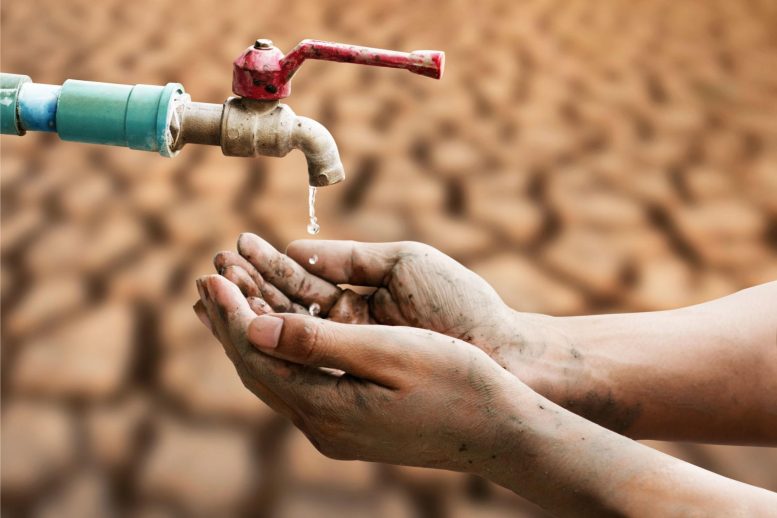
    Water Scarcity Drought
    Researchers from Utrecht University have uncovered that heatwaves have a more pronounced effect on sectoral water usage compared to droughts. By analyzing data from the last 30 years, they found significant variations in water consumption patterns across sectors and regions in response to extreme weather events. These findings underscore the need for more detailed water usage data, especially from under-researched regions, to enhance global water management strategies in the face of climate change.

    Extreme weather events reshape water use patterns. Improved water data collection is needed for better management strategies.

    Rising global population and more frequent extreme weather events are putting our water resources at risk. However, there’s a limited understanding of how different sectors use water during drought-heatwave events, especially on a broad scale.

    To address this gap, a team of scientists from the Department of Physical Geography at Utrecht University studied how sectoral water use is affected during droughts, heatwaves, and compound (combined) events worldwide. Their research, published in Environmental Research Letters, reveals that stronger sectoral water use responses are found for heatwaves compared to impacts during droughts.

    Key Research Findings

    The research is the first global study quantifying on sectoral water use responses under extreme droughts, heatwaves, and compound events. Sectoral water use responses are understood as how the water use practices of sectors (namely domestic, irrigation, thermoelectric energy, manufacturing, and livestock) are affected by the occurrence of droughts, heatwaves, and compound events, which could lead them to increase or decrease their use of water or to show no particular reaction to these hydroclimatic extremes.

    A large amount of data on sectoral water use at global, country, and local scales during the last 30 years was analyzed. “We focused on the water used by various sectors, namely irrigation, livestock, domestic, energy, and manufacturing because we expected particular responses to the occurrence of different extreme events,” says Gabriel Cardenas Belleza, PhD candidate at Utrecht University and lead author of this publication.

    Sectoral and Regional Variances

    The analysis shows that extreme events over the last thirty years had substantial impacts on water use patterns, but these responses highly differ per sector and region across the world. “Socio-economic factors and public water management plans strongly influence water use responses, and even more so during extreme events. For instance, while the Western continental United States decreases its water use during extremes, the central US increases it,” says Cardenas. In addition, the results reveal that the domestic and irrigation sectors, in general, have the highest priority for water use worldwide, however, stricter measures are taken in favor of the domestic sector during extremes.

    The analysis also shows that heatwaves and compound drought-heatwave events overall have stronger impacts on water use in comparison to solely droughts. “Heatwaves and compound events can lead to higher water use as a consequence of the temporary increase in water demand under high temperatures, which can still be satisfied due to the short duration of such extremes, compared to longer-lasting events like droughts,” says Cardenas.

    Future Implications and Needs

    The results of the study demonstrate the urgency to collect more water use data to better understand the implications of extreme events and climate change on different water use sectors and for improved assessments of future water scarcity. “Our research provides a first step to evaluate multi-sectoral water use behavior during extremes. However, more local-scale information from data-scarce areas, like Africa and parts of Asia and South America, is needed to better understand sectoral water use behavior and improve water management strategies.”

    Reference: “Sectoral water use responses to droughts and heatwaves: analyses from local to global scales for 1990–2019” by Gabriel A Cárdenas Belleza, Marc F P Bierkens and Michelle T H van Vliet, 10 October 2023, Environmental Research Letters.
    DOI: 10.1088/1748-9326/acf82e

    Never miss a breakthrough: Join the SciTechDaily newsletter.
    Follow us on Google and Google News.

    Climate Change Drought Geoscience Utrecht University Water
    Share. Facebook Twitter Pinterest LinkedIn Email Reddit

    Related Articles

    Global Drought Catastrophe: UN Uncovers “An Unprecedented Emergency on a Planetary Scale”

    Rivers at Risk: How Climate Chaos Is Tainting Our Waters

    Climate Change and U.S. Agriculture: Why Irrigating More Crops Is Vital for Future Yield

    Tipping the Scales: Did an 11,700-Year-Old Event Seal the Horn of Africa’s Dry Fate?

    Snowpack Melt Trend Signals Impending Summer Water Crisis in Western Regions

    Lake Powell Still Shrinking – The Second Largest Reservoir in the US at Lowest Level Ever

    Strategies To Meet Future Water Demands and Improve Drought Resiliency Identified in Upper Missouri River Basin Study

    Lake Mead – The Largest Reservoir in the United States – Drops to a Record Low

    Recent Summer Droughts in Europe Are Far More Severe Than Anything in the Past 2,100 Years

    Leave A Reply Cancel Reply

    • Facebook
    • Twitter
    • Pinterest
    • YouTube

    Don't Miss a Discovery

    Subscribe for the Latest in Science & Tech!

    Trending News

    Breakthrough Bowel Cancer Trial Leaves Patients Cancer-Free for Nearly 3 Years

    Natural Compound Shows Powerful Potential Against Rheumatoid Arthritis

    100,000-Year-Old Neanderthal Fossils in Poland Reveal Unexpected Genetic Connections

    Simple “Gut Reset” May Prevent Weight Gain After Ozempic or Wegovy

    2.8 Days to Disaster: Scientists Warn Low Earth Orbit Could Suddenly Collapse

    Common Food Compound Shows Surprising Power Against Superbugs

    5 Simple Ways To Remember More and Forget Less

    The Atomic Gap That Could Cost the Semiconductor Industry Billions

    Follow SciTechDaily
    • Facebook
    • Twitter
    • YouTube
    • Pinterest
    • Newsletter
    • RSS
    SciTech News
    • Biology News
    • Chemistry News
    • Earth News
    • Health News
    • Physics News
    • Science News
    • Space News
    • Technology News
    Recent Posts
    • After 37 Years, the World’s Longest-Running Soil Warming Experiment Uncovers a Startling Climate Secret
    • NASA Satellite Captures First-Ever High-Res View of Massive Pacific Tsunami
    • ADHD Isn’t Just a Deficit: Study Reveals Powerful Hidden Strengths
    • Scientists Uncover “Astonishing” Hidden Property of Light
    • Scientists Discover Stem Cells That Could Regrow Teeth and Bone
    Copyright © 1998 - 2026 SciTechDaily. All Rights Reserved.
    • Science News
    • About
    • Contact
    • Editorial Board
    • Privacy Policy
    • Terms of Use

    Type above and press Enter to search. Press Esc to cancel.