
Close Menu
    Facebook X (Twitter) Instagram
    SciTechDaily
    • Biology
    • Chemistry
    • Earth
    • Health
    • Physics
    • Science
    • Space
    • Technology
    Facebook X (Twitter) Pinterest YouTube RSS
    SciTechDaily
    Home»Space»Astronomers Discover Evidence for Most Powerful Pulsar in Distant Galaxy
    Space

    Astronomers Discover Evidence for Most Powerful Pulsar in Distant Galaxy

    By National Radio Astronomy ObservatoryJune 20, 20223 Comments7 Mins Read
    Facebook Twitter Pinterest Telegram LinkedIn WhatsApp Email Reddit
    Share
    Facebook Twitter LinkedIn Pinterest Telegram Email Reddit
    Shell of Explosion Debris From Supernova
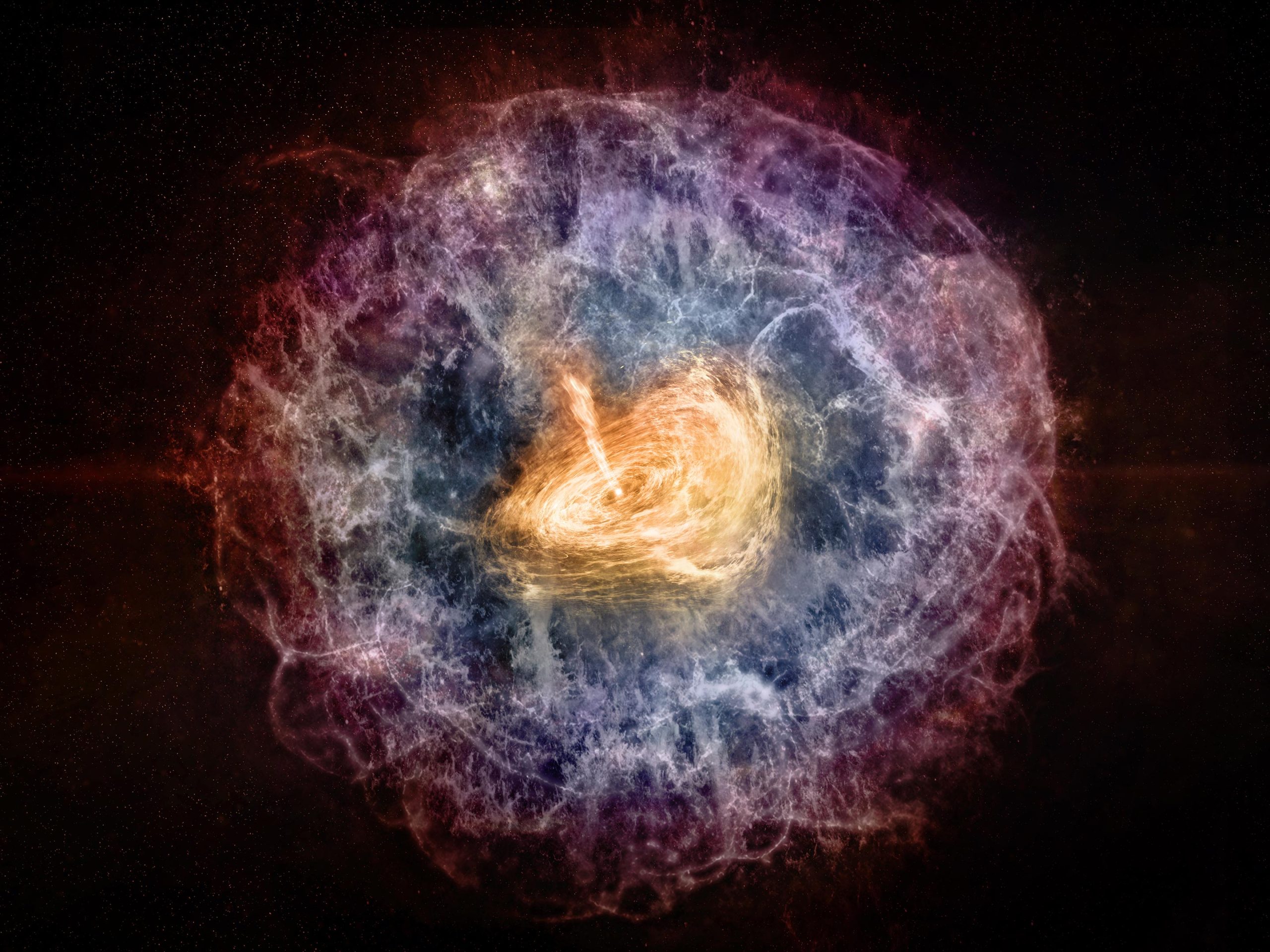
    As the shell of explosion debris from the supernova expands over a few decades, it becomes less dense and eventually becomes thin enough that radio waves from inside can escape. This allowed observations by the VLA Sky Survey to detect bright radio emission created as the rapidly spinning neutron star’s powerful magnetic field sweeps through the surrounding space, accelerating charged particles. This phenomenon is called a pulsar wind nebula. Credit: Melissa Weiss, NRAO/AUI/NSF

    VT 1137-0337, discovered in VLASS data, is a young neutron star with strong radio emissions from a pulsar wind nebula. It may also be a magnetar, offering clues to Fast Radio Bursts.

    Astronomers analyzing data from the VLA Sky Survey (VLASS) have discovered one of the youngest known neutron stars — the superdense remnant of a massive star that exploded as a supernova. Images from the National Science Foundation’s Karl G. Jansky Very Large Array (VLA) indicate that bright radio emission powered by the spinning pulsar’s magnetic field has only recently emerged from behind a dense shell of debris from the supernova explosion.

    The object, called VT 1137-0337, is in a dwarf galaxy 395 million light-years from Earth. It first appeared in a VLASS image made in January of 2018. It did not appear in an image of the same region made by the VLA’s FIRST Survey in 1998. It continued to appear in later VLASS observations in 2018, 2019, 2020, and 2022.
    Most Powerful Pulsar in Distant Galaxy
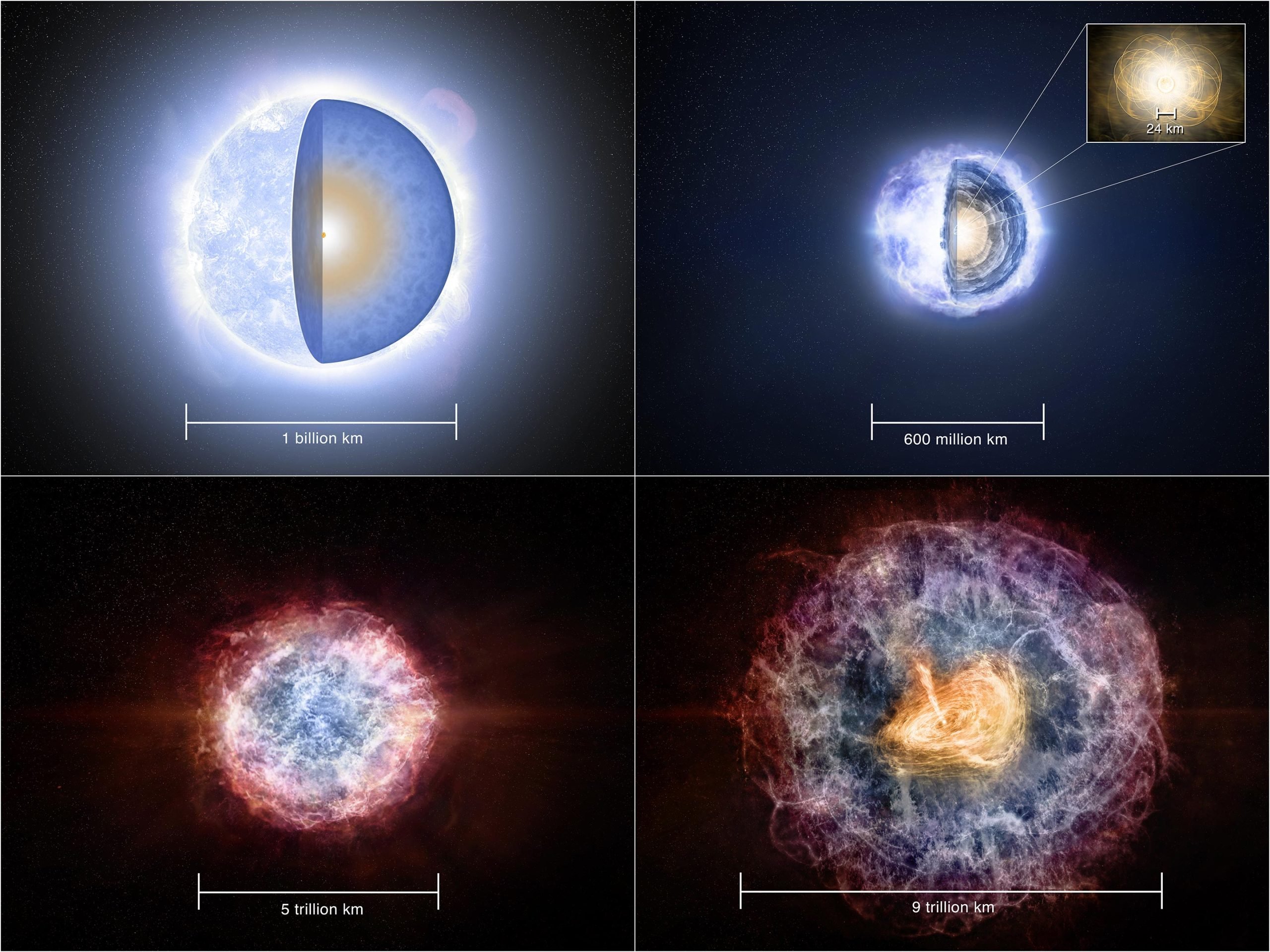
    Top Left: A giant blue star, much more massive than our Sun, has consumed, through nuclear fusion at its center, all its hydrogen, helium, and heavier elements up to iron. It now has a small iron core (red dot) at its center. Unlike the earlier stages of fusion, the fusion of iron atoms absorbs, rather than releases, energy. The fusion-released energy that has held up the star against its own weight now is gone, and the star will quickly collapse, triggering a supernova explosion. Top Right: The collapse has begun, producing a superdense neutron star with a strong magnetic field at its center (inset). The neutron star, though containing about 1.5 times the mass of the Sun, is only about the size of Manhattan. Bottom Left: The supernova explosion has ejected a fast-moving shell of debris outward into interstellar space. At this stage, the debris shell is dense enough to shroud from view any radio waves coming from the region of the neutron star. Bottom Right: As the shell of explosion debris expands over a few decades, it becomes less dense and eventually becomes thin enough that radio waves from inside can escape. This allowed observations by the VLA Sky Survey to detect bright radio emission created as the rapidly spinning neutron star’s powerful magnetic field sweeps through the surrounding space, accelerating charged particles. This phenomenon is called a pulsar wind nebula. Credit: Melissa Weiss, NRAO/AUI/NSF

    “What we’re most likely seeing is a pulsar wind nebula,” said Dillon Dong, a Caltech graduate student who will begin a Jansky Postdoctoral Fellowship at the National Radio Astronomy Observatory (NRAO) later this year. A pulsar wind nebula is created when the powerful magnetic field of a rapidly spinning neutron star accelerates surrounding charged particles to nearly the speed of light.

    “Based on its characteristics, this is a very young pulsar — possibly as young as only 14 years, but no older than 60 to 80 years,” said Gregg Hallinan, Dong’s Ph.D advisor at Caltech.

    The scientists reported their findings at the American Astronomical Society’s meeting in Pasadena, California.
    Giant Blue Star
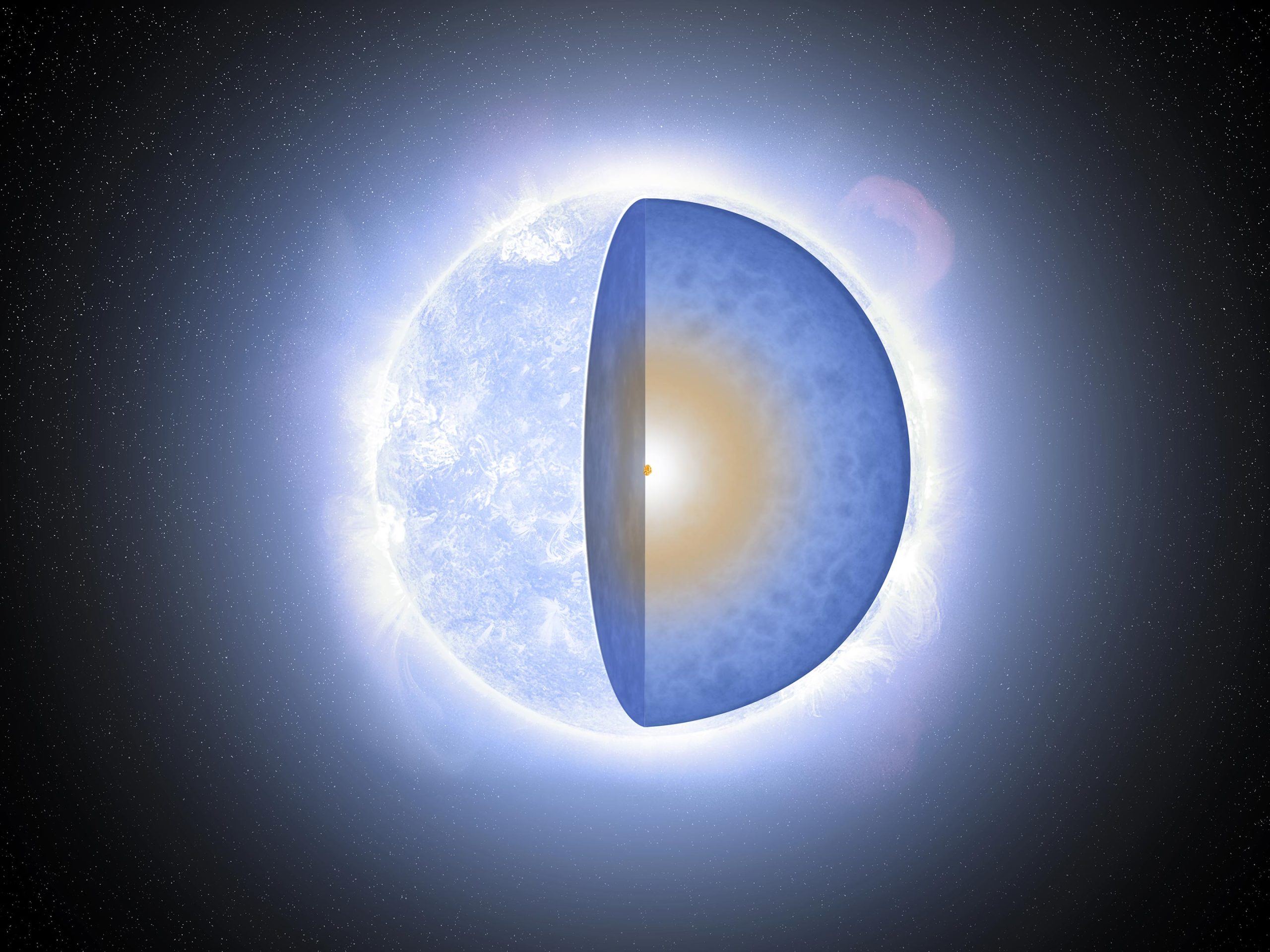
    A giant blue star, much more massive than our Sun, has consumed, through nuclear fusion at its center, all its hydrogen, helium, and heavier elements up to iron. It now has a small iron core (red dot) at its center. Unlike the earlier stages of fusion, the fusion of iron atoms absorbs, rather than releases, energy. The fusion-released energy that has held up the star against its own weight now is gone, and the star will quickly collapse, triggering a supernova explosion. Credit: Melissa Weiss, NRAO/AUI/NSF

    Dong and Hallinan discovered the object in data from VLASS, an NRAO project that began in 2017 to survey the entire sky visible from the VLA — about 80 percent of the sky. Over a period of seven years, VLASS is conducting a complete scan of the sky three times, with one of the objectives to find transient objects. The astronomers found VT 1137-0337 in the first VLASS scan from 2018.

    Comparing that VLASS scan to data from an earlier VLA sky survey called FIRST revealed 20 particularly luminous transient objects that could be associated with known galaxies.

    “This one stood out because its galaxy is experiencing a burst of star formation, and also because of the characteristics of its radio emission,” Dong said. The galaxy, called SDSS J113706.18-033737.1, is a dwarf galaxy containing about 100 million times the mass of the Sun.
    Star’s Collapse Has Begun
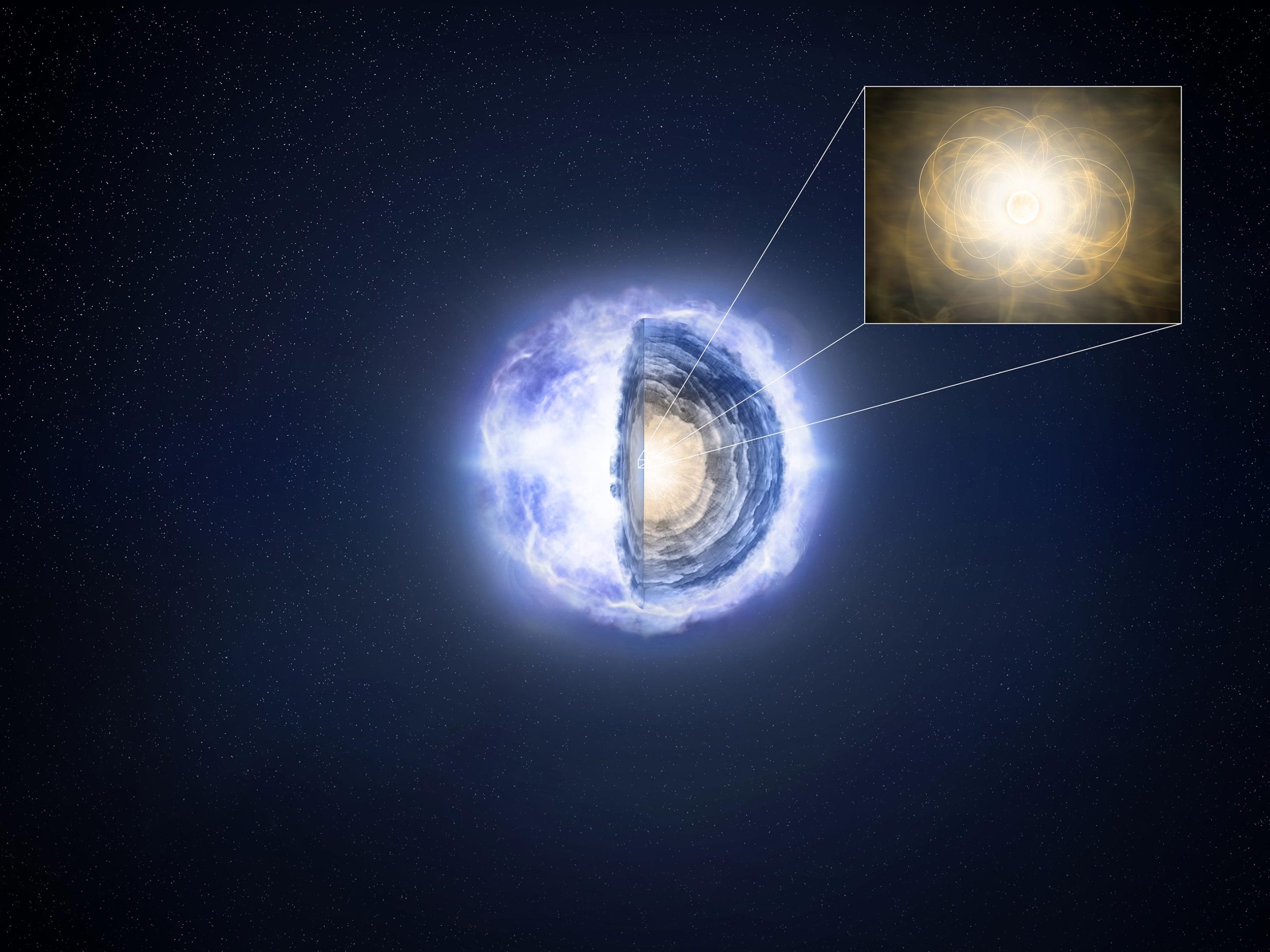
    The star’s collapse has begun, producing a superdense neutron star with a strong magnetic field at its center (inset). The neutron star, though containing about 1.5 times the mass of the Sun, is only about the size of Manhattan. Credit: Melissa Weiss, NRAO/AUI/NSF

    In studying the characteristics of VT 1137-0337, the astronomers considered several possible explanations, including a supernova, gamma ray burst, or tidal disruption event in which a star is shredded by a supermassive black hole. They concluded that the best explanation is a pulsar wind nebula.

    In this scenario, a star much more massive than the Sun exploded as a supernova, leaving behind a neutron star. Most of the original star’s mass was blown outward as a shell of debris. The neutron star spins rapidly, and as its powerful magnetic field sweeps through the surrounding space it accelerates charged particles, causing strong radio emission.

    Initially, the radio emission was blocked from view by the shell of explosion debris. As that shell expanded, it became progressively less dense until eventually the radio waves from the pulsar wind nebula could pass through.
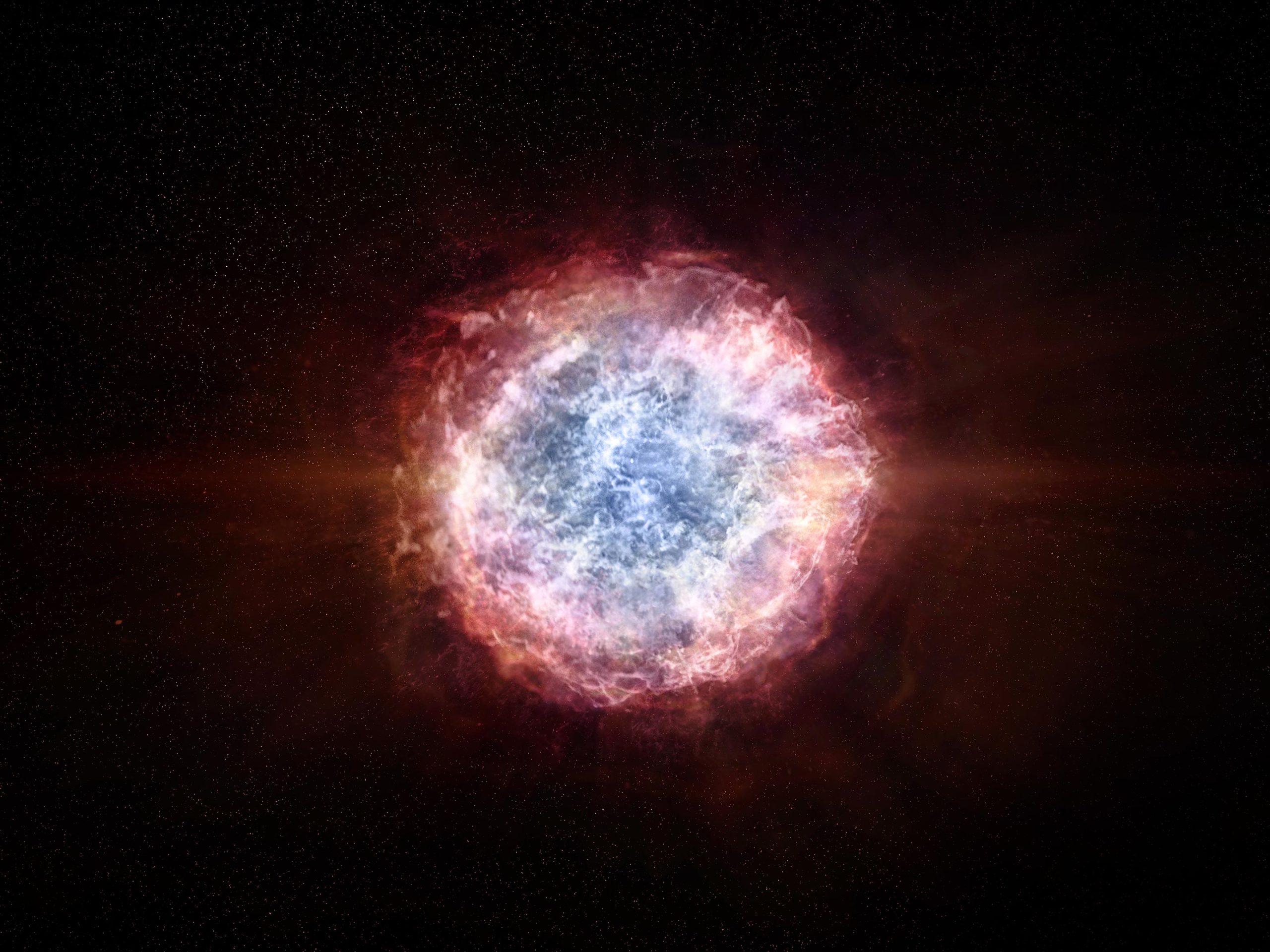
    Supernova Explosion Ejected Fast Moving Shell of Debris
    The supernova explosion has ejected a fast-moving shell of debris outward into interstellar space. At this stage, the debris shell is dense enough to shroud from view any radio waves coming from the region of the neutron star. Credit: Melissa Weiss, NRAO/AUI/NSF

    “This happened between the FIRST observation in 1998 and the VLASS observation in 2018,” Hallinan said.

    Probably the most famous example of a pulsar wind nebula is the Crab Nebula in the constellation Taurus, the result of a supernova that shone brightly in the year 1054. The Crab is readily visible today in small telescopes.

    “The object we have found appears to be approximately 10,000 times more energetic than the Crab, with a stronger magnetic field,” Dong said. “It likely is an emerging ‘super Crab’,” he added.
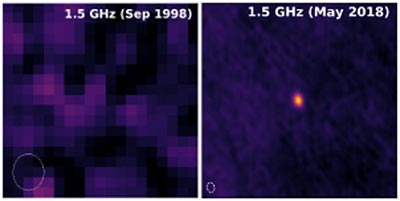
    VT 1137 0337
    VLA images of the location of VT 1137-0337 in 1998, left, and 2018, right. The object became visible to the VLA sometime between these two dates. Credit: Dong & Hallinan, NRAO/AUI/NSF

    While Dong and Hallinan consider VT 1137-0337 to most likely be a pulsar wind nebula, it also is possible that its magnetic field may be strong enough for the neutron star to qualify as a magnetar — a class of super-magnetic objects. Magnetars are a leading candidate for the origin of the mysterious Fast Radio Bursts (FRBs) now under intense study.

    “In that case, this would be the first magnetar caught in the act of appearing, and that, too, is extremely exciting,” Dong said.

    Indeed some Fast Radio Bursts have been found to be associated with persistent radio sources, the nature of which also is a mystery. They bear a strong resemblance in their properties to VT 1137-0337, but have shown no evidence of strong variability.

    “Our discovery of a very similar source switching on suggests that the radio sources associated with FRBs also may be luminous pulsar wind nebulae,” Dong said.

    The astronomers plan to conduct further observations to learn more about the object and to monitor its behavior over time.

    The National Radio Astronomy Observatory is a facility of the National Science Foundation, operated under cooperative agreement by Associated Universities, Inc.

    Never miss a breakthrough: Join the SciTechDaily newsletter.
    Follow us on Google and Google News.

    Astronomy Astrophysics National Radio Astronomy Observatory Popular Pulsars
    Share. Facebook Twitter Pinterest LinkedIn Email Reddit

    Related Articles

    Something Is Ticking Near the Milky Way’s Supermassive Black Hole

    Infrared Dark Clouds Reveal Why Some Stars are Bigger than Others

    GBT Reveals Hidden Details in Starburst Galaxy M82

    Astronomers Discover New Information about Black Hole Mergers

    Astronomers Discover a Neutron Star That has the Ability to Transform

    Astronomers Discover Hydrogen Clouds Between Nearby Galaxies, Andromeda and Triangulum

    Switching Behavior of Pulsar Challenges Emission Theories

    Massive Outburst in Spiral Galaxy NGC 660 Surprises Astronomers

    Scientists Challenge Pulsar ‘Glitch’ Theory

    3 Comments

    1. Really? on June 20, 2022 9:59 am

      Man, you never give up, do you? I’ve seen you post essentially this same message under science articles for years – and it holds no more credibility now than it did then. Why don’t you confine your commenting to articles about the Bible, where it will likely be far more appreciated? Seeing this nonsense as a response to articles based on science is just sad.

      Reply
    2. xABBAAA on June 20, 2022 10:37 am

      /// If you can save one! So, who do you save?
      A multiverse, if gramatics is correct…

      Reply
    3. toti on June 21, 2022 10:54 am

      the comment “young as only 14 years, but no older than 60 to 80 years,” should be clarified, the pulsar image/radiation we are detecting is 395 million years old, and the corresponding image is for a pulsar that at that time was between 14 and 80 years old.

      Reply
    Leave A Reply Cancel Reply

    • Facebook
    • Twitter
    • Pinterest
    • YouTube

    Don't Miss a Discovery

    Subscribe for the Latest in Science & Tech!

    Trending News

    Scientists Uncover Potential Brain Risks of Popular Fish Oil Supplements

    Scientists Discover a Surprising Way To Make Bread Healthier and More Nutritious

    After 60 Years, Scientists Uncover Unexpected Brain Effects of Popular Diabetes Drug Metformin

    New Research Uncovers Hidden Side Effects of Popular Weight-Loss Drugs

    Scientists Rethink Extreme Warming After Surprising Ocean Discovery

    Landmark Study Links Never Marrying to Significantly Higher Cancer Risk

    Researchers Discover Unknown Beetle Species Just Steps From Their Lab

    Largest-Ever Study Finds Medicinal Cannabis Ineffective for Anxiety, Depression, PTSD

    Follow SciTechDaily
    • Facebook
    • Twitter
    • YouTube
    • Pinterest
    • Newsletter
    • RSS
    SciTech News
    • Biology News
    • Chemistry News
    • Earth News
    • Health News
    • Physics News
    • Science News
    • Space News
    • Technology News
    Recent Posts
    • Early Warning Signals of Esophageal Cancer May Be Hiding in Plain Sight
    • Researchers Have Discovered a THC-Free Cannabis Compound That May Replace Opioids
    • Common Blood Pressure Drug Shows Surprising Power Against Deadly Antibiotic-Resistant Superbug
    • Students Build Dark Matter Detector and Set New Experimental Limits
    • Scientists Discover Caffeine Can Repair Key Memory Circuits After Sleep Loss
    Copyright © 1998 - 2026 SciTechDaily. All Rights Reserved.
    • Science News
    • About
    • Contact
    • Editorial Board
    • Privacy Policy
    • Terms of Use

    Type above and press Enter to search. Press Esc to cancel.