
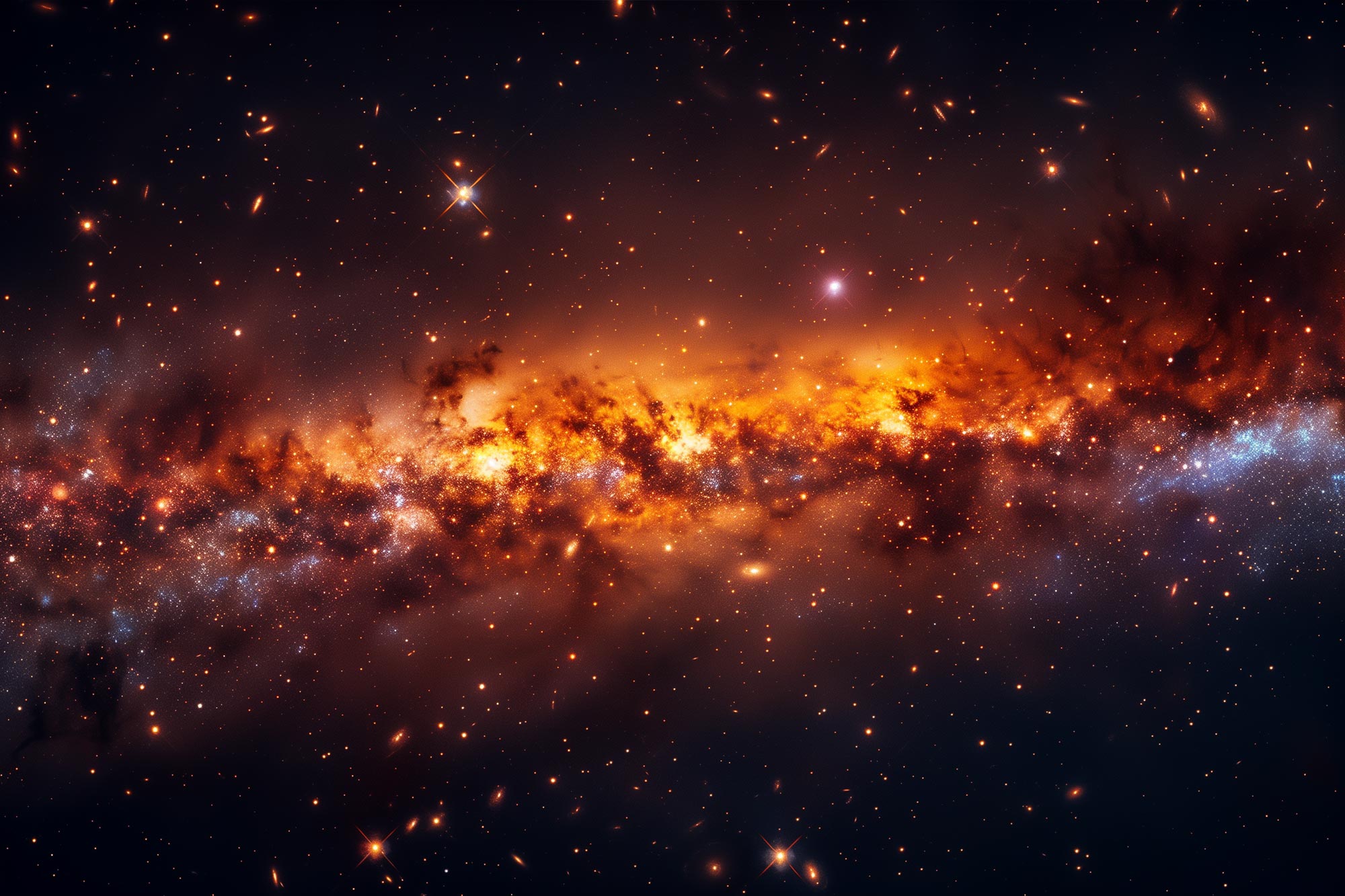
CU Boulder researchers found massive, dust-filled galaxies called UFOs using JWST, challenging previous galaxy formation theories.
A new study led by astrophysicists from the University of Colorado Boulder aims to uncover the nature of a peculiar class of galaxies known as Ultra-red Flattened Objects, or UFOs. Unlike unidentified flying objects, these UFOs are unusually large, red-hued galaxies that have captured the attention of researchers.
According to lead author Justus Gibson, a doctoral student in the Department of Astrophysical and Planetary Sciences, the study highlights these enigmatic galaxies, first identified by CU Boulder researchers in images from the James Webb Space Telescope (JWST).
Now, Gibson and his colleagues believe they have gained a deeper understanding of the galaxies’ inner workings.
The researchers explained that UFOs are odd cosmic ducks for several reasons. For one, they exist near the observational limit of earlier space instruments, such as the Hubble Space Telescope. However, Hubble completely missed them because these galaxies emit very little visible light.
This new study relies on observations from the Webb Telescope, a groundbreaking spacecraft launched in December 2021. Using these images along with computer simulations, the team reports that UFO galaxies appear similar in size and shape to the Milky Way—but they are much dustier.
The team recently published its findings in The Astrophysical Journal.
“JWST allows us to see this type of galaxy that we never would have been able to see before,” Gibson said. “It tells us that maybe we didn’t understand the universe as well as we thought.”
The universe is turning out to be more interesting than some scientists assumed, said study co-author Erica Nelson, who first discovered the UFO galaxies.
“They’re so visually striking,” said Nelson, assistant professor of astrophysics at CU Boulder. “They’re enormous red discs that pop up in these images, and they were totally unexpected. They make you say: ‘What? How?’”
Hidden galaxies
Gibson noted that UFO galaxies look red because they emit very little visible light—most of the light that escapes these galaxies is infrared radiation, and what little visible light they emit is at the limit of what human eyes can see (red, in other words). As a result, the UFO galaxies were all but invisible to Hubble, which only records visible light. The Webb telescope, in contrast, collects infrared light, which means it’s well-suited to spotting these kinds of objects.
“Prior to the launch of James Webb, we thought we would find really, really far away galaxies,” Gibson said. “But we thought that closer to us, we already had a pretty good understanding of all the types of galaxies there are.”
In the new study, Gibson and his colleagues drew on observations from a collaboration called the JWST Advanced Deep Extragalactic Survey (JADES). In all, the team identified 56 UFO galaxies in images from JADES.
They found a lot of dust.
Biting the dust
The researchers noted that all galaxies, and even Earth’s solar system, contain interplanetary dust, the remnants of dying stars that exploded a long time ago, shooting tiny particles of metal far into space. But the UFO galaxies contain a lot more dust than the Milky Way—enough dust to block about 50 times more light from beaming into space. It’s a bit like a sandstorm on Earth obscuring the sun.
The researchers also used computer simulations, or models, to understand how the galaxies are shaped. Gibson noted that galaxies can come in many shapes and sizes, from Frisbee-like discs to football shapes and spheres.
The team’s calculations suggest that UFO galaxies may be shaped like run-of-the-mill discs (think Milky Way).
“You have these big bad disks—like our home, the Milky Way—flying around space, completely invisible to us,” Nelson said.
How these galaxies got so dusty isn’t clear. Nelson said she hopes that by studying them, astrophysicists can learn how galaxies grow and form new stars over time. For now, the UFOs raise a lot more questions than answers.
“Why on Earth do these galaxies have so much more dust than all the other galaxies?” she said. “Got me.”
Reference: “JADES Ultrared Flattened Objects: Morphologies and Spatial Gradients in Color and Stellar Populations” by Justus L. Gibson, Erica Nelson, Christina C. Williams, Sedona H. Price, Katherine E. Whitaker, Katherine A. Suess, Anna de Graaff, Benjamin D. Johnson, Andrew J. Bunker, William M. Baker, Rachana Bhatawdekar, Kristan Boyett, Stephane Charlot, Emma Curtis-Lake, Daniel J. Eisenstein, Kevin Hainline, Ryan Hausen, Roberto Maiolino, George Rieke, Marcia Rieke, Brant Robertson, Sandro Tacchella and Chris Willott, 3 October 2024, The Astrophysical Journal.
DOI: 10.3847/1538-4357/ad64c2
Never miss a breakthrough: Join the SciTechDaily newsletter.
Follow us on Google and Google News.