
Close Menu
    Facebook X (Twitter) Instagram
    SciTechDaily
    • Biology
    • Chemistry
    • Earth
    • Health
    • Physics
    • Science
    • Space
    • Technology
    Facebook X (Twitter) Pinterest YouTube RSS
    SciTechDaily
    Home»Space»Astronomers View a Rare Multiple Quasar Imaging Event Caused by a Gas Cloud
    Space

    Astronomers View a Rare Multiple Quasar Imaging Event Caused by a Gas Cloud

    By National Radio Astronomy ObservatoryAugust 29, 2013No Comments4 Mins Read
    Facebook Twitter Pinterest Telegram LinkedIn WhatsApp Email Reddit
    Share
    Facebook Twitter LinkedIn Pinterest Telegram Email Reddit
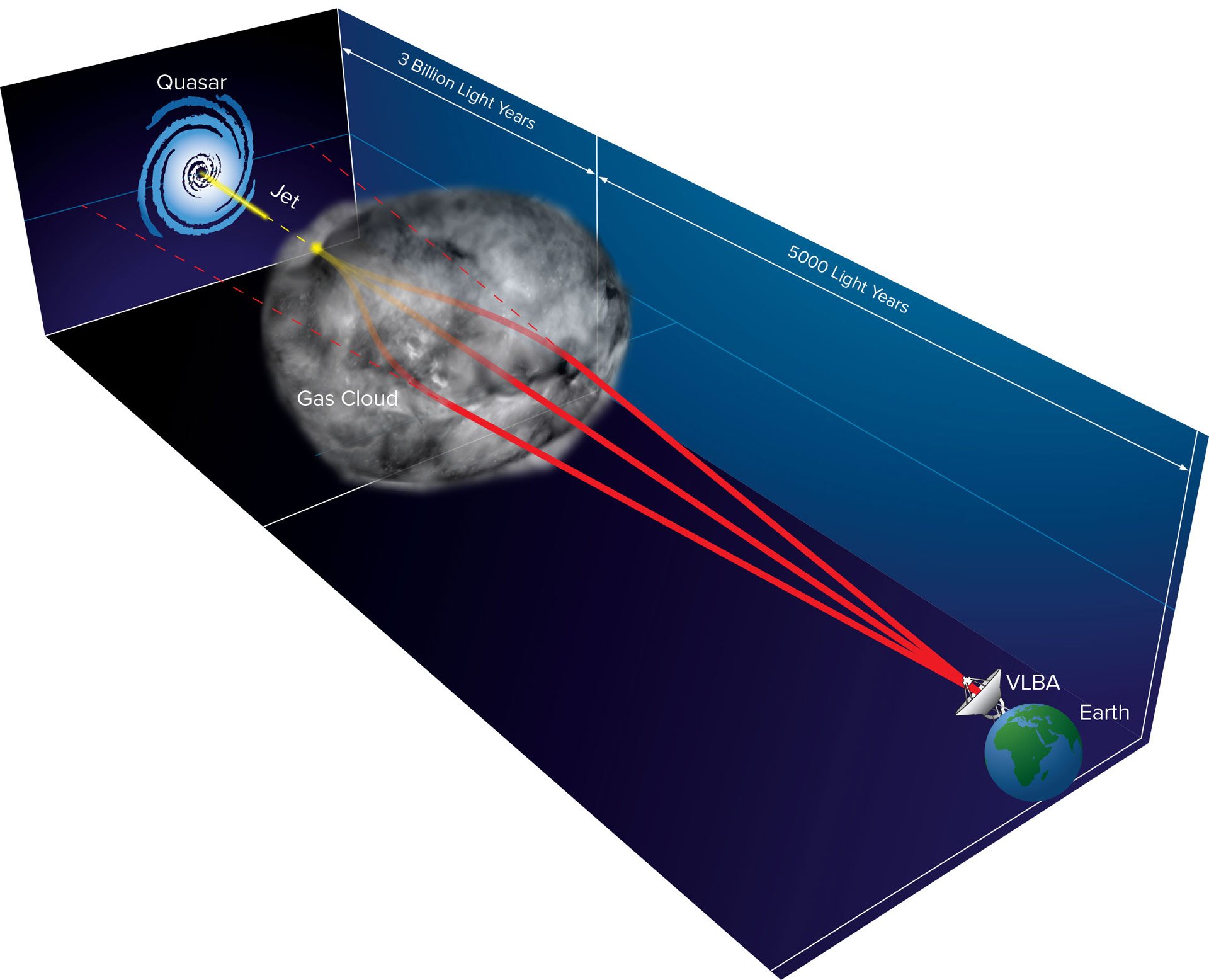
    VLBA Observes a Rare Multiple Quasar Imaging Event
    Artist’s Diagram of the refraction event (not drawn to scale), showing how radio waves from the distant quasar jet are bent by a gas cloud in our own Galaxy, creating multiple images seen with the Very Long Baseline Array. Credit: Bill Saxton, NRAO/AUI/NSF

    Scientists view a rare multiple quasar imaging event caused by the effects of a cloud of ionized gas in the Milky Way Galaxy.

    For the first time, astronomers have seen the image of a distant quasar split into multiple images by the effects of a cloud of ionized gas in our own Milky Way Galaxy. Such events were predicted as early as 1970, but the first evidence for one now has come from the National Science Foundation’s Very Long Baseline Array (VLBA) radio telescope system.

    The scientists observed the quasar 2023+335, nearly 3 billion light-years from Earth, as part of a long-term study of ongoing changes in some 300 quasars. When they examined a series of images of 2023+335, they noted dramatic differences. The differences, they said, are caused by the radio waves from the quasar being bent as they pass through the Milky Way gas cloud, which moved through our line of sight to the quasar.

    “This event, obviously rare, gives us a new way to learn some of the properties of the turbulent gas that makes up a significant part of our Galaxy,” said Matt Lister, of Purdue University.

    The scientists added 2023+335 to their list of observing targets in 2008. Their targets are quasars and other galaxies with supermassive black holes at their cores. The gravitational energy of the black holes powers “jets” of material propelled to nearly the speed of light. The quasar 2023+335 initially showed a typical structure for such an object, with a bright core and a jet. In 2009, however, the object’s appearance changed significantly, showing what looked like a line of bright, new radio-emitting spots.

    “We’ve never seen this type of behavior before, either among the hundreds of quasars in our own observing program or among those observed in other studies,” Lister said.

    The multiple-imaging event came as other telescopes detected variations in the radio brightness of the quasar, caused, the astronomers said, by scattering of the waves.

    The scientists’ analysis indicates that the quasar’s radio waves were bent by a turbulent cloud of charged gas nearly 5,000 light-years from Earth in the direction of the constellation Cygnus. The cloud’s size is roughly comparable to the distance between the Sun and Mercury, and the cloud is moving through space at about 56 kilometers (35 miles) per second.

    Monitoring of 2023+335 over time may yield more such events, the scientists said, allowing them to learn additional details both about the process by which the waves are scattered and about the gas that does the scattering. Other quasars that are seen through similar regions of the Milky Way also may show this behavior.

    The monitoring program that yielded this discovery is called MOJAVE (Monitoring Of Jets in Active galactic nuclei with VLBA Experiments), run by an international team of scientists led by Lister. The analysis of this rare event was spearheaded by Alexander Pushkarev of the Max Planck Institute for Radioastronomy in Germany. The researchers recently published their results in the journal Astronomy and Astrophysics.

    The National Radio Astronomy Observatory is a facility of the National Science Foundation, operated under cooperative agreement by Associated Universities, Inc.

    Reference: “VLBA observations of a rare multiple quasar imaging event caused by refraction in the interstellar medium” by A. B. Pushkarev, Y. Y. Kovalev, M. L. Lister, T. Hovatta, T. Savolainen, M. F. Aller, H. D. Aller, E. Ros, J. A. Zensus, J. L. Richards, W. Max-Moerbeck and A. C. S. Readhead, 4 July 2013, Astronomy & Astrophysics.
    DOI: 10.1051/0004-6361/201321484
    arXiv:1305.6005 

    Never miss a breakthrough: Join the SciTechDaily newsletter.
    Follow us on Google and Google News.

    Astronomy Astrophysics National Radio Astronomy Observatory Purdue University Quasars
    Share. Facebook Twitter Pinterest LinkedIn Email Reddit

    Related Articles

    Record-Breaking Jet of Particles Spied From a Supermassive Black Hole in the Early Universe

    Cosmic Lens Reveals Faint Radio Galaxy More Than 8 Billion Light-Years From Earth

    Massive X-ray Jet – Extending for 160,000 Light-Years – Spied From Supermassive Black Hole in Early Universe

    New Clues About Early Universe From Black Hole Powered Cosmic Jet 13 Billion Light-Years From Earth

    Astronomers Have Discovered the Most Distant Source of Radio Emission Ever Known – 13 Billion Light-Years Away

    A Most Distant Signal: Earliest Supermassive Black Hole and Quasar in the Universe Discovered

    Puzzling Astrophysics of Quasars in the Early Universe

    Astronomers Discover Earliest Supermassive Black Hole and Quasar in the Universe – 1000x More Luminous Than the Milky Way

    Most Distant Quasar Discovered Sheds Light on How Supermassive Black Holes Grow

    Leave A Reply Cancel Reply

    • Facebook
    • Twitter
    • Pinterest
    • YouTube

    Don't Miss a Discovery

    Subscribe for the Latest in Science & Tech!

    Trending News

    Monster Storms on Jupiter Unleash Lightning Beyond Anything on Earth

    Scientists Create “Liquid Gears” That Spin Without Touching

    The Simple Habit That Could Help Prevent Cancer

    Millions Take These IBS Drugs, But a New Study Finds Serious Risks

    Scientists Unlock Hidden Secrets of 2,300-Year-Old Mummies Using Cutting-Edge CT Scanner

    Bread Might Be Making You Gain Weight Even Without Eating More Calories

    Scientists Discover Massive Magma Reservoir Beneath Tuscany

    Europe’s Most Active Volcano Just Got Stranger – Here’s Why Scientists Are Rethinking It

    Follow SciTechDaily
    • Facebook
    • Twitter
    • YouTube
    • Pinterest
    • Newsletter
    • RSS
    SciTech News
    • Biology News
    • Chemistry News
    • Earth News
    • Health News
    • Physics News
    • Science News
    • Space News
    • Technology News
    Recent Posts
    • Scientists Discover a New Meteor Shower From a Mysterious Crumbling Asteroid
    • This Simple Fruit Wash Could Make Produce Safer and Last Days Longer
    • These Tiny Robots 50x Smaller Than a Hair Can Hunt and Move Bacteria
    • Simple Blood Test May Predict Alzheimer’s Years Before Brain Scans Show Signs
    • Scientists Say Adding This Unusual Seafood to Your Diet Could Reverse Signs of Aging
    Copyright © 1998 - 2026 SciTechDaily. All Rights Reserved.
    • Science News
    • About
    • Contact
    • Editorial Board
    • Privacy Policy
    • Terms of Use

    Type above and press Enter to search. Press Esc to cancel.