
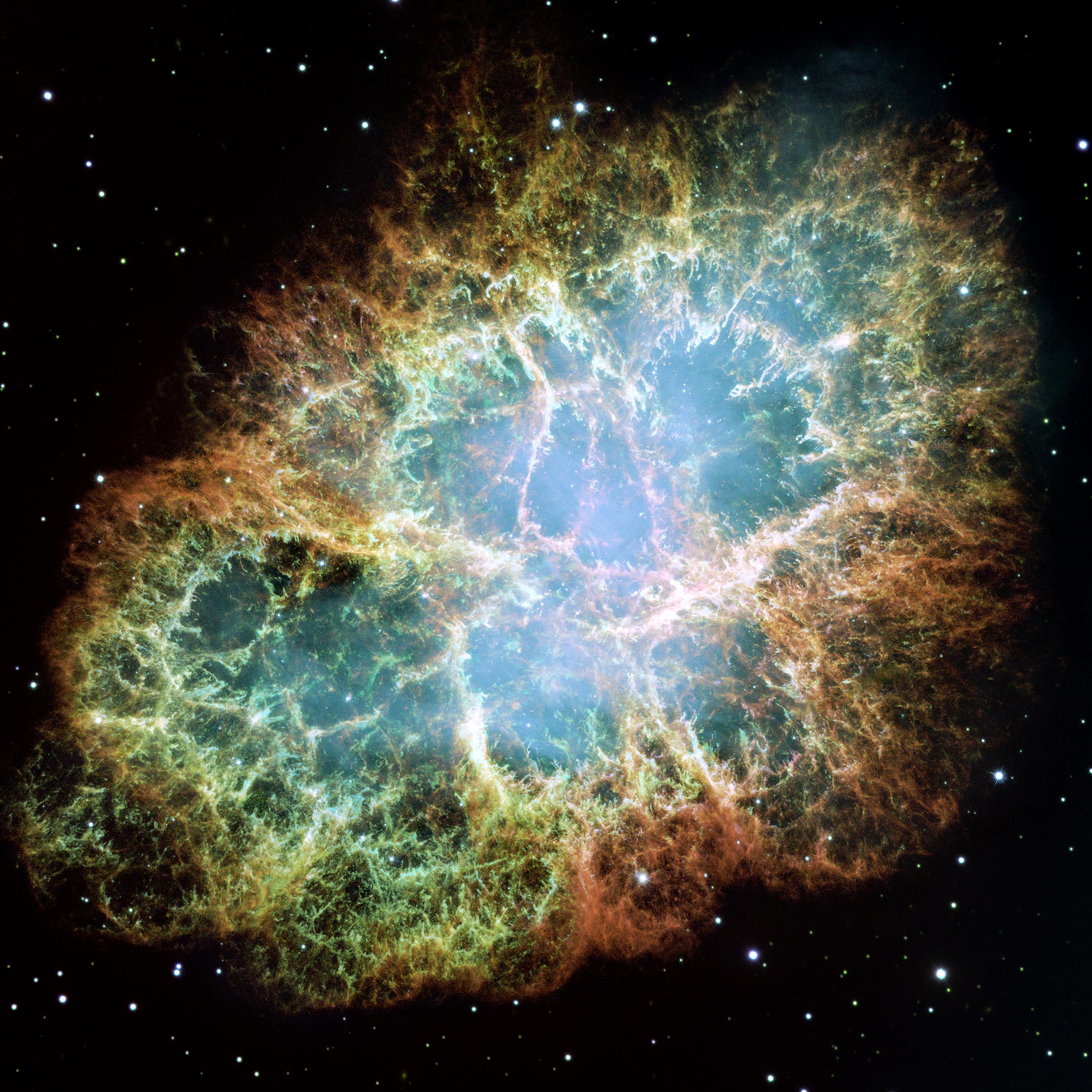
An astrophysicist has cracked the mystery behind strange “zebra” stripes in radio signals from the Crab Nebula.
This discovery sheds light on the behavior of a pulsar at the nebula’s center—a rapidly spinning neutron star that emits powerful beams of radiation. The findings could reshape how we understand these cosmic phenomena.
Unraveling the Crab Nebula’s Zebra Pattern
A theoretical astrophysicist from the University of Kansas may have unraveled a nearly 20-year-old mystery surrounding the origins of a peculiar “zebra” pattern in high-frequency radio pulses from the Crab Nebula.
The research, recently published in the prestigious journal Physical Review Letters, offers groundbreaking insights into this cosmic phenomenon.
At the heart of the Crab Nebula lies a 12-mile-wide neutron star, known as a pulsar, spinning rapidly and emitting beams of electromagnetic radiation that sweep across the universe like a cosmic lighthouse.
Observations of the Crab Pulsar
“The emission, which resembles a lighthouse beam, repeatedly sweeps past Earth as the star rotates,” said lead author Mikhail Medvedev, professor of physics & astronomy at KU. “We observe this as a pulsed emission, usually with one or two pulses per rotation. The specific pulsar I’m discussing is known as the Crab Pulsar, located in the center of the Crab Nebula 6,000 light years away from us.”
The Crab Nebula is the remnant of a supernova that appeared in 1054.
“Historical records, including Chinese accounts, describe an unusually bright star appearing in the sky,” said the KU researcher.

Unique Characteristics of the Crab Pulsar
But unlike any other known pulsar, Medvedev said the Crab Pulsar features a zebra pattern — unusual band spacing in the electromagnetic spectrum proportional to band frequencies, and other weird features like high polarization and stability.
“It’s very bright, across practically all wave bands,” he said. “This is the only object we know of that produces the zebra pattern, and it only appears in a single emission component from the Crab Pulsar. The main pulse is a broadband pulse, typical of most pulsars, with other broadband components common to neutron stars. However, the high-frequency interpulse is unique, ranging between 5 and 30 gigahertz — frequencies similar to those in a microwave oven.”
Since this pattern was discovered in a 2007 paper, the KU researcher said the pattern had proved “baffling” for investigators.
“Researchers proposed various emission mechanisms, but none have convincingly explained the observed patterns,” he said.
New Insights From Wave Optics
Using data from the Crab Pulsar, Medvedev established a method using wave optics to gauge the density of the pulsar’s plasma – the “gas” of charged particles (electrons and positrons) — using a fringe pattern found in the electromagnetic pulses.
“If you have a screen and an electromagnetic wave passes by, the wave doesn’t propagate straight through,” Medvedev said. “In geometrical optics, shadows cast by obstacles would extend indefinitely — if you’re in the shadow, there’s no light; outside of it, you see light. But wave optics introduces a different behavior — waves bend around obstacles and interfere with each other, creating a sequence of bright and dim fringes due to constructive and destructive interference.”
This well-known fringe pattern phenomenon is caused by consistent constructive interference but has different characteristics when radio waves propagate around a neutron star.
“A typical diffraction pattern would produce evenly spaced fringes if we just had a neutron star as a shield,” Medvedev said. “But here, the neutron star’s magnetic field generates charged particles constituting a dense plasma, which varies with distance from the star. As a radio wave propagates through the plasma, it passes through dilute areas but is reflected by dense plasma. This reflection varies by frequency: Low frequencies reflect at large radii, casting a bigger shadow, while high frequencies create smaller shadows, resulting in different fringe spacing.”
Implications for Astrophysical Research
In this way, Medvedev determined the Crab Pulsar’s plasma matter causes diffraction in the electromagnetic pulses responsible for the neutron star’s singular zebra pattern.
“This model is the first one capable of measuring those parameters,” Medvedev said. “By analyzing the fringes, we can deduce the density and distribution of plasma in the magnetosphere. It’s incredible because these observations allow us to convert fringe measurements into a density distribution of the plasma, essentially creating an image or performing tomography of the neutron star’s magnetosphere.”
Next, Medvedev said his theory can be tested with collection of more data from the Crab Pulsar and fine-tuned by factoring in its powerful and strange gravitational and polarization effects. The new understanding of how a plasma matter alters a pulsar’s signal will change how astrophysicists understand other pulsars.
“The Crab Pulsar is somewhat unique — it’s relatively young by astronomical standards, only about a thousand years old, and highly energetic,” he said. “But it’s not alone; we know of hundreds of pulsars, with over a dozen that are also young. Known binary pulsars, which were used to test Einstein’s general relativity theory, can also be explored with the proposed method. This research can indeed broaden our understanding and observation techniques for pulsars, particularly young, energetic ones.”
Reference: “Origin of Spectral Bands in the Crab Pulsar Radio Emission” by Mikhail V. Medvedev, 15 November 2024, Physical Review Letters.
DOI: 10.1103/PhysRevLett.133.205201
This material is based upon work supported by the National Science Foundation under Award No. PHY-2409249 and PHY-2010109.
Never miss a breakthrough: Join the SciTechDaily newsletter.
Follow us on Google and Google News.