

More than 50 years after Apollo 8’s legendary Earthrise photo, a new image from the Moon’s surface delivers a hauntingly different view.
Captured by the Blue Ghost lander in 2025, this photograph portrays Earth as a ghostly, distant orb hovering over the lunar expanse.
A Photograph That Changed the World
In 1968, during Apollo 8’s historic orbit around the Moon, astronaut Bill Anders took one of the most famous photographs in history: Earthrise. The image captured Earth as a brilliant blue-and-white sphere rising above the Moon’s barren landscape. It not only reshaped NASA’s perspective on our planet but also fueled the growing environmental movement, highlighting Earth’s beauty and fragility.
“We came all this way to explore the Moon, and the most important thing is that we discovered the Earth,” Anders later said of his journey. “Earth was the only thing in color. Everything else was black or white. It was the only thing that had any life to it.”
Now, more than 50 years later, a new photograph taken from the Moon’s surface offers a strikingly different perspective. This latest image, known as the Blue Ghost photo, shows Earth as a small, gray speck suspended in the vastness of space, drifting beyond the Moon’s desolate horizon.
Blue Ghost’s Journey to Mare Crisium
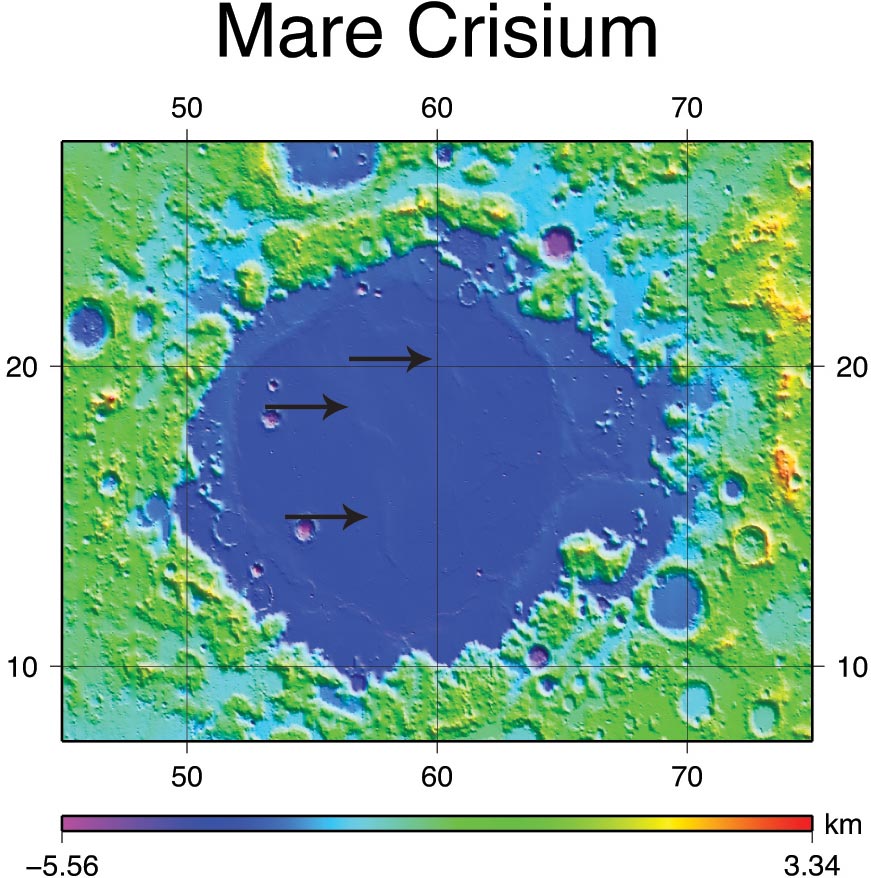
The new photo was taken on March 2, 2025, after the Blue Ghost lander—a 330-pound (150-kilogram) spacecraft built by Firefly Aerospace—gently touched down on the powdery regolith of Mare Crisium. This dark feature in the Moon’s northeast quadrant formed when basaltic lava filled an ancient impact crater billions of years ago. Since the feature is close to the edge of the visible disk when viewed from Earth, it comes into view on a waxing crescent Moon and remains prominent until soon after a full Moon.
Blue Ghost, named after a rare type of firefly found in the U.S. Southeast, landed in Mare Crisium six weeks after a SpaceX Falcon 9 rocket launched the probe from NASA’s Kennedy Space Center. The new photograph, taken soon after sunrise, shows a faint, almost spectral view of Earth beyond the lander’s shadow. Unlike the crisp details in Earthrise, where swirling clouds and continents are visible, Earth appears as more of an apparition—our gas-rich atmosphere scattering light in a way that makes the planet look opaque and monochromatic.
Why Earth Looks Different This Time
The photo was taken with a high-definition commercial off-the-shelf digital camera with a wide fisheye lens with little to no zoom, making Earth appear small, a Firefly Aerospace spokesperson explained. “In contrast, Bill Anders was in orbit and using a 250-millimeter telephoto lens when he took the Earthrise photograph, so Earth looked relatively large,” said Olivia Tyrrell, an optical engineer at NASA’s Langley Research Center. Tyrrell is a member of the science team for SCALPSS (Stereo Cameras for Lunar Plume Surface Studies), one of ten scientific payloads aboard Blue Ghost.
Capturing Earth Along the Journey
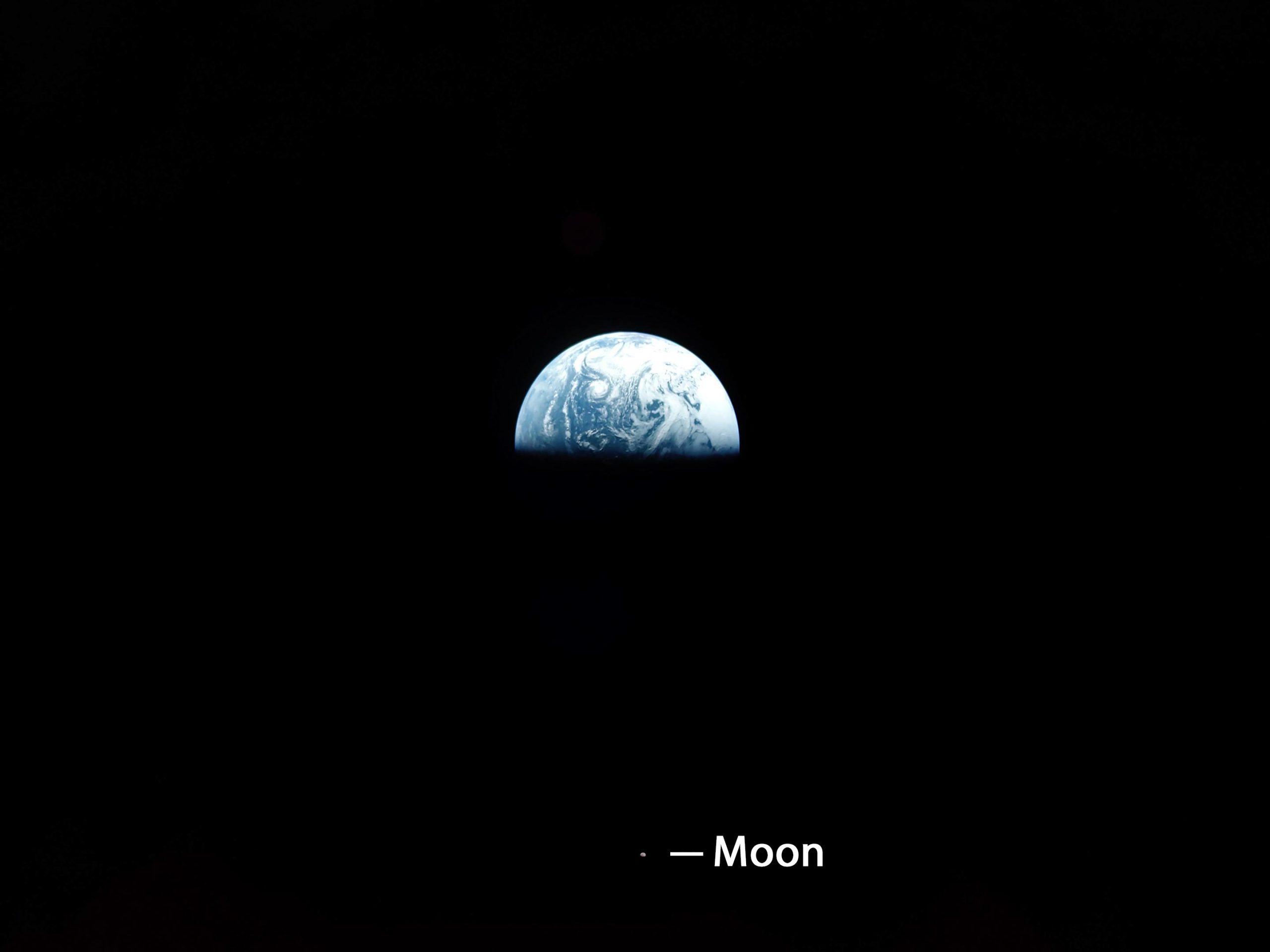
Earth, however, looked much bluer and larger in other photographs taken during Blue Ghost’s journey to the Moon. On February 12, a Firefly Aerospace camera captured the remarkable image (above) of part of Earth’s Southern Hemisphere and the Moon a few days after trans-lunar injection, a maneuver that altered the spacecraft’s orbit and put it on a trajectory for the Moon. At the time, the spacecraft was much closer to Earth than the Moon, so the Moon appears as a mere speck in the photo. On Earth, ice sheets covering Antarctica and a tropical cyclone churning in the Indian Ocean are visible.
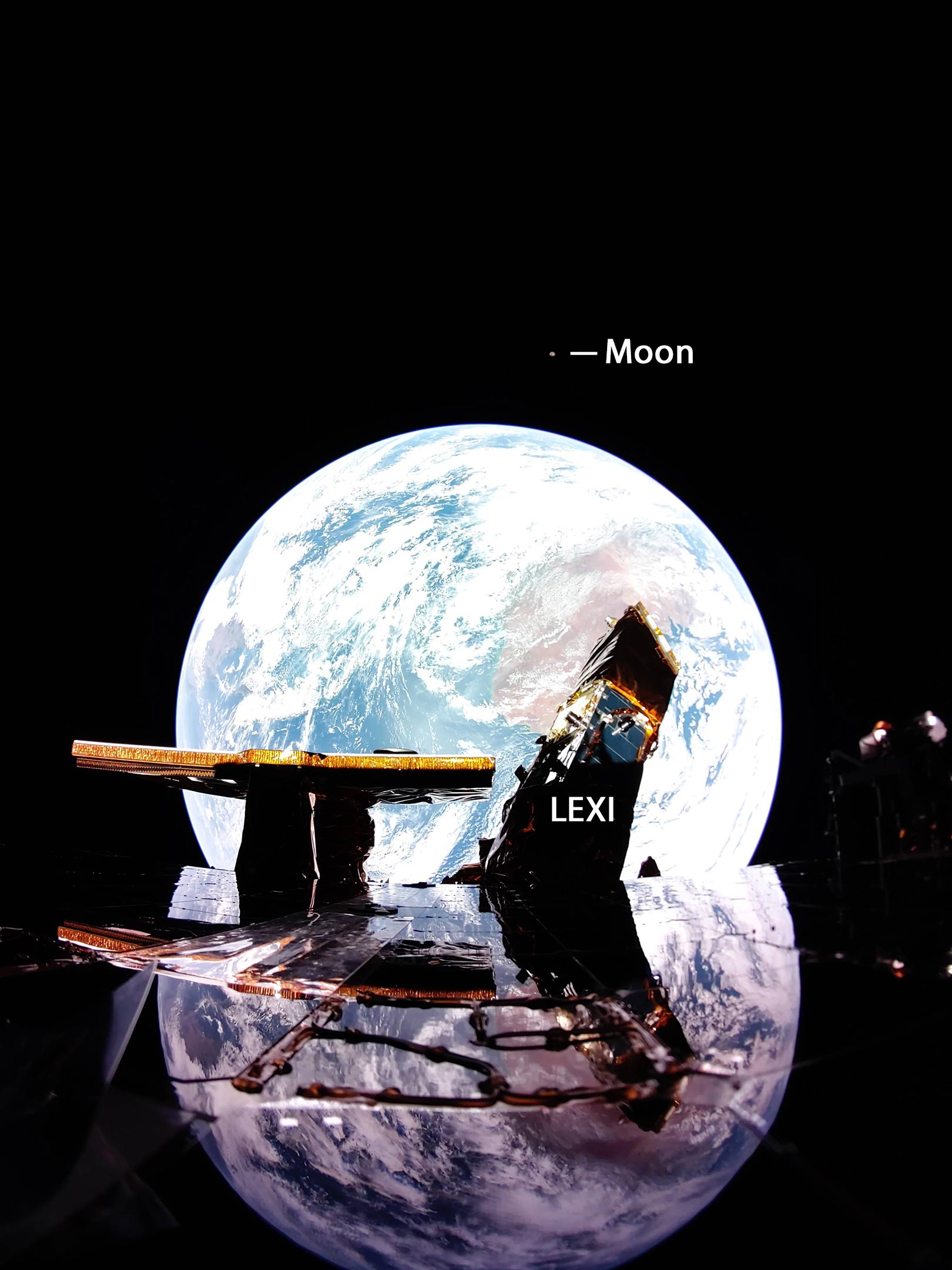
Around the same time, Firefly Aerospace’s cameras looked back home and captured an image (below) of Earth’s clouds and part of Australia, also visible in the reflections off the mission’s solar panels (foreground).
A Telescope for Earth’s Space Weather
The mission’s X-band antenna and LEXI (Lunar Environment Heliospheric X-ray Imager), a NASA telescope designed to study Earth from the Moon, are shown in the center of the image. Scientists will use the telescope to study how Earth’s atmosphere responds to space weather, or variations in the conditions in space caused by solar activity such as flares and coronal mass ejections.
For six Earth days during the Blue Ghost mission, LEXI will collect images of X-rays emanating from the edges of Earth’s sprawling magnetosphere. These images will help researchers track how the protective boundary reacts to space weather and other cosmic forces and sometimes allows streams of charged solar particles into Earth’s atmosphere, creating auroras and potentially damaging infrastructure.
A Short but Crucial Lunar Mission
The Blue Ghost lander was designed to operate for about one lunar day, equivalent to 14 Earth days. The mission is part of the Commercial Lunar Payload Services (CLPS) initiative, a partnership between NASA and several American companies to deliver science and technology to the lunar surface.
Never miss a breakthrough: Join the SciTechDaily newsletter.
Follow us on Google and Google News.
3 Comments
Richard Nixon was forced out of office in 1974, and in 1975, NASA’s budget was cut quite substantially by the Democrat controlled Congress and Senate, and many of it’s ambitious goals were scuttled. The original space shuttle had retractable jets for landing. Those were deleted, essentially by the Democratic Party, as were further manned missions. I believe this is because it distracted from their domestic agenda of essentially nationalizing as much of the civilian economy as possible. The so called lovers of science only love the science of global warming, and won’t give it a rest, as this publication is glad to cooperate with each and every pert
This is the second attach on scince I am seeing in article one was from a religious nut and this one. I suspect you are a paid operative who simply goes around on random article shouting your libertarian mouth gargle Stop
Why the label on the photo?