
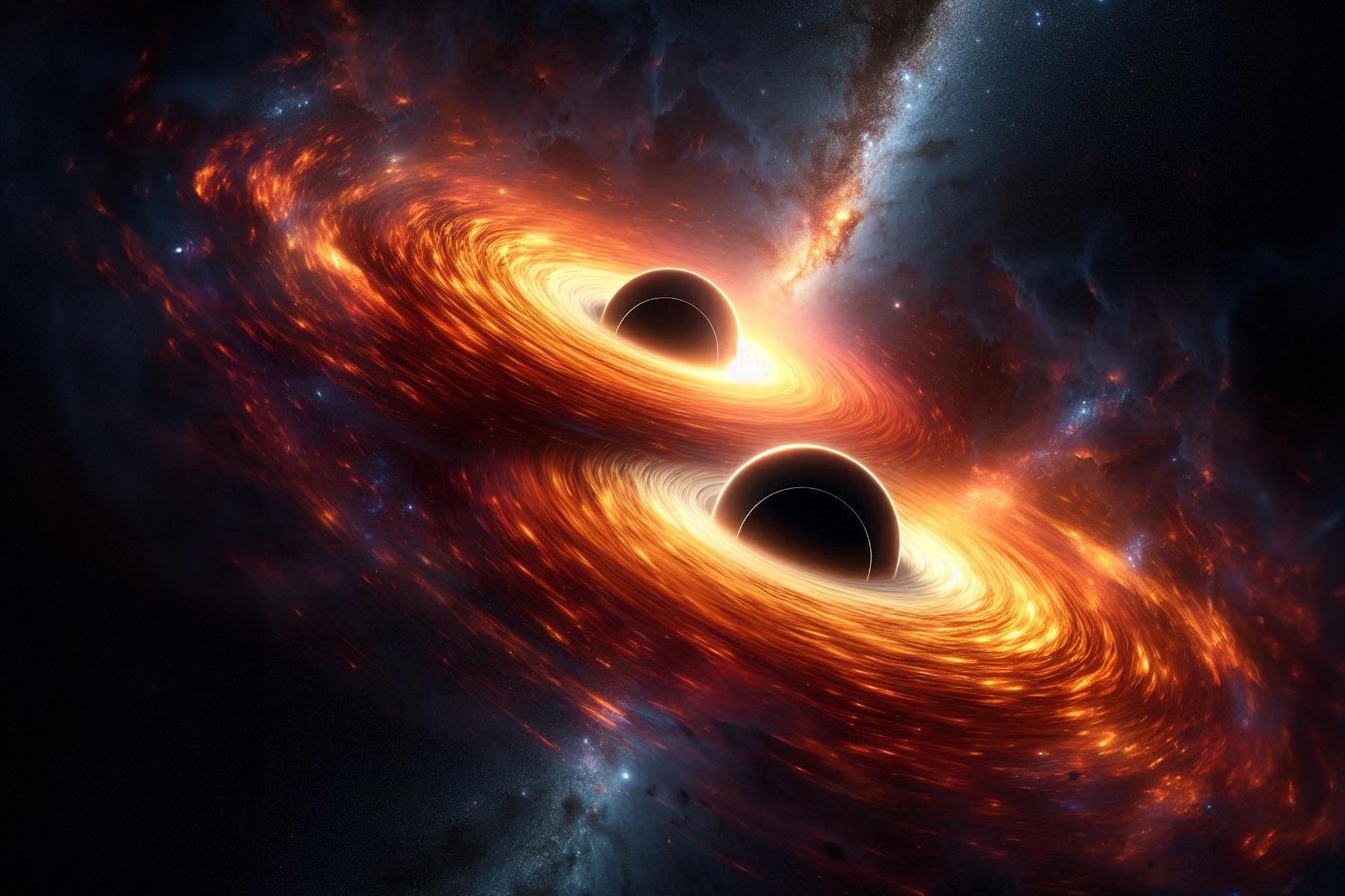
Merging black holes may reveal new particles through gravitational waves, either via ionization or specific orbital changes. This offers new strategies to search for ultralight particles.
In a paper recently published in Physical Review Letters, physicists from Amsterdam and Copenhagen propose that detailed observations of merging black hole pairs could reveal information about potential new particles. The research builds on a series of recent discoveries made by UvA scientists over the past six years.
Gravitational waves that are emitted by the merger of two black holes carry detailed information about the shape and evolution of the orbits of the components. A new study by physicists Giovanni Maria Tomaselli and Gianfranco Bertone from the University of Amsterdam (UvA), together with former UvA master student Thomas Spieksma, now at the Niels Bohr Institute in Copenhagen, suggests that a careful analysis of this information may reveal the existence of new particles in nature.
Superradiance
The mechanism that makes the detection of new particles possible is called black hole superradiance. When a black hole spins fast enough, it can shed some of its mass into a ‘cloud’ of particles around it. The black hole-cloud system is referred to as a ‘gravitational atom’, due to its similarity with the electron cloud around a proton. Since superradiance is only efficient if the particles are much lighter than the ones measured in experiments so far, this process provides the unique opportunity to probe the existence of new particles known as ultralight bosons, whose existence may resolve several puzzles in astrophysics, cosmology, and particle physics.
The orbital evolution of binary black holes in the presence of ultralight boson clouds has been studied by UvA scientists in a series of influential papers over the past six years. One important new phenomenon that was discovered was that of resonant transitions, where the cloud ‘jumps’ from one state to another, similar to how an electron in an ordinary atom can jump between orbits.
Another new phenomenon, again similar to the behavior of ordinary atoms, is ionization, where part of the cloud is ejected. Both of these effects leave characteristic imprints on the emitted gravitational waves, but the details of such imprints depend on the – so far unknown – state of the particle cloud. In an effort to fill in these remaining details, the new study combines all the previous results, and follows the history of the system from the formation of the binary black hole to the black hole merger.
Two possibilities
The main conclusions substantially improve our understanding of the binary gravitational atoms. The researchers found that there were two possible outcomes of the evolution of such a system, both equally interesting. If the black holes and the cloud initially rotate in opposite directions, then the cloud survives in the state originally produced by superradiance, and it becomes detectable through its ionization, which leaves a clear signature on the gravitational waves. In all other cases, resonant transitions destroy the cloud altogether, and the binary’s orbit acquires very specific values of eccentricity and inclination, which can be measured from the gravitational waves signal.
Thus, the new result provides a novel and solid search strategy for new particles, either via the detection of ionization effects in gravitational waveforms in one case, or in the other case via the observation of an anomalous excess of systems with the predicted values of eccentricity and inclination. For both cases, upcoming detailed gravitational wave observations will reveal very interesting information about the question of whether new ultralight particles exist.
Reference: “Legacy of Boson Clouds on Black Hole Binaries” by Giovanni Maria Tomaselli, Thomas F. M. Spieksma and Gianfranco Bertone, 16 September 2024, Physical Review Letters.
DOI: 10.1103/PhysRevLett.133.121402
Never miss a breakthrough: Join the SciTechDaily newsletter.
Follow us on Google and Google News.
4 Comments
Note 2410190756
It is suggested that the combination of unstable black holes (qvixers) could help discover new gravitational atoms and particles through gravitational wave analysis, providing a ‘new approach’ to particle detection.
Source 1.
When black holes combine, new particles can be revealed through gravitational waves, which are possible through ionization or specific orbital changes. This provides a new strategy for finding ultra-light particles.
The mechanism that enables the detection of new particles is called black hole superluminance. When a black hole rotates fast enough, it can emit some of its mass into the surrounding particle ‘cloud’. The black hole-cloud system is called a ‘gravitational atom’ because it resembles an electron cloud around a proton. Since superluminance is only efficient when particles are much lighter than what has been measured in experiments so far, this process provides a unique opportunity to investigate the existence of a new particle known as an ultra-light boson, and its existence can solve many puzzles in astrophysics, cosmology, and particle physics.
When the black hole and cloud initially rotate in opposite directions, the cloud survives in its original state created by its superluminance and can be detected by ionization, which leaves a clear mark on the gravitational wave. In all other cases the resonance transition completely destroys the cloud and the binary orbit acquires very specific eccentricity and inclination angle values, which can be measured from the gravitational wave signal.
One important new phenomenon discovered in the orbital evolution of binary black holes with ultra-light bosonic clouds is resonance transition, in which clouds ‘jump’ from one state to another, similar to the way electrons of ordinary atoms jump between orbits.
The new results thus provide a new and robust search strategy for the new particles, either by detecting ionization effects in gravitational waveforms or by observing anomalous excess systems with predicted eccentricity and inclination angle values. In both cases, detailed gravitational wave observations to come will reveal very interesting information about the question of whether new ultra-light particles exist.
1.
Black holes arbitrarily merge because two or more qixers are in an unstable fermion state. However, stable black holes (vixers) are easy to separate even when combined, but when the fractions combine into fractions to form a boson, the strong coupling force is like the entanglement of a lock cipher. That’s why we need a unique key. Huh.
The qms.qvix.+tsp isotope elementary particle produces a quasiparticle generated from two quasi-black holes (qms) from the dark energy qms. Or ‘represented’. The case where the vixer is fast enough appears in the tspms() cloud because of the unbalanced qixer(a,b).value.cap. The cloud and value have different detection of gravitational waves if their spin is different. At reverse rotation (-), new particles are detected. Uh-huh.
Then -tsp(-time_space.particle) isotope particles can be hidden. Huh. Dark energy is denser than dark matter because gravitational waves cannot detect it. So dark matter reacts to gravity, and dark energy can be an ideal of matter that is not detected even by gravitational waves, a state of inequality below. Huh.
The qms.qvixer line is used to hide new particles coming from a combination of black holes. The hidden particles are detected as the progressive cancellation waveform reacts to gravitational waves. But when they are grains of boson that form clouds, they react through the cap of the waveform. Huh.
ㅡㅡㅡㅡㅡㅡㅡㅡㅡㅡㅡㅡㅡㅡ
Source 1.
https://scitechdaily.com/black-hole-mergers-could-be-hiding-mysterious-new-particles/
Black hole merger may hide mysterious new particles
All things follow certain laws, which can be revealed through observation and research ( such as topological structures ). When physics is passionate about studying imaginary particles and things, it is no longer much different from theology.
Scientific research guided by correct theories can help people avoid detours, failures, and exaggeration. The physical phenomena observed by researchers in experiments are always appearances, never the natural essence of things. The natural essence of things needs to be extracted and sublimated based on mathematical theories via appearances , rather than being imagined arbitrarily.
Everytime scientific revolution, the scientific research space brought by the new paradigm expands exponentially. Physics should not ignore the analyzable physical properties of topological vortices.
(1) Traditional physics: based on mathematical formalism, experimental verification and arbitrary imagination.
(2) Topological Vortex Theory (TVT): Although also based on mathematics (such as topology), it focuses more on non intuitive geometry and topological structures, challenging traditional physical intuition.
Topological Vortex Theory (TVT) points out the limitations of the Standard Model in describing the large-scale structure of the universe, proposes the need to consider non-standard model components such as dark matter and dark energy, and suggests that topological vortex fields may be key to understanding these phenomena. Topological vortex theory (TVT) heralds innovative technologies such as topological electronics, topological smart batteries, topological quantum computing, etc., which may bring low-energy electronic components, almost inexhaustible currents, and revolutionary computing platforms, etc.
Topology tells us that topological vortices and antivortices can form new spacetime structures via the synchronous effect of superposition, deflection, or twisting of them. Mathematics does not tell us that there must be God particles, ghost particles, fermions, or bosons present. When physics and mathematics diverge, arbitrary imagination will make physics no different from theology. Topological vortex research reflections on the philosophy and methodology of science help us understand the nature essence of science and the limitations of scientific methods. This not only has guiding significance for scientific research itself, but also has important implications for science education and popularization.
Today, so-called official (such as PRL, Nature, Science, PNAS, etc.) in physics stubbornly believes that two sets of cobalt-60 rotating in opposite directions can become two sets of objects that mirror each other, is a typical case that pseudoscience is rampant and domineering.
Please witness the exemplary collaboration between theoretical physicists and experimentalists (https://scitechdaily.com/microscope-spacecrafts-most-precise-test-of-key-component-of-the-theory-of-general-relativity/#comment-854286). Let us continue to witness with facts the dirtiest and ugliest era in the history of human social sciences and humanities. The laws of nature will not change due to misleading of certain so-called academic publications or endorsements from certain so-called scientific awards.
As some comments have stated ( https://scitechdaily.com/super-photons-unveiled-sculpting-light-into-unbreakable-communication-networks/#comment-861546 ): Fortunately, we have enough pieces to put the puzzle together properly, and there are folks who have chosen to forego today’s societal structures in order to do exactly that.
Additionally, some comments have stated ( https://scitechdaily.com/science-made-simple-what-is-nuclear-fission/#comment-862083 ): You have been spewing this type of nonsensical word salad for several years now. Outrage doesn’t equal competence. If anything, your inability to convince anyone is a sign of your incompetence. Ask the commenter:Today, so-called official (such as PRL, Nature, Science, PNAS, etc.) in physics stubbornly believes that two sets of cobalt-60 rotating in opposite directions can become two sets of objects that mirror each other, and it even won awards. These so-called academic publications blatantly talk nonsense, which is a public humiliation of the normal intellectual level of the public. Do you think this is human misfortune or personal misfortune?
Isn’t this the evil consequence of the Physics Review family misleading science? Academic circle is not Entertainment industry. Have some people really never know what shame is?
Mysterious New Particles.
VERY GOOD. There are too many Mysterious New Particles, continuing to search may not be a bad thing, just don’t deify them.
When physics is passionate about studying imaginary particles and things, it is no longer much different from theology. They are passionate about God particles and Devil particles, and have always been immersed in supreme glory.
However, unfortunately particles are just appearances, the material basis of spacetime motion is the ideal fluid properties of space.
The Mysterious New Particles are just appearances, the material basis of merging black hole pairs is the ideal fluid properties of space.