
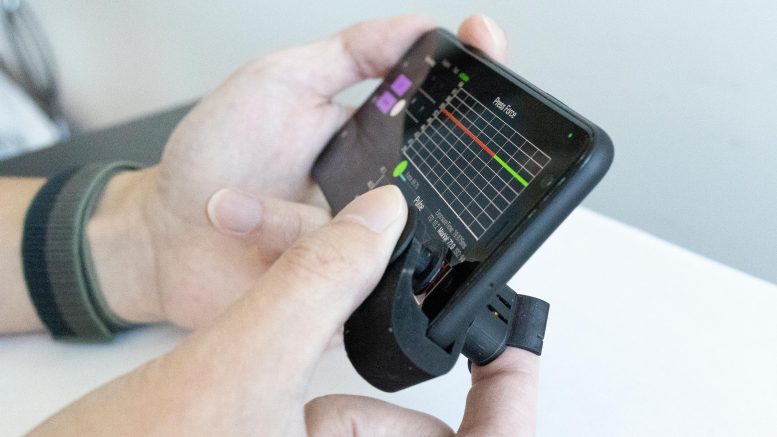
Engineers have developed a low-cost, user-friendly clip and smartphone app for blood pressure monitoring. The clip, which costs less than a dollar to produce, works without needing calibration and offers an affordable alternative to traditional blood pressure monitoring methods. The technology, already showing comparable results to blood pressure cuffs in early tests, is set to be commercialized by Billion Labs Inc.
Engineers at the University of California San Diego (UCSD) have developed a simple, low-cost clip that uses a smartphone’s camera and flash to monitor blood pressure at the user’s fingertip. The clip works with a custom smartphone app and currently costs about 80 cents to make. The researchers estimate that the cost could be as low as 10 cents apiece when manufactured at scale.
The technology was published today (May 29) in the journal Scientific Reports.
Researchers say it could help make regular blood pressure monitoring easy, affordable and accessible to people in resource-poor communities. It could benefit older adults and pregnant women, for example, in managing conditions such as hypertension.
“We’ve created an inexpensive solution to lower the barrier to blood pressure monitoring,” said study first author Yinan (Tom) Xuan, an electrical and computer engineering Ph.D. student at UC San Diego.
“Because of their low cost, these clips could be handed out to anyone who needs them but cannot go to a clinic regularly,” said study senior author Edward Wang, a professor of electrical and computer engineering at UC San Diego and director of the Digital Health Lab. “A blood pressure monitoring clip could be given to you at your checkup, much like how you get a pack of floss and toothbrush at your dental visit.”
Another key advantage of the clip is that it does not need to be calibrated to a cuff.
“This is what distinguishes our device from other blood pressure monitors,” said Wang. Other cuffless systems being developed for smartwatches and smartphones, he explained, require obtaining a separate set of measurements with a cuff so that their models can be tuned to fit these measurements.
“Our is a calibration-free system, meaning you can just use our device without touching another blood pressure monitor to get a trustworthy blood pressure reading.”
How the Clip Works
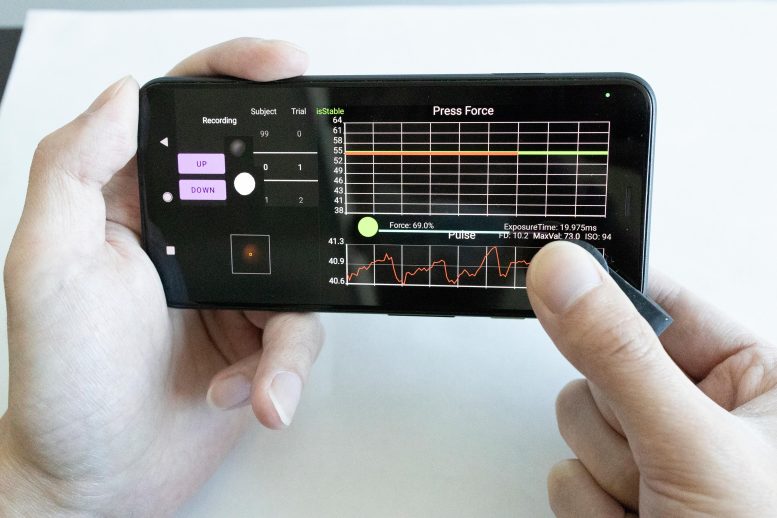
To measure blood pressure, the user simply presses on the clip with a fingertip. A custom smartphone app guides the user on how hard and long to press during the measurement.
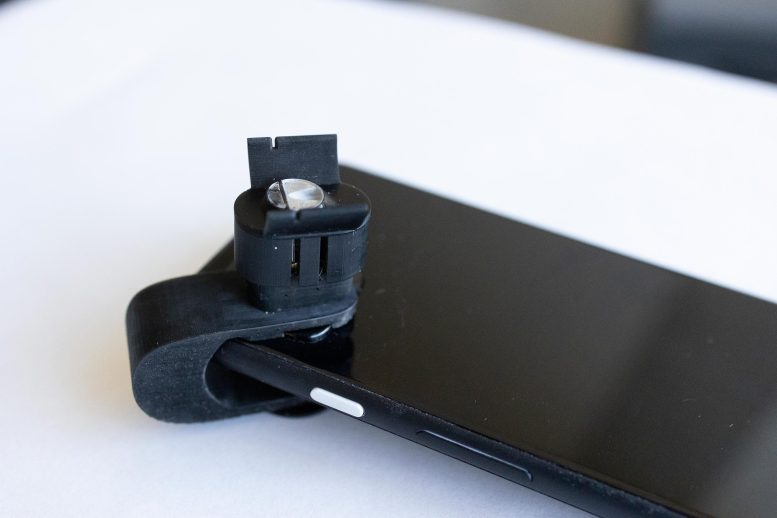
The clip is a 3D-printed plastic attachment that fits over a smartphone’s camera and flash. It features an optical design similar to that of a pinhole camera. When the user presses on the clip, the smartphone’s flash lights up the fingertip. That light is then projected through a pinhole-sized channel to the camera as an image of a red circle. A spring inside the clip allows the user to press with different levels of force. The harder the user presses, the bigger the red circle appears on the camera.
The smartphone app extracts two main pieces of information from the red circle. By looking at the size of the circle, the app can measure the amount of pressure that the user’s fingertip applies. And by looking at the brightness of the circle, the app can measure the volume of blood going in and out of the fingertip. An algorithm converts this information into systolic and diastolic blood pressure readings.
The researchers tested the clip on 24 volunteers from the UC San Diego Medical Center. Results were comparable to those taken by a blood pressure cuff.
“Using a standard blood pressure cuff can be awkward to put on correctly, and this solution has the potential to make it easier for older adults to self-monitor blood pressure,” said study co-author and medical collaborator Alison Moore, chief of the Division of Geriatrics in the Department of Medicine at UC San Diego School of Medicine.
While the team has only proven the solution on a single smartphone model, the clip’s current design theoretically should work on other phone models, said Xuan.
Wang and one of his lab members, Colin Barry, a co-author on the paper who is an electrical and computer engineering student at UC San Diego, co-founded a company, Billion Labs Inc., to refine and commercialize the technology.
Next steps include making the technology more user-friendly, especially for older adults; testing its accuracy across different skin tones; and creating a more universal design.
Reference: “Ultra-low-cost Mechanical Smartphone Attachment for No-Calibration Blood Pressure Measurement” by Yinan Xuan, Colin Barry, Jessica De Souza, Jessica H. Wen, Nick Antipa, Alison A. Moore and Edward J. Wang, 29 May 2023, Scientific Reports.
DOI: 10.1038/s41598-023-34431-1
Co-authors include Jessica De Souza, Jessica Wen and Nick Antipa, all at UC San Diego.
This work is supported by the National Institute of Aging Massachusetts AI and Technology Center for Connected Care in Aging and Alzheimer’s Disease (MassAITC P30AG073107 Subaward 23-016677 N 00), the Altman Clinical and Translational Research Institute Galvanizing Engineering in Medicine (GEM) Awards, and a Google Research Scholar Award.
Disclosures: Edward Wang and Colin Barry are co-founders of and have a financial interest in Billion Labs Inc. Wang is also the CEO of Billion Labs Inc. The other authors declare that they have no competing interests. The terms of this arrangement have been reviewed and approved by the University of California San Diego in accordance with its conflict-of-interest policies.
Never miss a breakthrough: Join the SciTechDaily newsletter.
Follow us on Google and Google News.