
Close Menu
    Facebook X (Twitter) Instagram
    SciTechDaily
    • Biology
    • Chemistry
    • Earth
    • Health
    • Physics
    • Science
    • Space
    • Technology
    Facebook X (Twitter) Pinterest YouTube RSS
    SciTechDaily
    Home»Biology»Blood-Sucking Parasites Could Revolutionize Treatment for Autoimmune Diseases
    Biology

    Blood-Sucking Parasites Could Revolutionize Treatment for Autoimmune Diseases

    By Monash UniversityApril 2, 20268 Comments3 Mins Read
    Facebook Twitter Pinterest Telegram LinkedIn WhatsApp Email Reddit
    Share
    Facebook Twitter LinkedIn Pinterest Telegram Email Reddit
    Lyme Disease Tick on Skin
    Ticks can suppress immune detection by interfering with chemokine signaling, a process now better understood through the discovery of a broadly acting evasin. Credit: Stock

    A tick protein that inhibits multiple immune signals could lead to better treatments for autoimmune diseases and inflammation.

    The body’s immune system relies on rapid communication to fight threats. When harmful microbes or foreign substances are detected, it releases chemical signals called chemokines. These act like distress beacons, guiding immune cells to the affected area so they can contain and destroy the invader.

    Ticks have evolved a way to quietly bypass this alarm system. As parasites that feed on blood, they can remain attached for long periods without being noticed. They achieve this by releasing specialized proteins known as evasins, which intercept chemokines before they can alert the immune system. By effectively silencing these signals, ticks avoid triggering inflammation and can continue feeding undetected.

    Chemokines, however, are not always beneficial. When their activity becomes excessive or poorly controlled, they can drive chronic inflammation. This process is a key factor in diseases such as rheumatoid arthritis (RA), multiple sclerosis (MS), inflammatory bowel disease, and even cancer, where persistent immune signaling can damage healthy tissue.
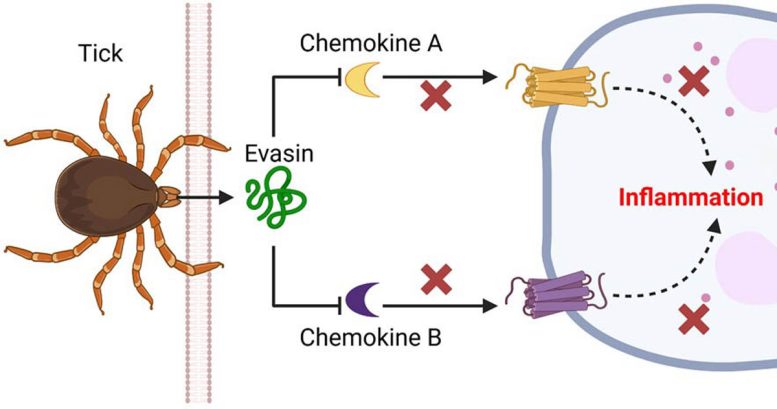
    Pathway to New Tick Evasins
    Pathway to tick evasins that may help treat inflammatory diseases. Credit: Monash University

    Researchers at the Monash University Biomedicine Discovery Institute have now identified a tick-derived evasin that can bind to two major groups of chemokines. This finding is significant for developing new treatments for inflammatory and autoimmune diseases. Previously, known evasins could only target one chemokine group at a time.

    Breakthrough for Autoimmune and Inflammatory Disease Treatment

    The study, published in the journal Structure and led by Professor Martin Stone and Dr. Ram Bhusal, highlights the therapeutic potential of this broad-acting evasin. Because it can target multiple chemokine types, it may offer a new way to treat autoimmune and inflammatory conditions, as well as cancer.

    According to co-first authors Mr. Kunwar and Dr. Devkota, scientists had believed that ticks suppressed immune responses by releasing a mix of evasins, each aimed at a different chemokine group. “However, in this study, we have identified a naturally occurring evasin that can inhibit both major classes of chemokines,” Mr. Kunwar said. “This is a novel finding and represents a significant advance in the field.”

    Professor Martin Stone and Dr Ram Bhusal
    Professor Martin Stone and Dr. Ram Bhusal, co-lead authors on the study published in Structure. Credit: Monash University

    Dr. Devkota added, “The discovery opens up new opportunities to develop therapies that target chemokines driving inflammatory diseases such as RA and MS. While treatments are available, there remains a significant need for therapies that more effectively prevent disease progression.”

    Reference: “Discovery of an evolutionarily distinct evasin with dual CC and CXC chemokine inhibitory activity” by Surendra Kunwar, Shankar Raj Devkota, Caroline Ang, Pramod Aryal, Wenrui Gai, Rina Pokhrel, Sean S. So, Wanting Jiao, Richard J. Payne, Remy Robert, Martin J. Stone and Ram Prasad Bhusal, 26 February 2026, Structure.
    DOI: 10.1016/j.str.2026.02.001

    Never miss a breakthrough: Join the SciTechDaily newsletter.
    Follow us on Google and Google News.

    Disease Immunology Inflammation Molecular Biology Monash University Ticks
    Share. Facebook Twitter Pinterest LinkedIn Email Reddit

    Related Articles

    Researchers Identify a Protein That Blocks HIV

    Study Shows that Vorinostat can Dislodge the Dormant HIV Virus in Patients

    New Design Makes Previously Inaccessible Proteins Vulnerable to Drugs

    Genetic Cause of Glioblastoma Pinpointed

    Molecular and Statistical Tools Analyze Complex Differences Between Genomes

    Increasing Th17 Cells in the Gut May Improve the Control of HIV Growth

    A2A Adenosine Receptor May Be a Key to Multiple Sclerosis Treatment

    A Step Towards Understanding the Cellular Basis for Age-Related Vulnerability to Breast Cancer

    Viruses Attack Mitochondria to Travel and Spread Within the Nervous System

    8 Comments

    1. kamir bouchareb st on April 3, 2026 7:33 am

      what is this

      Reply
    2. Tina on April 4, 2026 3:47 am

      This is a very interesting search.
      Has it be tested on humans.

      Reply
    3. Dr tk ss on April 6, 2026 8:57 pm

      Excellent work. The knowledge is helpful and has High potential in therapeutic application.

      Reply
    4. Shawana on April 7, 2026 2:19 pm

      I diagnosed primary Sjogren syndrome I am scared if is go secondary how I manage pain

      Reply
    5. Skyler on April 7, 2026 10:00 pm

      ILD/ Lung Fibrosis inflammation as well can be treated ??

      Reply
    6. Anne Howard on April 8, 2026 3:42 am

      People who have had Lyme Disease undiagnosed and untreated for decades have immune systems altered by tick protein and more.
      Research needs to be done for their treatment. Many have developed autoimmune diseases too. Funding should follow this ongoing critical need.

      Reply
    7. Anne Howard on April 8, 2026 3:44 am

      People who have had Lyme Disease undiagnosed and untreated for decades have immune systems altered by tick protein and more.
      Research needs to be done for their treatment. Many have developed autoimmune diseases too. Funding should follow this ongoing critical need.
      * Being blocked as a ‘duplicate comment’ …never posted before.

      Reply
      • Pamela on May 10, 2026 1:26 pm

        It would be great if there was a cure for Crohn’s disease

        Reply
    Leave A Reply Cancel Reply

    • Facebook
    • Twitter
    • Pinterest
    • YouTube

    Don't Miss a Discovery

    Subscribe for the Latest in Science & Tech!

    Trending News

    Scientists Say This Simple Supplement May Actually Reverse Heart Disease

    Warming Oceans Could Trigger a Dangerous Methane Surge

    This Simple Movement Could Be Secretly Cleaning Your Brain

    Male Birth Control Breakthrough: Scientists Find Way To Turn Sperm Production Off and Back On

    A Common Vitamin Could Hold the Key to Treating Fatty Liver Disease

    New Research Shows Vitamin B12 May Hold the Key to Healthy Aging

    These Simple Daily Habits Can Quickly Improve Blood Pressure and Heart Risk Factors

    A Common Nutrient May Play a Surprising Role in Anxiety

    Follow SciTechDaily
    • Facebook
    • Twitter
    • YouTube
    • Pinterest
    • Newsletter
    • RSS
    SciTech News
    • Biology News
    • Chemistry News
    • Earth News
    • Health News
    • Physics News
    • Science News
    • Space News
    • Technology News
    Recent Posts
    • Scientists May Have Discovered How Parkinson’s Disease Spreads Through the Brain
    • A Simple Blood Test Could Predict Your Odds of Living Longer With Surprising Accuracy
    • Scientists Unveil New Treatment Strategy That Could Outsmart Cancer
    • Why Some Brains Switch Gears Faster Than Others
    • Beavers Turn Rivers Into Powerful Carbon Sinks, Study Finds
    Copyright © 1998 - 2026 SciTechDaily. All Rights Reserved.
    • Science News
    • About
    • Contact
    • Editorial Board
    • Privacy Policy
    • Terms of Use

    Type above and press Enter to search. Press Esc to cancel.