
Close Menu
    Facebook X (Twitter) Instagram
    SciTechDaily
    • Biology
    • Chemistry
    • Earth
    • Health
    • Physics
    • Science
    • Space
    • Technology
    Facebook X (Twitter) Pinterest YouTube RSS
    SciTechDaily
    Home»Physics»Breaking Limits: How “Living” Electrodes Are Revolutionizing High-Speed Electronics
    Physics

    Breaking Limits: How “Living” Electrodes Are Revolutionizing High-Speed Electronics

    By Osaka UniversityFebruary 11, 20251 Comment3 Mins Read
    Facebook Twitter Pinterest Telegram LinkedIn WhatsApp Email Reddit
    Share
    Facebook Twitter LinkedIn Pinterest Telegram Email Reddit
    Advanced Microelectronics Art
    Researchers at Osaka University have developed a method to enhance high-speed electronic devices by using a VO2-based metamaterial that dynamically adjusts its properties through temperature control. This innovation improves the performance of silicon photodetectors by increasing their sensitivity to terahertz light.

    Researchers from SANKEN (The Institute of Scientific and Industrial Research) at Osaka University have discovered that temperature-controlled conductive networks in vanadium dioxide significantly improve the sensitivity of silicon devices to terahertz light.

    High-speed, low-power electronic devices are essential for wireless communication. Traditionally, increasing speed has involved shrinking device size, but as miniaturization progresses, fabrication becomes increasingly complex. Have we hit a technological limit?

    Not yet! Researchers at Osaka University are pursuing an alternative approach: enhancing device performance by integrating a patterned metal layer—known as a structural metamaterial—onto a conventional substrate like silicon. This technique accelerates electron flow, offering significant potential. However, a key challenge remains: ensuring precise control over the metamaterial’s structure to allow for real-time adjustments based on practical operating conditions.

    Vanadium Dioxide: A Solution for Dynamic Control

    In search of a solution, the research team examined vanadium dioxide (VO2). When heated appropriately, small areas in a VO2 layer transform from insulating to metallic. These metallic regions can carry charge, thus behaving as tiny dynamic electrodes. The researchers exploited this behavior to produce ‘living’ microelectrodes that selectively enhanced the response of silicon photodetectors to terahertz light.
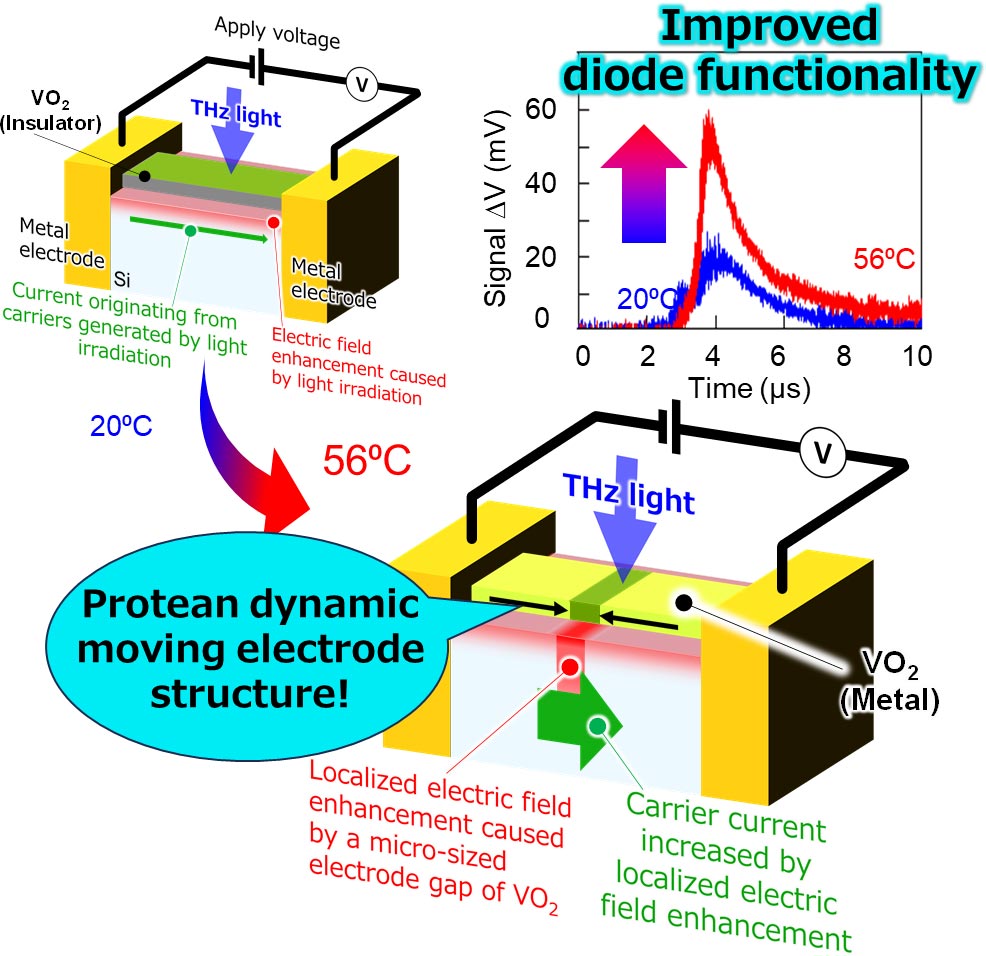
    A Diode Containing a ‘Living’ Electrode With a Dynamic Structure
    Overview of this study: a diode containing a ‘living’ electrode with a dynamic structure, which can be controlled with sub-micrometer precision through temperature regulation, was fabricated on a silicon substrate. The diode demonstrated enhanced performance as a terahertz light detector. Credit: Ai I. Osaka

    “We produced a terahertz photodetector containing VO2 as a metamaterial,” explains lead author Ai Osaka. “A precise processing method was used to fabricate a high-quality VO2 layer on a silicon substrate. The size of the metallic domains in the VO2 layer, tens of times larger than what has been conventionally achieved, was controlled through temperature regulation, which in turn modulated the response of the silicon substrate to terahertz light.”

    Enhancing Terahertz Light Sensitivity

    When the temperature was suitably regulated, the metallic domains in the VO2 formed a conductive network that controlled the localized electric field in the silicon layer, increasing its sensitivity to terahertz light.

    “Heating the photodetector to 56°C led to strong signal enhancement,” adds senior author Azusa Hattori. “We attributed this enhancement to effective coupling between the silicon layer and a dynamic conductive VO2 microelectrode network at this temperature. That is, the temperature-controlled structure of the VO2 metamaterial regulated electric field enhancement and thus impact ionization in silicon.”

    The temperature-regulated behavior of the ‘living’ VO2 metallic regions enhanced the response of silicon to terahertz light. These results illustrate the potential of metamaterials to spur the development of advanced electronics that overcome the limitations of traditional materials to meet speed and efficiency requirements.

    Reference: “Si–VO2 Hybrid Materials with Tunable Networks of Submicrometer Metallic VO2 Domains Provide Enhanced Diode Functionality” by Ai I. Osaka, Masaya Nagai, Shingo Genchi, Boyuan Yu, Rui Li, Hui Ren, Hiroki Momono, Goro Isoyama, Hidekazu Tanaka and Azusa N. Hattori, 25 January 2025, ACS Applied Electronic Materials.
    DOI: 10.1021/acsaelm.4c01914

    Funding: Japan Society for the Promotion of Science, Ministry of Education, Culture, Sports, Science and Technology, Academic Research Grant Project of Hyogo Science and Technology Association

    Never miss a breakthrough: Join the SciTechDaily newsletter.
    Follow us on Google and Google News.

    Metamaterials Nanotechnology Optoelectronics Photodetectors Silicon University of Osaka
    Share. Facebook Twitter Pinterest LinkedIn Email Reddit

    Related Articles

    Scientists Unlock New Way To Control Exotic Light Waves in 2D Materials

    One Tiny Structure Just Broke a Fundamental Rule of Optics

    Quantum Dots Rebuilt by Light in a Trillionth of a Second

    Color-Changing Magnifying Glass Gives Clear View of Invisible Infrared Light

    Generating Megatesla Magnetic Fields on Earth Using Intense-Laser-Driven Microtube Implosions

    Physicists Use Silicon Nanoblades to Harvest Energy From Waste Heat

    Cathodoluminescence Used to Probe Metamaterials

    Electron-Cloaking Material May Enable More Efficient Transfer of Electrons

    New Nanofabrication Process for Metamaterials

    1 Comment

    1. Bao-hua ZHANG on February 11, 2025 11:31 pm

      The researchers attributed this enhancement to effective coupling between the silicon layer and a dynamic conductive VO2 microelectrode network at this temperature.
      VERY GOOD.

      If the researchers are interested, you can browse The Spin-orbit Coupling In Topological Vortex Theory (TVT): https://scitechdaily.com/microscope-spacecrafts-most-precise-test-of-key-component-of-the-theory-of-general-relativity/#comment-873858.

      Materials science never ends. Scientific research guided by correct theories can enable researchers to think more.

      Reply
    Leave A Reply Cancel Reply

    • Facebook
    • Twitter
    • Pinterest
    • YouTube

    Don't Miss a Discovery

    Subscribe for the Latest in Science & Tech!

    Trending News

    Bone-Strengthening Discovery Could Reverse Osteoporosis

    Scientists Uncover Hidden Trigger Behind Stem Cell Aging

    Scientists Find Way to Reverse Fatty Liver Disease Without Changing Diet

    Could Humans Regrow Limbs? New Study Reveals Promising Genetic Pathway

    Scientists Reveal Eating Fruits and Vegetables May Increase Your Risk of Lung Cancer

    Scientists Reverse Brain Aging With Simple Nasal Spray

    Scientists Uncover Potential Brain Risks of Popular Fish Oil Supplements

    Scientists Discover a Surprising Way To Make Bread Healthier and More Nutritious

    Follow SciTechDaily
    • Facebook
    • Twitter
    • YouTube
    • Pinterest
    • Newsletter
    • RSS
    SciTech News
    • Biology News
    • Chemistry News
    • Earth News
    • Health News
    • Physics News
    • Science News
    • Space News
    • Technology News
    Recent Posts
    • Alzheimer’s Symptoms May Start Outside the Brain, Study Finds
    • Cancer’s Secret Weapon? Scientists Reveal How Tumors “Learn” To Survive Treatment
    • Millions Take This Popular Supplement – Scientists Discover a Concerning Link to Heart Failure
    • What Makes Rubber So Strong? Scientists Finally Solve 100-Year-Old Mystery
    • Scientists Decode Mysterious Magnetic “Maze Domains” To Boost EV Efficiency
    Copyright © 1998 - 2026 SciTechDaily. All Rights Reserved.
    • Science News
    • About
    • Contact
    • Editorial Board
    • Privacy Policy
    • Terms of Use

    Type above and press Enter to search. Press Esc to cancel.