
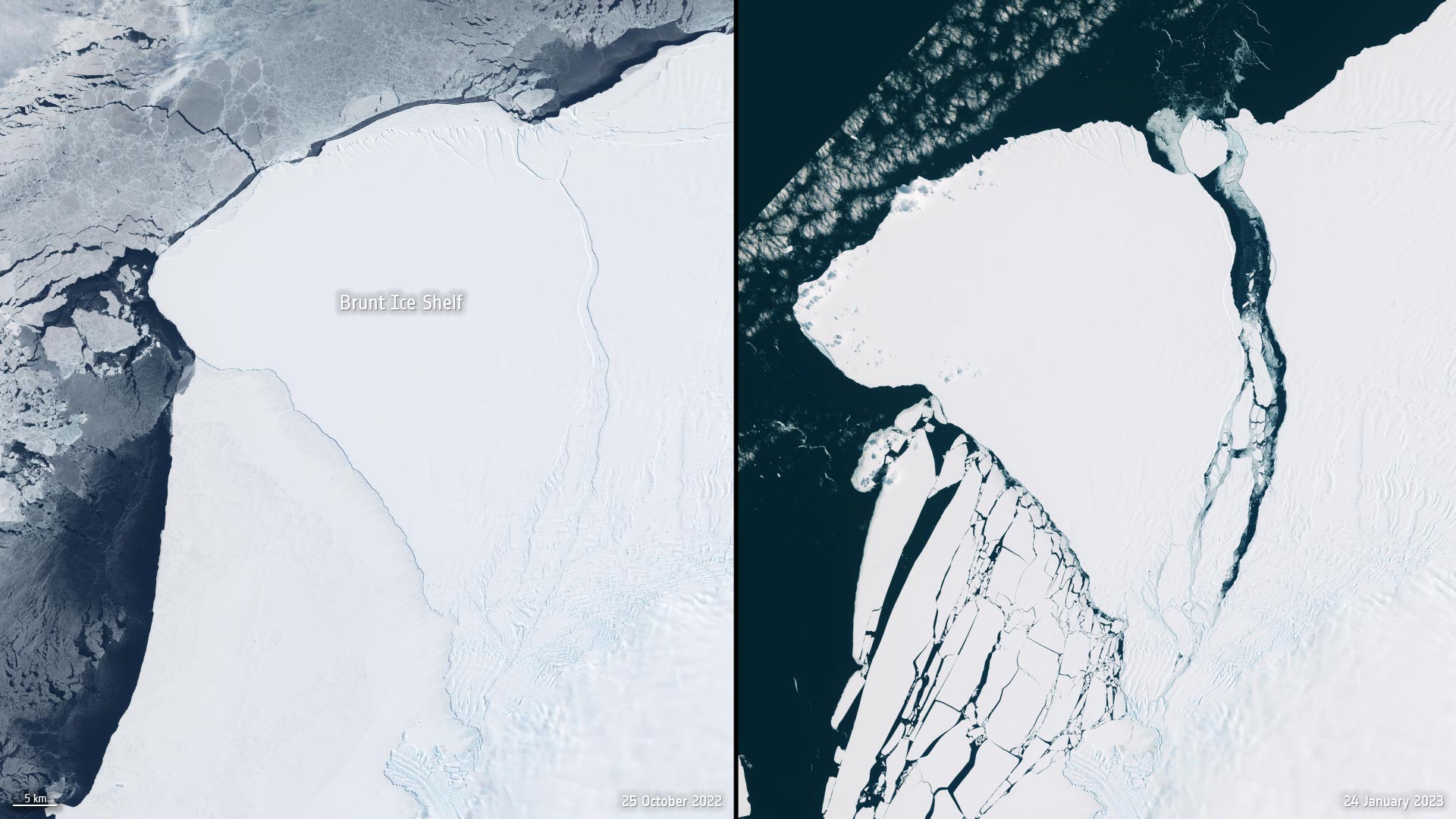
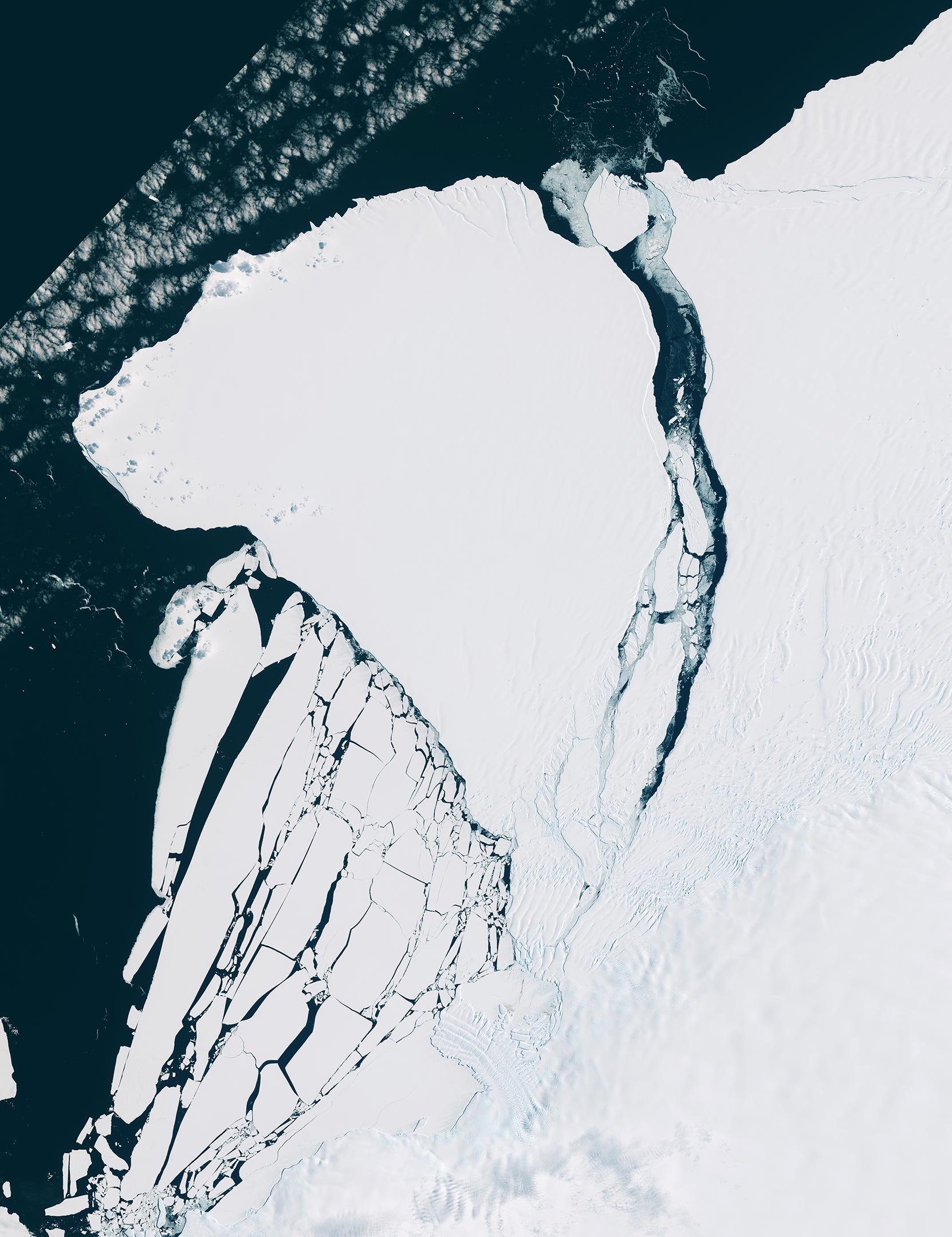
Satellite imagery confirms a gigantic iceberg, around five times the size of Malta, has finally calved from Antarctica’s Brunt Ice Shelf. The new berg, estimated to be around 1550 sq km (600 sq miles) and around 150 m (500 feet) thick, calved when the crack known as Chasm-1 fully extended northwards severing the west part of the ice shelf. This enormous size makes it over 12 times the area of the city of San Francisco, California, which is 121 sq km (47 sq miles).
This crack was first revealed to be extending in early 2012 after having been dormant for some decades. After several years of desperately clinging on, image data from the Copernicus Sentinel missions visually confirm the calving event.
The timing of the calving event, although unexpected, had long been anticipated. Glaciologists have monitored the many cracks and chasms that have formed in the thick Brunt Ice Shelf, which borders the Coats Land coast in the Weddell Sea sector of Antarctica, for years. It was only a matter of time that Chasm 1, which had been dormant for decades, would meet with the Halloween Crack, first spotted on Halloween 2016.
An iceberg around the size of Greater London broke off Antarctica’s Brunt Ice Shelf due to a natural process called ‘calving’. The iceberg, measuring 1550 sq km, detached from the 150 m-thick ice shelf a decade after scientists first spotted massive cracks in the shelf. Credit: ESA – European Space Agency
The new iceberg is anticipated to be named A-81 with the smaller piece to the north likely identified as either A-81A or A-82. Icebergs are traditionally identified by a capital letter indicating the Antarctic quadrant in which they were originally sighted, followed by a sequential number, then, if the iceberg breaks into smaller pieces, a sequential letter suffix.
The split was first reported by the British Antarctic Survey (BAS) as having occurred on January 22 between 19:00 and 20:00 UTC during a spring tide. BAS’s Halley VI Research Station, where glaciologists have been monitoring the behavior of the ice shelf, has remained unaffected by the calving event.
The research station was relocated in 2017 to a more secure location after the ice shelf was deemed unsafe. The station is currently around 20 km from the line of rupture and there are currently 21 staff working on the station to maintain power supplies and facilities that keep the scientific experiences operating throughout winter.
ESA’s Mark Drinkwater said, “After several years of iceberg calving watch, the long-awaited separation of the Brunt iceberg A-81 has finally taken place. The northward propagation of Chasm 1 and timely decision for BAS to move the Halley Base to safer ground have been accompanied by what has been perhaps the most detailed and longest-duration scrutiny of events leading to natural calving from an Antarctic ice shelf.
“Thanks to Copernicus, coupled with in-situ and airborne measurements made by the British Antarctic Survey, the safety of the Halley Base has been preserved. Meanwhile, the combination of summer images from Sentinel-2 and availability of year-round and winter monitoring by Sentinel-1 radar placed the pattern of strain and propagation of an ice shelf fracture under the worldwide public microscope.”
Dominic Hodgson, BAS glaciologist, added, “This calving event has been expected and is part of the natural behavior of the Brunt Ice Shelf. It is not linked to climate change. Our science and operational teams continue to monitor the ice shelf in real-time to ensure it is safe, and to maintain the delivery of the science we undertake at Halley.”
Using radar images from the Copernicus Sentinel-1 mission, the animation shows the A81 iceberg breaking away from the Brunt Ice Shelf on January 25, 2023. The new berg is estimated to be around 1550 sq km, which is around the size of Greater London, and is approximately 150 m thick. It calved when the crack known as Chasm-1 split northwards severing the west part of the ice shelf. The white square indicated the final breakpoint near the McDonald Ice Rumples. Routine monitoring from satellites offers unparalleled views of events happening in remote regions. The Copernicus Sentinel-1 mission carries radar, which can return images regardless of day or night and this allows us year-round viewing, which is especially important through the long, dark, austral winter months.
Routine monitoring from satellites offers unparalleled views of events happening in remote regions and show how ice shelves are actively responding to changes in ice dynamics, air and ocean temperatures. In February 2021, another giant berg, around 1270 sq km (490 sq miles), broke off from the northern section of Brunt. Spotted by Sentinel-1 imagery, it has already drifted away from the Brunt Ice Shelf into the Weddell Sea.
So, what happens now?
The calving of icebergs from an ice shelf has been observed to be followed by adjustment in the flow of ice into the ice shelf. If Brunt now experiences an acceleration, it could influence the behavior of other cracks in the area.
Mark explained, “The calving of iceberg A74, and latest separation, now focuses attention back onto the Halloween crack – whose extension could contribute to further destabilization of the Brunt Ice Shelf.
“A typical accompaniment to such strain release events and removal of pinning of an ice shelf front by bottom features such as McDonald Bank which forms the McDonald Ice Rumples may be an acceleration in the velocity of ice flowing into the ice shelf. We will be using the capabilities of the Copernicus Sentinels to closely monitor the behavior and stability of the remaining Brunt Ice Shelf.”
Never miss a breakthrough: Join the SciTechDaily newsletter.
Follow us on Google and Google News.
2 Comments
come on man 12x the size of san francisco?? isnt there a better example for scale?
Jeff,
the various authors give multiple comparisons – pick 1 U like. 😊
– 5X Malta
– size of Greater London
– 2X area of NYC