

Close Menu
    Facebook X (Twitter) Instagram
    SciTechDaily
    • Biology
    • Chemistry
    • Earth
    • Health
    • Physics
    • Science
    • Space
    • Technology
    Facebook X (Twitter) Pinterest YouTube RSS
    SciTechDaily
    Home»Technology»Capturing Extra Energy From the Sun: Harnessing Hot Carriers for High Efficiency Solar Cells
    Technology

    Capturing Extra Energy From the Sun: Harnessing Hot Carriers for High Efficiency Solar Cells

    By KAUSTJanuary 12, 20201 Comment3 Mins Read
    Facebook Twitter Pinterest Telegram LinkedIn WhatsApp Email Reddit
    Share
    Facebook Twitter LinkedIn Pinterest Telegram Email Reddit

    Solar Panels Sky Reflection

    Materials that can slow the cooling of highly energetic hot carriers could capture extra energy from the Sun.

    Two-dimensional solar materials may offer a way to extract more energy from sunlight. By tuning the structure of a 2D perovskite solar material, researchers from KAUST and the Georgia Institute of Technology have shown they can prolong the lifetime of highly energetic hot carriers generated by light striking the material. The approach could offer a way to capture solar energy more efficiently.

    Hybrid organic-inorganic perovskites are attractive solar materials because they are potentially much less expensive to produce than silicon. However, there remain questions over perovskites’ long-term stability.
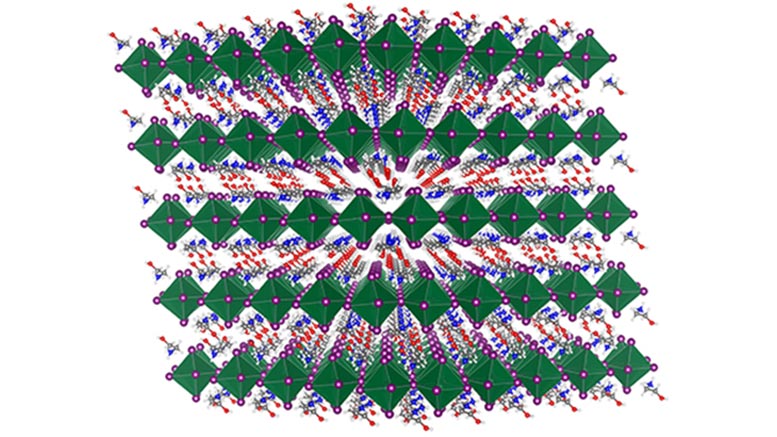
    Crystal Structure Two Dimensional Hybrid Perovskite

    Crystal structure of a two-dimensional hybrid perovskite with long hot-carrier cooling time. Credit: © 2019 Jun Yin

    “As an alternative to 3D hybrid perovskites, 2D hybrid perovskites have improved stability and moisture resistance,” says Jun Yin, a member of Omar Mohammed’s and Osman Bakr’s research groups. However, hot carrier cooling in these materials has not been extensively studied, adds Partha Maity, a postdoctoral fellow on the KAUST team.

    Hot carriers form due to the wide range of energies of sunlight, which ranges from low-energy infrared and red light at one end of the spectrum, to violet and ultraviolet at the high-energy end. Solar panels capture energy when incoming light bumps an electron into an excited state, but even red light can excite an electron into a conductive band. Higher energy light can generate super-excited hot carriers, but they shed their extra energy much faster than conventional solar materials can capture them.

    Mohammed and the team examined whether changing the organic component of hybrid 2D perovskites could slow hot carrier cooling, enabling all their energy to be captured.

    Using ultrafast laser spectroscopy, they examined lead iodide perovskite materials with three different organic components: ethanolamine (EA), aminopropanol (AP) and phenylethylamine (PEA). “Ultrafast spectroscopy is a very powerful and convenient approach to directly track hot carrier relaxation,” Mohammed says. “We can follow their ultrafast dynamics in real time.”

    The team saw a significant difference between the three different materials. “We found that the (EA)2PbI4 single crystal underwent a much slower hot carrier cooling process,” Yin says. Aided by molecular dynamics simulations, the team showed that the EA-based structure suppressed a range of mechanisms by which hot carriers usually lose energy to the surrounding perovskite structure.

    “Since we learned from this study how to slow the hot carrier dynamics in 2D perovskites, we will now focus on the extraction of these carriers in a real solar cell architecture and on their possible contribution to overall conversion efficiency,” Mohammed says. The team will also examine hot carrier dynamics and extraction in 2D perovskites with different compositions, he adds.

    Reference: “Tuning Hot Carrier Cooling Dynamics by Dielectric Confinement in Two-Dimensional Hybrid Perovskite Crystals” by Jun Yin, Partha Maity, Rounak Naphade, Bin Cheng, Jr-Hau He, Osman M. Bakr, Jean-Luc Brédas and Omar F. Mohammed, 15 October 2019, ACS Nano.
    DOI: 10.1021/acsnano.9b04085

    Never miss a breakthrough: Join the SciTechDaily newsletter.
    Follow us on Google and Google News.

    2D Materials Green Energy KAUST Perovskite Solar Cell Solar Cells
    Share. Facebook Twitter Pinterest LinkedIn Email Reddit

    Related Articles

    World Record: Perovskite/Silicon Tandem Solar Cells on the Magic Threshold of 30% Efficiency

    Highly Efficient Eco-Friendly Perovskite Solar Cells With Enhanced Stability

    Next-Gen Solar Tech With the Stability and Efficiency to Transform the Solar Energy Industry

    Precision Spray Coating Could Enable Solar Cells With Better Stability and Performance

    Cheap Renewable Energy a Step Closer As Next-Generation Solar Cells Pass Strict International Tests

    Breakthrough Self-Assembly Innovation Enables Cheaper Solar Energy Production

    New Efficiency Record Set by Novel Multi-Material Solar Cells

    Scientists Make High-Performance Hybrid Perovskite Solar Cells Safer

    Important Breakthrough in Perovskite Solar Cells

    1 Comment

    1. John-Paul on January 12, 2020 2:50 pm

      Sticks in keyfob taps button. leaves after getting money.

      Reply
    Leave A Reply Cancel Reply

    • Facebook
    • Twitter
    • Pinterest
    • YouTube

    Don't Miss a Discovery

    Subscribe for the Latest in Science & Tech!

    Trending News

    Bone-Strengthening Discovery Could Reverse Osteoporosis

    Scientists Uncover Hidden Trigger Behind Stem Cell Aging

    Scientists Find Way to Reverse Fatty Liver Disease Without Changing Diet

    Could Humans Regrow Limbs? New Study Reveals Promising Genetic Pathway

    Scientists Reveal Eating Fruits and Vegetables May Increase Your Risk of Lung Cancer

    Scientists Reverse Brain Aging With Simple Nasal Spray

    Scientists Uncover Potential Brain Risks of Popular Fish Oil Supplements

    Scientists Discover a Surprising Way To Make Bread Healthier and More Nutritious

    Follow SciTechDaily
    • Facebook
    • Twitter
    • YouTube
    • Pinterest
    • Newsletter
    • RSS
    SciTech News
    • Biology News
    • Chemistry News
    • Earth News
    • Health News
    • Physics News
    • Science News
    • Space News
    • Technology News
    Recent Posts
    • Wind Farms Are Disrupting Ocean Currents, Moving Millions of Tons of Mud Each Year
    • Scientists Discover Massive Magma Reservoir Beneath Tuscany
    • Scientists Create “Neurobots” – Living Machines With Their Own Nervous Systems
    • Europe’s Most Active Volcano Just Got Stranger – Here’s Why Scientists Are Rethinking It
    • Why Are Giant Ants Letting Tiny Ants Crawl All Over Them?
    Copyright © 1998 - 2026 SciTechDaily. All Rights Reserved.
    • Science News
    • About
    • Contact
    • Editorial Board
    • Privacy Policy
    • Terms of Use

    Type above and press Enter to search. Press Esc to cancel.