

A dramatic reduction in sulfur pollution from shipping has unintentionally contributed to recent global warming, offering a real-world experiment in marine cloud brightening — one of the leading geoengineering ideas.
The 2020 shipping regulations cut sulfate emissions, improving air quality but also reducing cloud reflectivity, allowing more heat to reach the ocean. Scientists struggled to measure the exact warming impact due to cloud variability, but by applying AI, NOAA researchers successfully identified a modest warming effect from fewer ship-induced clouds.
Sulfur Pollution and Climate Impact
A global effort to reduce sulfur pollution from shipping has unintentionally contributed to recent warming on Earth, offering new insights into the complexities of assessing solar geoengineering strategies, such as marine cloud brightening.
In 2020, the International Maritime Organization (IMO) implemented strict regulations to lower sulfur levels in ship fuel. These changes aimed to reduce emissions of sulfate aerosols and sulfur dioxide — pollutants linked to serious health issues like asthma, lung cancer, and cardiovascular diseases — and to improve air quality in coastal and port areas.
While the cleaner fuels have improved air quality, they have also reduced the reflectivity of low-level marine clouds. Previously, aerosol particles from ship exhaust brightened these clouds, enhancing their ability to reflect sunlight and cool the ocean below. With less sulfur pollution, this cooling effect has diminished, allowing more sunlight to warm the ocean surface.
The Challenge of Measuring Cloud Influence
Soon, observers noticed a decrease in “ship tracks,” those distinct, bright white, linear clouds that form in the trail of large ships, allowing more sunlight to heat the ocean surface. But quantifying the warming effect of increased sunshine on the ocean surface using conventional climate models has proven challenging because they simply can’t represent clouds well enough.
“Clouds are one of the most ephemeral natural phenomena, changing all the time as they drift through the sky,” said Graham Feingold, a program leader at the NOAA Chemical Sciences Laboratory and coauthor of the current study. “How do you design an experiment to understand their impact on the temperature of Earth’s surface below?”
Harnessing AI to Understand Cloud Changes
NOAA scientists tried a new approach that harnessed the powerful pattern-recognition capabilities of artificial intelligence (AI) and machine learning to capture and reproduce the complex physical and chemical processes that control cloud formation and unmask the true climate impact that these ship-induced, sunlight-reflecting clouds once had.
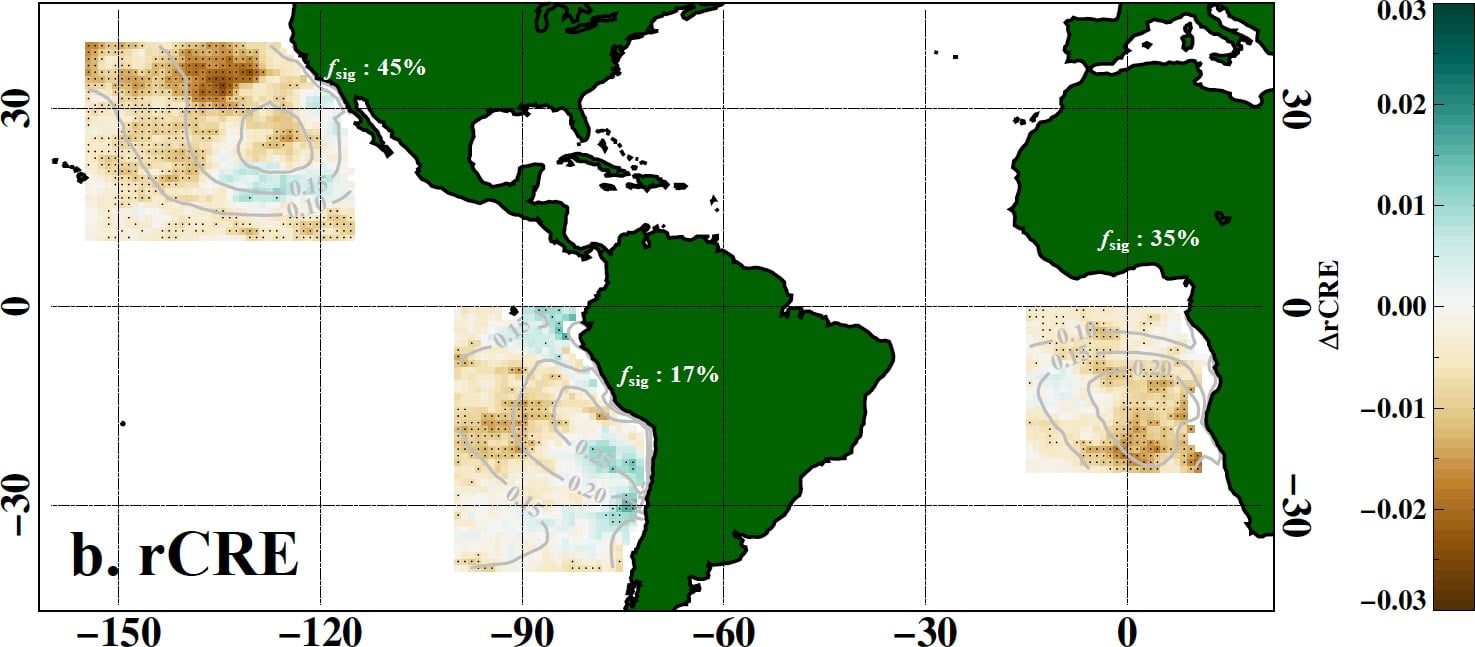
In a new study published in the Nature journal Communications Earth & Environment, the researchers report a modest global warming effect attributable to the reduction in reflective ship track clouds over the heavily used shipping lanes in the northeastern and southeastern Pacific and the southeastern Atlantic off the coast of Africa.
The estimate is in line with several recently published studies that point to more widespread reductions in cloud reflectivity as a possible cause of record global mean temperatures in 2023. That research identifies the decline in low-altitude clouds in the northern mid-latitudes and the tropics, particularly over the Atlantic ocean, where the most unusual temperature records were observed in 2023.
The current study is specific to the contribution of the shipping industry to reductions in stratocumulus cloud brightness.
“Just how much the IMO2020 regulations contribute to this warming compared to other factors, such as reductions in particulate matter from other sources, or global-warming induced reductions in low clouds, remains uncertain” said Jianhao Zhang, lead author of the study. Zhang is a research scientist with the University of Colorado Boulder CIRES at the NOAA CSL.
AI as a Tool for Climate Signal Detection
What’s important about this research, Zhang and his co-authors say, is the success of AI at teasing out a robust signal from very noisy and highly variable climate data.
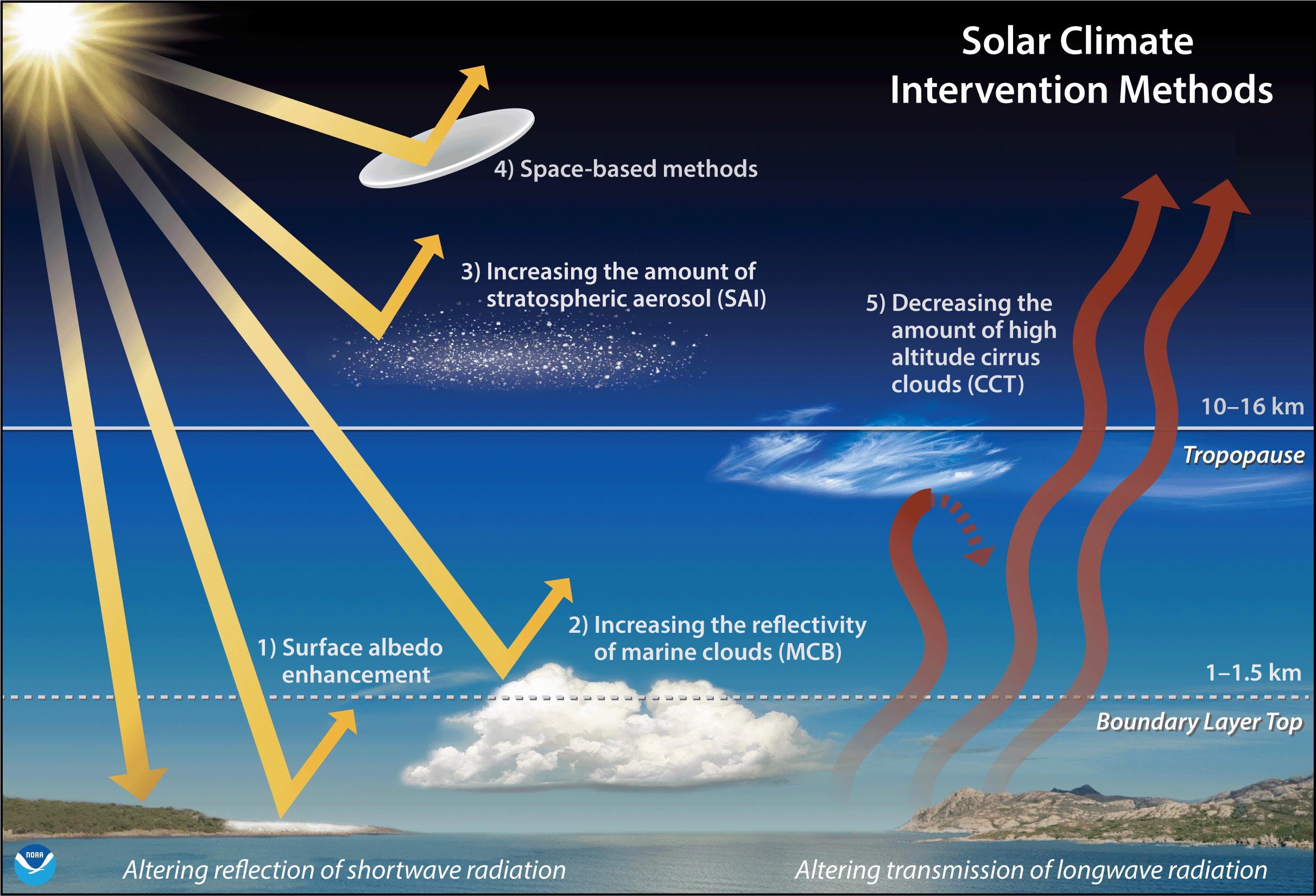
Ship tracks are the product of sulfate aerosols interacting with low-level marine clouds. These aerosols act as efficient cloud “seeds” (or cloud condensation nuclei), ramping up the available sites on which cloud droplets can form and increasing the reflectivity of the clouds along the ship’s path. This is the same mechanism underlying the concept of marine cloud brightening — a climate intervention approach that proposes to increase the reflectivity of marine clouds by spraying sea salt aerosols into the atmosphere instead of sulfate particles. For this reason, ship tracks are studied as a direct analog to MCB.
Simulating a World Without the 2020 Regulation
To estimate the cooling effect that these ship tracks used to have, an ensemble of neural networks was trained with multiple years of global cloud observations from satellites collected before 2020 over three major shipping corridors in the Pacific and Atlantic oceans where ship tracks are the most prevalent. The neural networks were then tasked with simulating the observation record beyond 2020 as if the IMO2020 regulation had never taken place, generating a “business as usual” scenario.
Comparing the AI-generated “business as usual” dataset with the real post-2020 cloud observations effectively erased the noisy background of natural variability from the data, revealing the signal of the change, Zhang said.
Long-Term Data: The Key to Clarity
The most critical part of this analysis is the many years-long data records of cloud properties used for the training and comparison datasets, collected both before and after 2020 by the MODIS (Moderate Resolution Imaging Spectroradiometer) and CERES (Clouds and Earth’s Radiant Energy System) instruments, both aboard NASA’s Terra and Aqua satellites. Without this long data record, AI would not have been able to differentiate between the ship-induced clouds and natural cloud variability.
In short, said Zhang, changes in cloud reflectivity whether intentional or due to climate change will be difficult to detect above natural variability, a finding that has direct implications for evaluating the potential of marine cloud brightening.
NOAA’s Research into Climate Interventions
NOAA is currently conducting advanced modeling, laboratory, and observational studies of the stratosphere and marine boundary layer to help fill important gaps in science’s understanding of the climate system, including research in how to effectively evaluate solar geoengineering techniques, including marine cloud brightening. NOAA is not field-testing or deploying solar radiation modification methods or techniques.
“Any outdoor test of marine cloud brightening is going to face a real challenge of detectability,” Feingold added. “This may require a much more ambitious test, in terms of size or timescale, than has generally been considered in order to demonstrate whether or not it’s viable.”
Reference: “Radiative forcing from the 2020 shipping fuel regulation is large but hard to detect” by Jianhao Zhang, Yao-Sheng Chen, Edward Gryspeerdt, Takanobu Yamaguchi and Graham Feingold, 13 January 2025, Communications Earth & Environment.
DOI: 10.1038/s43247-024-01911-9
Never miss a breakthrough: Join the SciTechDaily newsletter.
Follow us on Google and Google News.
4 Comments
Newton’s Third Law says that for every action there is an equal but opposite reaction. It seems that this law of motion has a social corollary called “unintended consequences.” Society should probably be prepared to experience such unintended consequences when purposely intervening in things that society is unhappy with.
“unintended consequences.”
That is too true to be funny. It’s why we have anthropogenic global heating…….. we never should have invented cooking with gas……..
So the solution is to add sulphur to all emissions? That’s gonna be a smelly proposition.
Goodness. It must have been very hot in the days of sailing ships!