
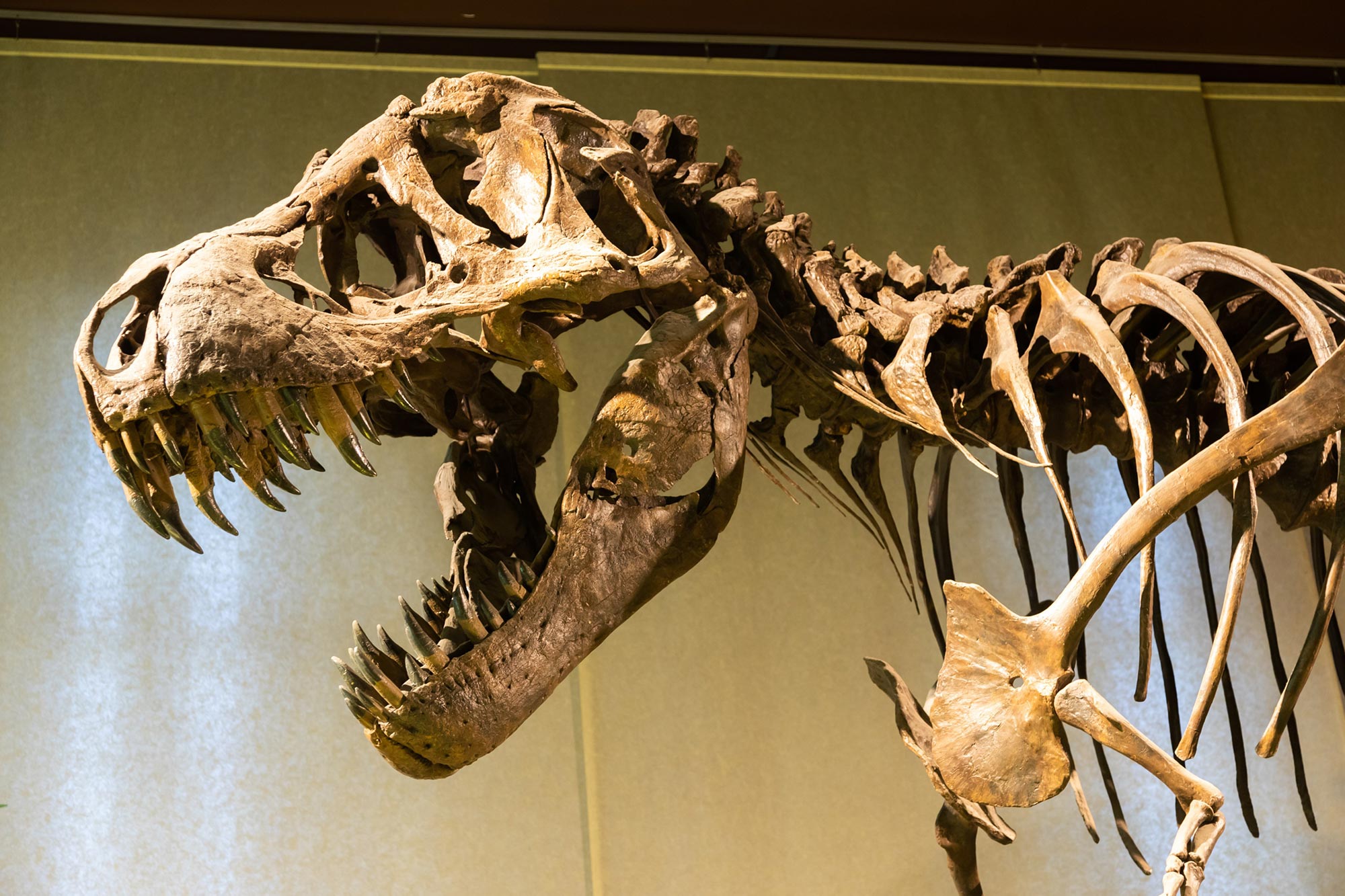
Scientists have discovered why the collagen in dinosaur skeletons has remained intact for millions of years, defying the usual 500-year lifespan of its chemical bonds.
By examining small-molecule mimics of collagen peptides, they revealed that interactions between the molecules’ acyl groups protect peptide bonds from hydrolysis by water, a finding that could inform the design of durable materials.
Dinosaurs continue to fascinate people, but that’s not their only enduring quality: Collagen in their skeletons remains intact for millions of years, despite containing chemical bonds that should only persist for about 500 years. Now, scientists report in the journal ACS Central Science that the unique tenacity of this protein may result from a molecular structure that shields these vulnerable bonds from attack by water that’s present in the environment.
Structural Secrets of Ancient Proteins
Collagen is the most abundant protein in animals. It’s found in skin and connective tissues, such as cartilage and bones. Fragments of collagen have been extracted from the bones of 68-million-year-old fossils of Tyrannosaurus rex and may have even been detected in the skeleton of a 195-million-year-old Lufengosaurus. Collagen consists of protein strands — chains of amino acids — that form triple helices.
Much like a rope, the helices in turn weave together to form a strong fibrous material. When exposed to water, the peptide bonds that connect amino acids normally break down in a process known as hydrolysis. But when peptides are incorporated in collagen, that destructive process doesn’t take place.
Various explanations have been proposed, but Ron Raines and colleagues felt those theories were missing a physical and chemical basis for the resistance of peptide bonds in collagen like that preserved in ancient dinosaur bones. The team set out to fill in the missing links.
Research Insights Into Collagen Durability
Using experimental and computational methods, the researchers examined the behavior of small-molecule mimics of collagen peptides. In particular, they studied the interactions between the molecules’ acyl groups, which each contain a carbon atom double bonded to an oxygen atom.
They found that each acyl group partially shares its electrons with a neighboring acyl group. These results suggest that such interactions protect every peptide bond in a collagen triple helix from hydrolysis, and therefore the structure is able to stay intact.
The researchers say lessons from the stability conferred by these interactions could help guide the design of other exceptionally long-lived materials.
Reference: “Pauli Exclusion by n→π* Interactions: Implications for Paleobiology” by Jinyi Yang, Volga Kojasoy, Gerard J. Porter and Ronald T. Raines, 4 September 2024, ACS Central Science.
DOI: 10.1021/acscentsci.4c00971
The authors acknowledge funding from the National Institutes of Health.
Never miss a breakthrough: Join the SciTechDaily newsletter.
Follow us on Google and Google News.
4 Comments
Logrithmic analysis still computes that there is no ability for them to survive beyond a few hundred thousand years. 2 million years is unbelievable at best.
Most studies show that 50k years is a stretch to anything living carbon being encapsulated and not breaking down on its own. Just because things have fiber and acetyle qualities cant mean they can last beyond 100k years. Suggestions aren’t accepted here. Confirmation bias is only how some one can arrive at this unless there was an atomic molecular generation stimulating the tissue itself. Evolutionary scientists now prove to be a dime a dozen if this hypothesis is followed.
Looking everywhere for what is the decay rate with the molecular armor and can’t find it. Do you have a source on that analysis?
There are holes in this idea when looking at a dating timeline. Collagen does not last vastly longer than measured peptide bond decay rates. Circular reasoning on the date of bone find, does not work. You can’t say that a bone is presumed to be 60 million years old, then state that collagen is found in that bone, so collagen must be able to last for 60 million years. The age of the bone is assumed.
It seems a lot like reaching for a solution in post to explain why a tightly held hypothesis fell flat on its face. A review of the assumptions that led to the original dating of the fossils is in order. Isn’t that normally what should happen when a hypothesis is shown by observation to be false? Wouldn’t re-examining what led to the hypothesis and any assumptions made along the way be more valuable than insisting that the assumed date must be true while grasping for any straw that might explain it? It’s not that looking for potential explanations shouldn’t be done at all. But it seems at this point that (Occam’s Razor) the simplest explanation is that the dating assumptions are wrong. So, a multi-pronged approach of researching collagen to see if it could potentially survive millions of years coupled with research on if it’s possible the fossils are younger than expected and mistakes or assumptions have led to an incorrect date seems more prudent. But insisting the dating is right, and just trying to hold on until someone comes up with an explanation that will work, seems like backwards science. (Sort of like insisting that the sun really revolves around the Earth after all, just trust us and just wait long enough for some scientists to find a sketchy reason to explain why actual observations aren’t fitting the theory.)