
Uniforms of U.S. Army soldiers must meet a long list of challenging requirements. They need to feel comfortable in all climates, be durable through multiple washings, resist fires and ward off insects, among other things. Existing fabrics don’t check all of these boxes, so scientists have come up with a novel way of creating a flame-retardant, insect-repellent fabric that uses nontoxic substances.
The researchers will present their results today (August 17, 2020) at the American Chemical Society (ACS) Fall 2020 Virtual Meeting & Expo. ACS is holding the meeting through Thursday. It features more than 6,000 presentations on a wide range of science topics.
“The Army presented to us this interesting and challenging requirement for multifunctionality,” says study leader Ramaswamy Nagarajan, Ph.D. “There are flame-resistant Army combat uniforms made of various materials that meet flame retardant requirements. But they are expensive, and there are problems with dyeing the fabrics. Also, some of the raw materials are not produced in the U.S. So, our goal was to find an existing material that we could modify to make it flame retardant and insect repellent, yet still have a fabric that a soldier would want to wear.”
Because Nagarajan’s research group focuses on sustainable green chemistry, the team sought nontoxic chemicals and processes for this study. They chose to modify a commercially available 50-50 nylon-cotton blend, a relatively inexpensive, durable, and comfortable fabric produced in the U.S. The material is used in a wide range of civilian and military applications because the nylon is strong and resistant to abrasion, whereas the cotton is comfortable to wear. But this type of textile doesn’t inherently repel bugs and is associated with a high fire risk.
“We started with making the fabric fire retardant, focusing on the cotton part of the blend,” explains Sourabh Kulkarni, a Ph.D. student who works with Nagarajan at the University of Massachusetts Lowell Center for Advanced Materials. “Cotton has a lot of hydroxyl groups (oxygen and hydrogen bonded together) on its surface, which can be activated by readily available chemicals to link with phosphorus-containing compounds that impart flame retardancy.” For their phosphorus-containing compound, they chose phytic acid, an abundant, nontoxic substance found in seeds, nuts, and grains.
Next, the researchers tackled the issue of making the material repel insects so that soldiers wouldn’t have to spray themselves repeatedly or carry an additional item in their packs. The team took permethrin, an everyday nontoxic insect repellent, and attached it to the fabric using plasma-assisted deposition in collaboration with a local company, LaunchBay. Through trial and error, the researchers eventually got both the phytic acid and permethrin to link to the fabric’s surface molecules.
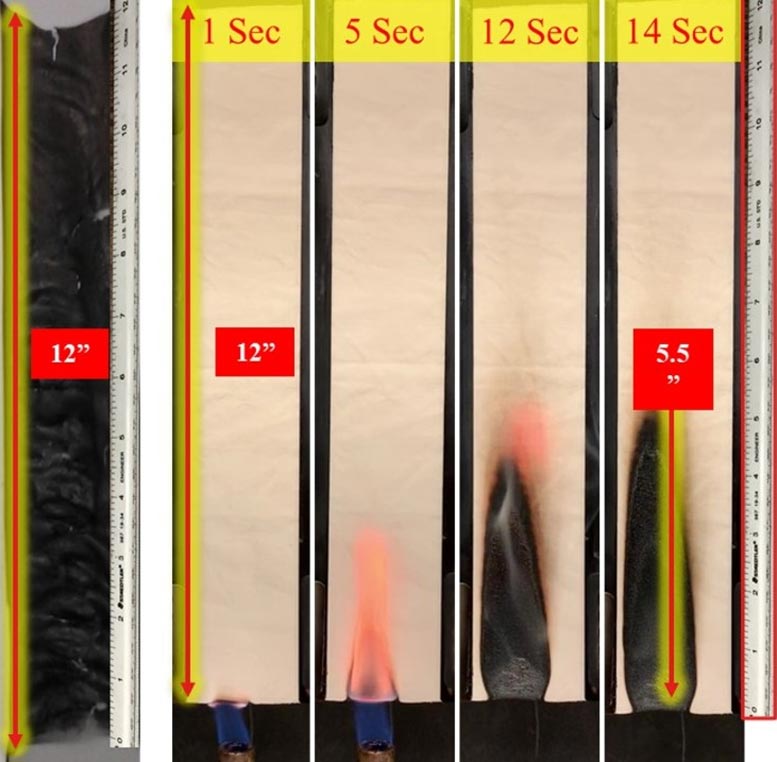
Using methods to measure heat release capacity and total heat release, as well as a vertical flame test, they found that the modified material performed at least 20% better than the untreated material. They also used a standard insect repellency test with live mosquitoes and found that the efficacy was greater than 98%. Finally, the fabric remained “breathable” after treatment as determined by air permeability studies.
“We are very excited,” Nagarajan says, “because we’ve shown we can modify this fabric to be flame retardant and insect repellent — and still be fairly durable and comfortable. We’d like to use a substance other than phytic acid that would contain more phosphorous and therefore impart a greater level of flame retardancy, better durability and still be nontoxic to a soldier’s skin. Having shown that we can modify the fabric, we would also like to see if we can attach antimicrobials to prevent infections from bacteria, as well as dyes that remain durable.”
A press conference on this topic will be held Thursday, August 20, at 12 p.m. Eastern time online.
Never miss a breakthrough: Join the SciTechDaily newsletter.
Follow us on Google and Google News.