
Melosira arctica has ten times higher concentration of plastic particles than surrounding seawater.
The alga Melosira arctica, which grows under Arctic sea ice, contains ten times as many microplastic particles as the surrounding seawater. This concentration at the base of the food web poses a threat to creatures that feed on the algae at the sea surface. Clumps of dead algae also transport the plastic with its pollutants particularly quickly into the deep sea – and can thus explain the high microplastic concentrations in the sediment there. Researchers led by the Alfred Wegener Institute have now reported this in the journal Environmental Science and Technology.
It is a food lift for bottom-dwelling animals in the deep sea: the alga Melosira arctica grows at a rapid pace under the sea ice during spring and summer months and forms metre-long cell chains there. When the cells die and the ice to whose underside they adhere melts, they stick together to form clumps that can sink several thousand metres to the bottom of the deep sea within a single day. There they form an important food source for bottom-dwelling animals and bacteria.
In addition to food, however, these aggregates also transport a dubious cargo into the Arctic deep sea: microplastics. A research team led by biologist Dr Melanie Bergmann from the Alfred Wegener Institute, Helmholtz Centre for Polar and Marine Research (AWI) has now published this in the journal Environmental Science and Technology.
Microplastics in Deep Sea Sediment
“We have finally found a plausible explanation for why we always measure the largest amounts of microplastics in the area of the ice edge, even in deep-sea sediment,” Melanie Bergmann reports. Until now, the researchers only knew from earlier measurements that microplastics concentrate in the ice during sea ice formation and are released into the surrounding water when it melts.
“The speed at which the Alga descends means that it falls almost in a straight line below the edge of the ice. Marine snow, on the other hand, is slower and gets pushed sideways by currents so sinks further away. With the Melosira taking microplastics directly to the bottom, it helps explain why we measure higher microplastic numbers under the ice edge,” explains the AWI biologist.
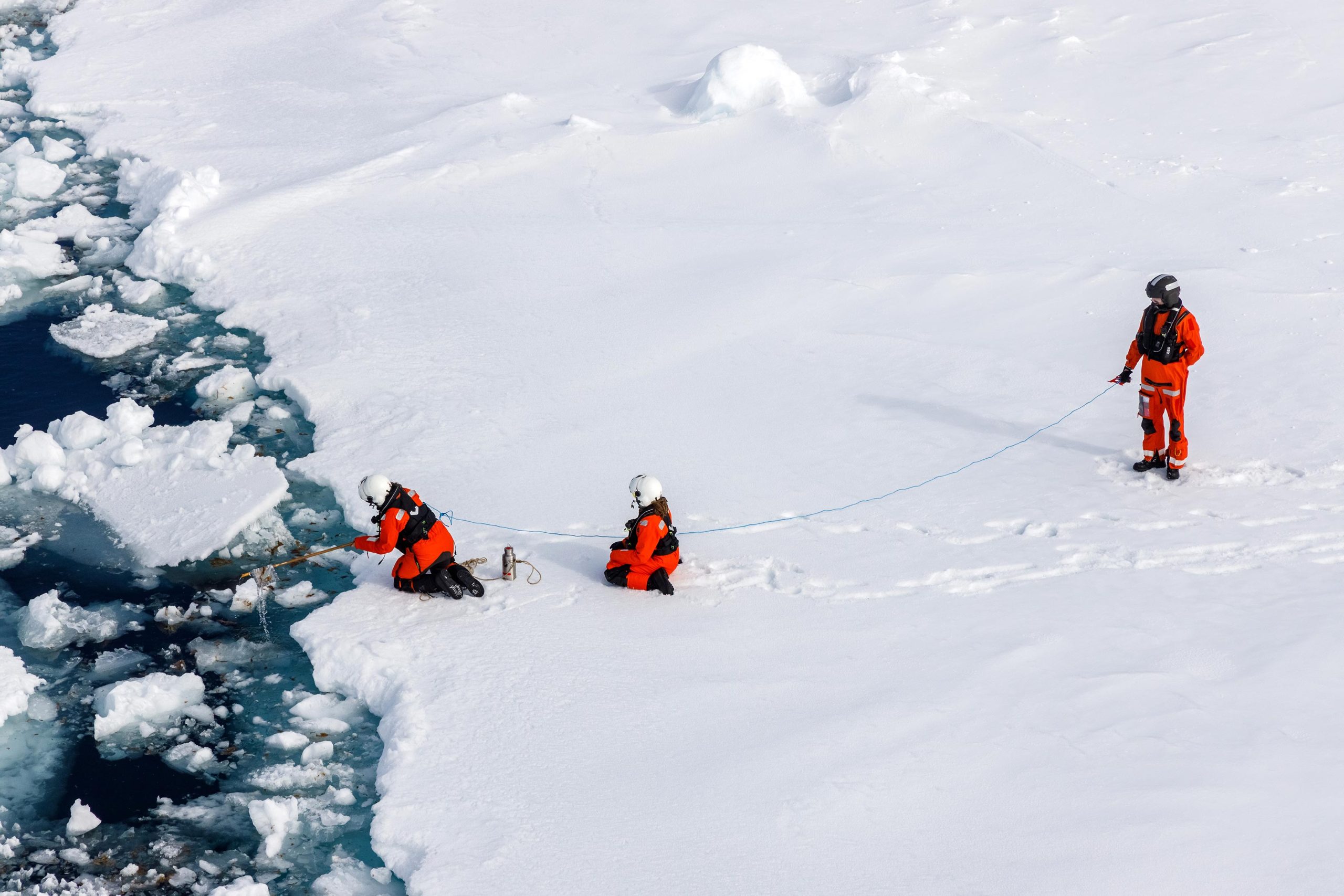
On an expedition with the research vessel Polarstern in the summer of 2021, she and a research team collected samples of Melosira algae and the surrounding water from ice floes. The partners from Ocean Frontier Institute (OFI), Dalhousie University and the University of Canterbury then analysed these in the laboratory for microplastic content. The surprising result: the clumps of algae contained an average of 31,000 ± 19,000 microplastic particles per cubic metre, about ten times the concentration of the surrounding water.
“The filamentous algae have a slimy, sticky texture, so it potentially collects microplastic from the atmospheric deposition on the sea, the seawater itself, from the surrounding ice and any other source that it passes. Once entrapped in the algal slime they travel as if in an elevator to the seafloor, or are eaten by marine animals,” explains Deonie Allen of the University of Canterbury and Birmingham University who is part of the research team.
Impacts on the Deep-Sea Food Web
Since the ice algae are an important food source for many deep-sea dwellers, the microplastic could thus enter the food web there. But it is also an important food source at the sea surface and could explain why microplastics were particularly widespread among ice-associated zooplankton organisms, as an earlier study with AWI participation shows. In this way, it can also enter the food chain here when the zooplankton is eaten by fish such as polar cod and these are eaten by seabirds and seals and these in turn by polar bears.
The detailed analysis of plastic composition showed that a variety of different plastics are found in the Arctic, including polyethylene, polyester, polypropylene, nylon, acrylic and many more. In addition to various chemicals and dyes, this creates a mix of substances whose impact on the environment and living creatures is difficult to assess.
“People in the Arctic are particularly dependent on the marine food web for their protein supply, for example through hunting or fishing. This means that they are also exposed to the microplastics and chemicals contained in it. Microplastics have already been detected in human intestines, blood, veins, lungs, placenta and breast milk and can cause inflammatory reactions, but the overall consequences have hardly been researched so far,” reports Melanie Bergmann.
“Micro and nano plastics have basically been detected in every place scientists have looked in the human body and within a plethora of other species. It is known to change behaviours, growth, fecundity and mortality rates in organisms and many plastic chemicals are known toxins to humans,” says Steve Allen, OFI Dalhousie University, a research team member.
The Arctic Ecosystem Under Dual Threat
Moreover, the Arctic ecosystem is already threatened by the profound environmental upheavals caused by the climate crisis. If the organisms are now additionally exposed to microplastics and the chemicals they contain, it can weaken them further.
“So, we have a combination of planetary crises that we urgently need to address effectively. Scientific calculations have shown that the most effective way to reduce plastic pollution is to reduce the production of new plastic,” says the AWI biologist and adds: “This should therefore definitely be prioritised in the global plastics agreement that is currently being negotiated.” That is why Melanie Bergmann is also accompanying the next round of negotiations, which will begin in Paris at the end of May.
Reference: “High levels of microplastics in the Arctic ice alga Melosira arctica, a vector to ice-associated and benthic food webs” by Melanie Bergmann, Steve Allen, Thomas Krumpen and Deonie Allen, 21 April 2023, Environmental Science and Technology.
DOI: 10.1021/acs.est.2c08010
Never miss a breakthrough: Join the SciTechDaily newsletter.
Follow us on Google and Google News.
5 Comments
A couple of questions:
Is there certainty about the microplastics being hazardous, or is it uninformed speculation? After all, synthetic fibers are sometimes prescribed for people who have problems with constipation.
If there is good reason to be alarmed, what is proposed to address the issue?
“synthetic fibers” should probably be “cellulose.”
A few years ago there was concern that some fast food chains were putting polyester fiber in milk shakes to thicken them. Other than aesthetic concerns, I don’t recollect any case being made that the practice was harmful.
Plastics are mostly made from petrochemicals, which are known carcinogens. There are known cancers in sea critters that appear to be a result of pollution, including plastics. In addition, many plastics have estrogenic effects, so there are critters out there with malformed sex organs that are the result of interference during fetal development. And finally, as noted, if you are eating plastics, you will feel full even though essentially you have eaten a bunch of junk food. Plastics gum up the digestive system so the “good” food can’t get through. Creatures are starving as a result. The algae are plants and the plastic is blocking sunlight on a cellular level. That’s starving the plants. I have to wonder what plastic is also doing to land-based plants. There is bacteria that can eat plastic, I wonder if we could someday soon have that bacteria inside our guts to deal with plastic in our bodies.
“… petrochemicals, which are known carcinogens.”
I’m always skeptical when someone makes such a blanket claim. Some petrochemicals, like benzene and carbon tetrachloride, are indeed known to be carcinogenic and mutagenic. However, logically, if some are dangerous, then others are less dangerous. Some may even be benign. Some, plastics, like teflon are virtually inert, which is what makes them useful. Of the tens of thousands of known organic chemicals, I think that it is a bridge too far to imply that all petrochemicals are carcinogenic, especially without some supporting evidence beyond your personal assertion.
We should probably be concerned about an increasing prevalence of microplastics. That means someone should engage in some serious research.
You are of the opinion that all plastics are a concern. You didn’t respond to my initial question: What do you recommend that we do about them?