

Scientists have discovered a new way to uncover what lies beneath the surfaces of planets like Mars by studying the debris spread from impact craters.
Using simulations and real Martian data, they showed that the size of a crater’s ejecta blanket reveals clues about underground materials, like ice or rock.
Crater Clues Beneath the Surface
Planetary scientists have found an exciting new way to look beneath the dusty surface of Mars—and possibly other planets too.
A recent study shows that the blanket of rock and debris blasted out by a meteor impact, known as an ejecta blanket, can reveal what lies underground. The size of this blanket changes depending on the type of material beneath the surface. This discovery could help scientists identify buried glaciers and other hidden features by using data from satellites orbiting Mars.
Surface Features as Subsurface Windows
“Historically, researchers have used the size and shape of impact craters to infer the properties of materials in the subsurface,” said Aleksandra Sokolowska, a UKRI fellow at Imperial College London. “But we show that the size of the ejecta blanket around a crater is sensitive to subsurface properties as well. That gives us a new observable on the surface to help constrain materials present underground.”
Sokolowska conducted the research while she was a postdoctoral researcher at Brown University, working with Ingrid Daubar, a planetary scientist in Brown’s Department of Earth, Environmental and Planetary Sciences.
Their findings were published in the Journal of Geophysical Research: Planets.
Looking Deeper Through Simulations
Impact craters are everywhere in the solar system, pocking the surfaces of all planets and moons with solid surfaces. Scientists have long looked at the size and shape of craters for clues about what might be beneath the surface. The strength of the subsurface, how porous it is, and a host of other factors can alter crater characteristics. That gives scientists a way to peer into planetary interiors from orbit, without having to land a spacecraft on the surface.
For this new research, Sokolowska wanted to see if crater ejecta might provide another source of information. To do that, she used computer simulations — co-developed by Gareth Collins, a professor at Imperial College London and study co-author — that capture the physics of planetary impacts. In the simulations, Sokolowska could vary the characteristics of the material far beneath the surface to see how it might affect the distance ejected debris travels. She tested a variety of different subsurface materials: solid bedrock, sediments like those that might be found in a buried lake bed, loose rock mixed with ice, and solid glacial deposits, among others.
Patterns in Debris Spread
The simulations showed that different subsurface materials and layering patterns produce a wide range of different ejecta patterns.
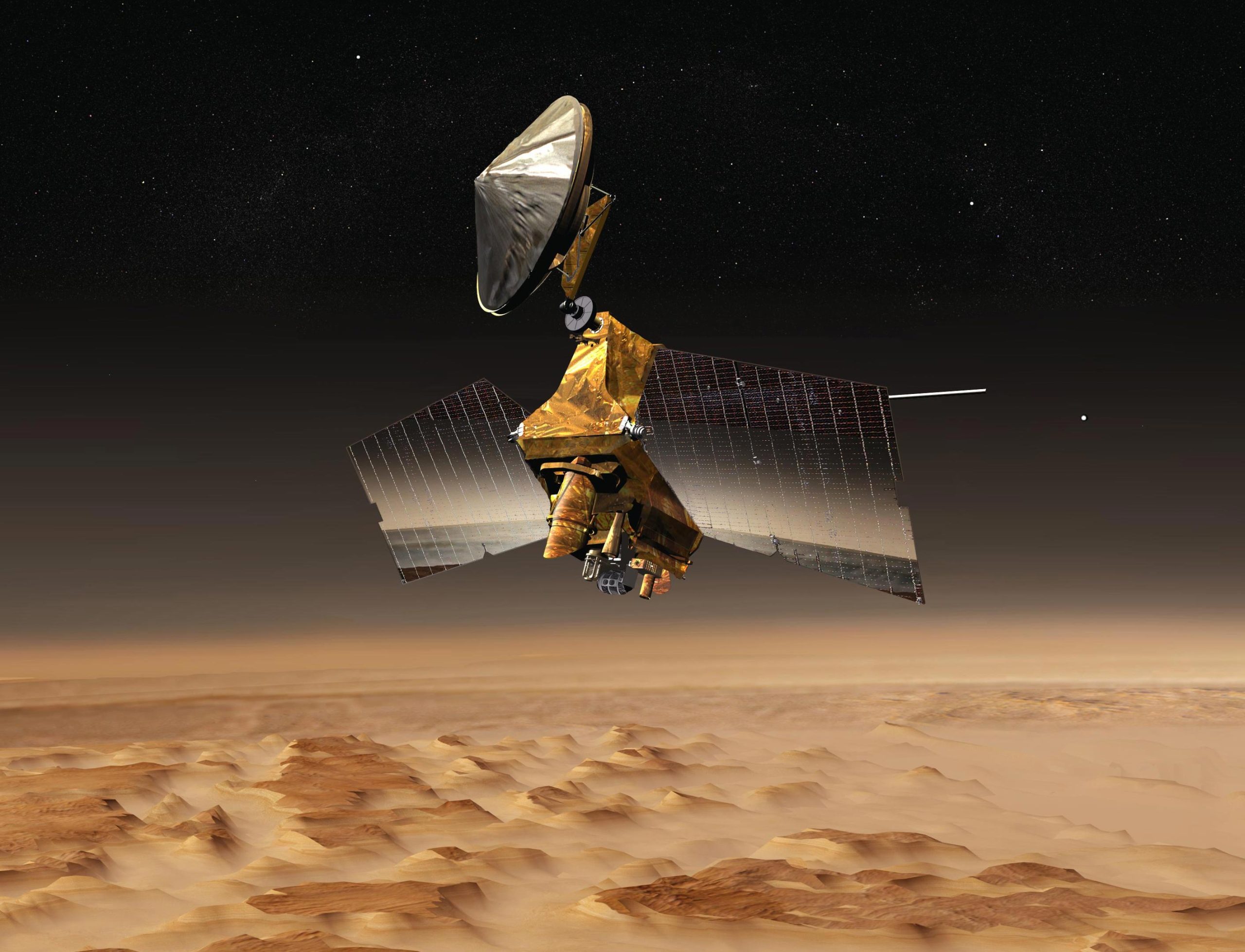
“The differences in ejecta radius can be quite large, and we predict that they could be measured from orbit with the HiRISE camera onboard Mars Reconnaissance Orbiter,” Sokolowska said. “Once the method is thoroughly tested, it could become a promising new tool for investigating subsurface properties. Turning this proof-of-concept work into a tool is the subject of my current fellowship at Imperial.”
To add some ground truth to the simulation results, the team looked at two fresh impact craters on Mars. Because the craters are fresh, their ejecta blankets haven’t been eroded much, making it relatively easy to measure their original size. The researchers also had some idea from data that one of the craters was located over solid bedrock, while the other was known to have some subsurface ice. Consistent with model predictions, the crater on the icy subsurface had a much smaller ejecta blanket than the one on bedrock.
Confirming Predictions from Orbit
The findings help confirm that differences in ejecta radius are detectable and reflect known subsurface properties.
The method could be useful for several current and upcoming spacecraft missions, the researchers say. In February 2026, the European Space Agency’s Hera spacecraft will arrive at Dimorphos, an asteroid that NASA hit with a projectile several years ago to test the possibility of deflecting asteroids that could be headed for Earth. Hera’s mission is to look at the crater made by the deflection test to learn more about the asteroid’s interior.
Mission Potential Beyond Mars
“Our work suggests that ejecta that did not escape from the asteroid and blanketed its surface could hold valuable information about the asteroid’s interior,” Sokolowska said.
Reference: “The Link Between Subsurface Rheology and Ejecta Mobility: The Case of Small New Impacts on Mars” by A. J. Sokolowska, G. S. Collins, I. J. Daubar and M. Jutzi, 13 May 2025, Journal of Geophysical Research: Planets.
DOI: 10.1029/2024JE008561
The research was supported by NASA, the U.K. Space Agency and the Swiss National Science Foundation.
Never miss a breakthrough: Join the SciTechDaily newsletter.
Follow us on Google and Google News.