
Engineers took to a competition pool to test robotic prototypes for an ambitious mission concept—a swarm of underwater explorers seeking signs of life on alien ocean worlds.
NASA’s upcoming missions to Europa will deploy advanced robots to probe its icy oceans for life. The robots, part of the SWIM project, have been rigorously tested on Earth and through simulations to handle extraterrestrial conditions.
Exploring Europa: NASA’s Ambitious Mission
When NASA’s Europa Clipper arrives at Jupiter’s moon Europa in 2030, it will conduct 49 flybys, using a suite of powerful scientific instruments to search for evidence that the ocean beneath Europa’s icy crust could support life. The spacecraft, which launched on October 14, is equipped with the most advanced science technology ever sent to the outer solar system. Yet, even as it begins its mission, NASA teams are already designing the next generation of robotic explorers to dive deeper into Europa’s hidden ocean and beyond, pushing the boundaries of scientific discovery.
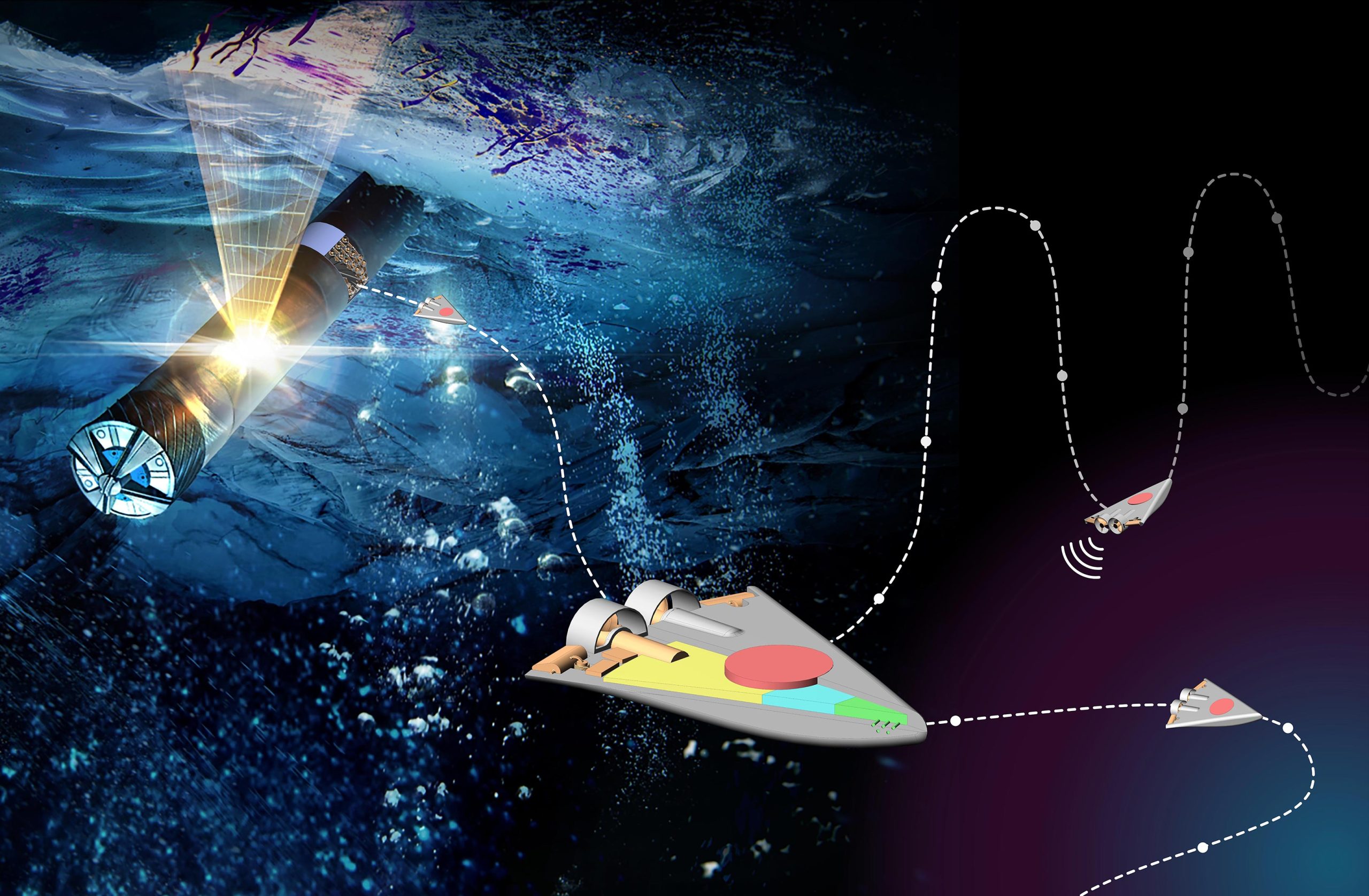
One such innovative concept is called SWIM, short for Sensing With Independent Micro-swimmers. This project imagines deploying a swarm of tiny, self-propelled robots, each about the size of a cellphone. These robots would be delivered to the subsurface ocean by an ice-melting cryobot. Once released, they would scatter and explore, searching for chemical and temperature signals that could point to the presence of life.

“People might ask, why is NASA developing an underwater robot for space exploration? It’s because there are places we want to go in the solar system to look for life, and we think life needs water. So we need robots that can explore those environments — autonomously, hundreds of millions of miles from home,” said Ethan Schaler, principal investigator for SWIM at NASA’s Jet Propulsion Laboratory in Southern California.
Under development at JPL, a series of prototypes for the SWIM concept recently braved the waters of a 25-yard (23-meter) competition swimming pool at Caltech in Pasadena for testing. The results were encouraging.
A prototype of a robot designed to explore subsurface oceans of icy moons is reflected in the water’s surface during a pool test at Caltech in September. Conducted by NASA’s Jet Propulsion Laboratory, the testing showed the feasibility of a mission concept for a swarm of mini swimming robots. Credit: NASA/JPL-Caltech
SWIM Practice
The SWIM team’s latest iteration is a 3D-printed plastic prototype that relies on low-cost, commercially made motors and electronics. Pushed along by two propellers, with four flaps for steering, the prototype demonstrated controlled maneuvering, the ability to stay on and correct its course, and a back-and-forth “lawnmower” exploration pattern. It managed all of this autonomously, without the team’s direct intervention. The robot even spelled out “J-P-L.”
Just in case the robot needed rescuing, it was attached to a fishing line, and an engineer toting a fishing rod trotted alongside the pool during each test. Nearby, a colleague reviewed the robot’s actions and sensor data on a laptop. The team completed more than 20 rounds of testing various prototypes at the pool and in a pair of tanks at JPL.
“It’s awesome to build a robot from scratch and see it successfully operate in a relevant environment,” Schaler said. “Underwater robots in general are very hard, and this is just the first in a series of designs we’d have to work through to prepare for a trip to an ocean world. But it’s proof that we can build these robots with the necessary capabilities and begin to understand what challenges they would face on a subsurface mission.”

Toward Autonomous Oceanic Exploration
The wedge-shaped prototype used in most of the pool tests was about 16.5 inches (42 centimeters) long, weighing 5 pounds (2.3 kilograms). As conceived for spaceflight, the robots would have dimensions about three times smaller — tiny compared to existing remotely operated and autonomous underwater scientific vehicles. The palm-size swimmers would feature miniaturized, purpose-built parts and employ a novel wireless underwater acoustic communication system for transmitting data and triangulating their positions.
Digital versions of these little robots got their own test, not in a pool but in a computer simulation. In an environment with the same pressure and gravity they would likely encounter on Europa, a virtual swarm of 5-inch-long (12-centimeter-long) robots repeatedly went looking for potential signs of life. The computer simulations helped determine the limits of the robots’ abilities to collect science data in an unknown environment, and they led to the development of algorithms that would enable the swarm to explore more efficiently.

The simulations also helped the team better understand how to maximize science return while accounting for tradeoffs between battery life (up to two hours), the volume of water the swimmers could explore (about 3 million cubic feet, or 86,000 cubic meters), and the number of robots in a single swarm (a dozen, sent in four to five waves).
In addition, a team of collaborators at Georgia Tech in Atlanta fabricated and tested an ocean composition sensor that would enable each robot to simultaneously measure temperature, pressure, acidity or alkalinity, conductivity, and chemical makeup. Just a few millimeters square, the chip is the first to combine all those sensors in one tiny package.
Of course, such an advanced concept would require several more years of work, among other things, to be ready for a possible future flight mission to an icy moon. In the meantime, Schaler imagines SWIM robots potentially being further developed to do science work right here at home: supporting oceanographic research or taking critical measurements underneath polar ice.

More About SWIM
SWIM is an innovative NASA project managed by Caltech’s Jet Propulsion Laboratory (JPL) and funded through NASA’s Innovative Advanced Concepts (NIAC) program, which fosters visionary ideas for future space exploration. The project envisions a swarm of small, autonomous swimming robots designed to explore subsurface oceans on icy moons, such as Europa, in search of signs of life. These cellphone-sized robots, delivered by an ice-melting cryobot, would spread out to detect chemical and temperature signals that could indicate habitability or life.
Supported by NIAC Phase I and II funding under NASA’s Space Technology Mission Directorate, SWIM is part of a program that evaluates cutting-edge technologies capable of transforming future missions. Researchers from U.S. government, industry, and academia are encouraged to contribute proposals to this initiative, advancing the boundaries of aerospace and space exploration.
Never miss a breakthrough: Join the SciTechDaily newsletter.
Follow us on Google and Google News.