
New Approach Merges Theoretical Fundamentals With Experimental Studies of the Proton’s Structure
Advances in quantum chromodynamics are shedding light on how quarks and gluons combine in protons, linking theoretical physics with practical experiments to decode the proton’s structure through high-energy collisions.
Quantum Chromodynamics
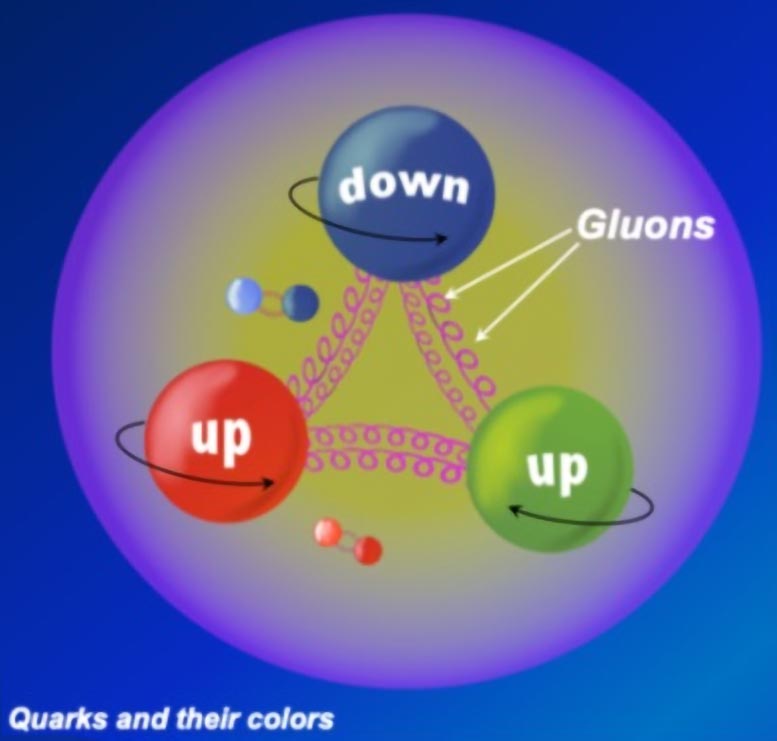
Protons and other subatomic particles bound by the strong nuclear force are composed of smaller, more fundamental constituents known as quarks and gluons. These quarks and gluons are held together by the principles of quantum chromodynamics (QCD), the theory that explains the strong interactions between quarks through the concept of color symmetry. Despite its explanatory power, QCD remains puzzling in many ways. The processes that cause quarks and gluons to combine and form observable particles are very mysterious and poorly understood.
Adding to the complexity, virtual quarks and gluons—particles that temporarily exist due to quantum fluctuations—constantly appear and disappear within protons. This raises the challenging question of which quarks and gluons are truly “in” a proton. Much of QCD research focuses on answering such fundamental questions, including how quantum mechanical theories can be reconciled with relativity. Recent advances in theoretical QCD have paved the way for linking the internal structure of particles like protons to data from high-energy particle collision experiments, offering new insights into these mysteries.
Bridging Theory and Experiment in Particle Physics
As theorists generate new ideas about QCD, other researchers plan experiments to test those ideas. These tests involve colliding particles like electrons and protons at high energies and then examining the results. By extrapolating backwards in time, physicists will use the remnants of the collisions to infer information about the structure of the original particles. However, the same theoretical difficulties that motivated these studies have left a key question unresolved. Namely, how do scientists relate the physics of the specific collisions with the physics of the internal structure of the particles themselves? The recent work provides the toolbox needed to resolve this question while also accounting for the theoretical subtleties.
The Role of Accelerators in Understanding Protons
Much of the experimental work related to extracting the quark and gluon structure of protons occurs at existing particle accelerators like the Thomas Jefferson National Accelerator Facility and the Relativistic Heavy Ion Collider, and in the future at the Electron Ion Collider. A large part of current research into the structure of the proton, both theoretical and experimental, involves identifying, extracting, and analyzing the bound state distributions of quarks and gluons in the proton, mapping out their motion, and understanding how this relates to the overall observed properties of the proton like its spin and mass. In the past, researchers found inconsistencies in the way physicists combined fundamental QCD theory to the study of data. The new theoretical results provide a clear recipe and boost confidence that data taken in future experiments can be reliably interpreted.
References:
“Phenomenology of TMD parton distributions in Drell-Yan and Z0 boson production in a hadron structure oriented approach” by F. Aslan, M. Boglione, J. O. Gonzalez-Hernandez, T. Rainaldi, T. C. Rogers and A. Simonelli, 11 October 2024, Physical Review D.
DOI: 10.1103/PhysRevD.110.074016
“Resolution to the problem of consistent large transverse momentum in TMDs” by J. O. Gonzalez-Hernandez, T. Rainaldi and T. C. Rogers, 23 May 2023, Physical Review D.
DOI: 10.1103/PhysRevD.107.094029
“Combining nonperturbative transverse momentum dependence with TMD evolution” by J. O. Gonzalez-Hernandez, T. C. Rogers and N. Sato, 2 August 2022, Physical Review D.
DOI: 10.1103/PhysRevD.106.034002
This work was supported by the Department of Energy (DOE) Office of Science, Office of Nuclear Physics. This work was also supported by the DOE contract under which Jefferson Science Associates, LLC operates the Thomas Jefferson National Accelerator Facility. Support was also provided by the European Union’s Horizon 2020 research and innovation program.
Never miss a breakthrough: Join the SciTechDaily newsletter.
Follow us on Google and Google News.
3 Comments
The human fault: They get an idea (usually from others) and believing it a settled matter, immediately fall into tunnel vision working out details. Perfectly good minds, intellectually jailed from taking the few minutes to examine what may well be erroneous foundations.
Proton structure is baffling.
In what route can we get involved in particle physics if we are trained in different field? Local doesn’t have the research on physics, more on industry. Could u point a route for me? Thank u.