
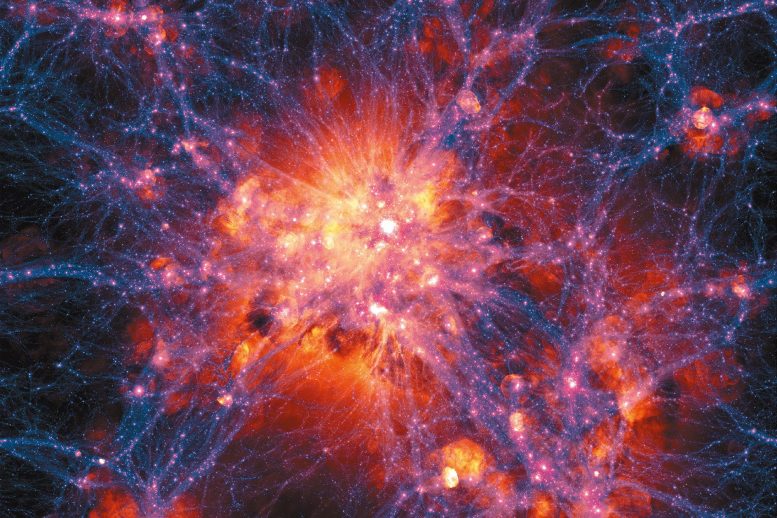
In their pursuit of understanding cosmic evolution, scientists rely on a two-pronged approach. Using advanced instruments, astronomical surveys attempt to look farther and farther into space (and back in time) to study the earliest periods of the Universe. At the same time, scientists create simulations that attempt to model how the Universe has evolved based on our understanding of physics. When the two match, astrophysicists and cosmologists know they are on the right track!
In recent years, increasingly-detailed simulations have been made using increasingly sophisticated supercomputers, which have yielded increasingly accurate results. Recently, an international team of researchers led by the University of Helsinki conducted the most accurate simulations to date. Known as SIBELIUS-DARK, these simulations accurately predicted the evolution of our corner of the cosmos from the Big Bang to the present day.
In addition to the University of Helsinki, the team was comprised of researchers from the Institute for Computational Cosmology (ICC) and the Centre for Extragalactic Astronomy at Durham University, the Lorentz Institute for Theoretical Physics at Leiden University, the Institut d’Astrophysique de Paris, and The Oskar Klein Centre at Stockholm University. The team’s results are published in the Monthly Notices of the Royal Astronomical Society.
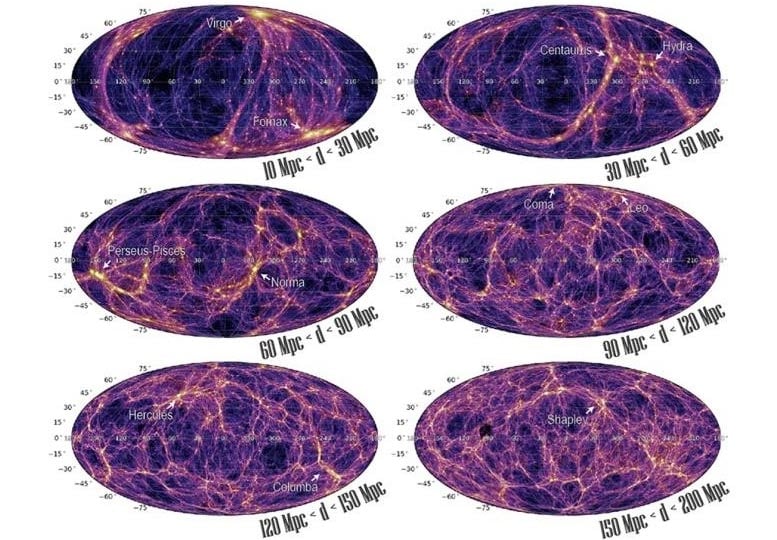
This simulation is the first study conducted as part of the “Simulations Beyond the Local Universe” (SIBELIUS) project and was performed using the DiRAC COSmology MAchine (COSMA), a distributed computer network operated by the ICC. The simulation covers a volume of space up to a distance of 600 million light-years from Earth and is represented by over 130 billion simulated ‘particles’, which required thousands of computers several weeks to produce.
The team used known physics to describe how Dark Matter and cosmic gas evolved during the history of the Universe. Specifically, they sought to determine if what we observe today is consistent with the standard model of cosmology – the Cold Dark Matter (CDM) model. For the past few decades, astrophysicists have used this model to explain the properties of the Cosmic Microwave Background (CMB) to the number and spatial distribution of the galaxies we see today.
Previous CDM simulations have typically modeled random patches of the Universe that are similar to what we observe today. By using advanced generative algorithms, these simulations were conditioned to reproduce our specific patch of the Universe. This allowed the team to see if their simulation reproduced the present-day structures in the vicinity of the Milky Way that astronomers have observed for decades.
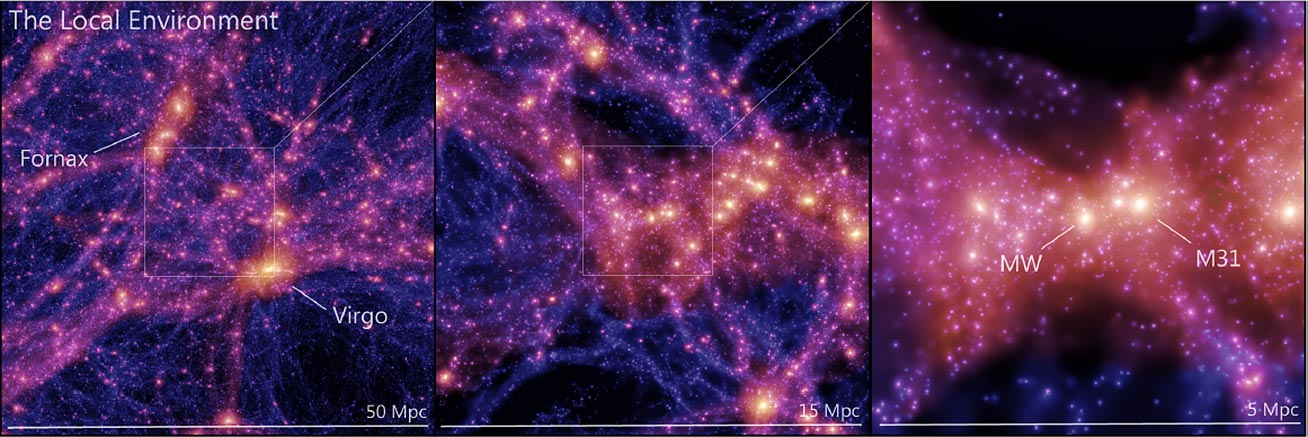
After meticulously comparing the virtual Universe they created to a series of observational surveys, they found that the simulation matched the locations and properties of structures like the Virgo, Coma, and Perseus galaxy clusters, the “Great Wall,” and the “Local Void.” Most importantly, at the center of the simulation were the two most important and familiar structures to astronomers: the virtual counterparts of the Milky Way and the neighboring Andromeda galaxy.
As co-author Professor Carlos Frenk (the Ogden Professor of Fundamental Physics at the ICC) explained:
“It is immensely exciting to see the familiar structures that we know exist around us emerge from a computer calculation. The simulations simply reveal the consequences of the laws of physics acting on the dark matter and cosmic gas throughout the 13.7 billion years that our universe has been around.
“The fact that we have been able to reproduce these familiar structures provides impressive support for the standard Cold Dark Matter model and tells us that we are on the right track to understand the evolution of the entire Universe.”
Another interesting finding was the prediction that our patch of the Universe has fewer galaxies on average due to a large-scale “matter underdensity.” While this does not contradict the CDM model, it could have consequences for astrophysicists interpreting observed galaxy surveys. “This project is truly ground-breaking,” said co-author Dr. Matthieu Schaller from Leiden University. “These simulations demonstrate that the standard Cold Dark Matter Model can produce all the galaxies we see in our neighborhood. This is a very important test for the model to pass.”
Dr. Stuart McAlpine, a former Ph.D. student at Durham and a current postdoctoral researcher at the University of Helsinki, added: “By simulating our Universe, as we see it, we are one step closer to understanding the nature of our cosmos. This project provides an important bridge between decades of theory and astronomical observations.”
Moving forward, the international team plans to further analyze the simulation in the hopes of providing further stringent tests of the CDM model.
Adapted from an article originally published on Universe Today.
Never miss a breakthrough: Join the SciTechDaily newsletter.
Follow us on Google and Google News.
2 Comments
The Cold Dark Matter model with cosmologicl map prepared by COSMA in SIBELIUS project to deduce structure of universe is accurate.Here this is obvious to find virtual counterparts of Milky Way and Andromeda in the map at center of the simulation,as confirmed by their respective rotations to show this effect.Though not started to merge or even will not merge, both are too near to each other,so as bound to have virtual counterpart rotations.In this case both are not in a line to merge and merge will possible iff their mutual gravity permit to do so.
The Cold Dark Matter model with cosmologicl map prepared by COSMA in SIBELIUS project to deduce structure of universe is accurate.Here this is obvious to find virtual counterparts of Milky Way and Andromeda in the map at center of the simulation,as confirmed by their respective rotations to show this effect.Though not started to merge or even will not merge, both are too near to each other,so as bound to have virtual counterpart rotations.In this case both are not in a line to merge and merge will possible iff their mutual gravity permit to do so.
Rotation of a galaxy is a time oriented property of position relative to other galaxies in universe.Henc the resultant effected,confirmed by observation.Dark matter(energy) is sole effect or reflection of rotation.Thanks to the authors fo carefulr preparation of this text.