
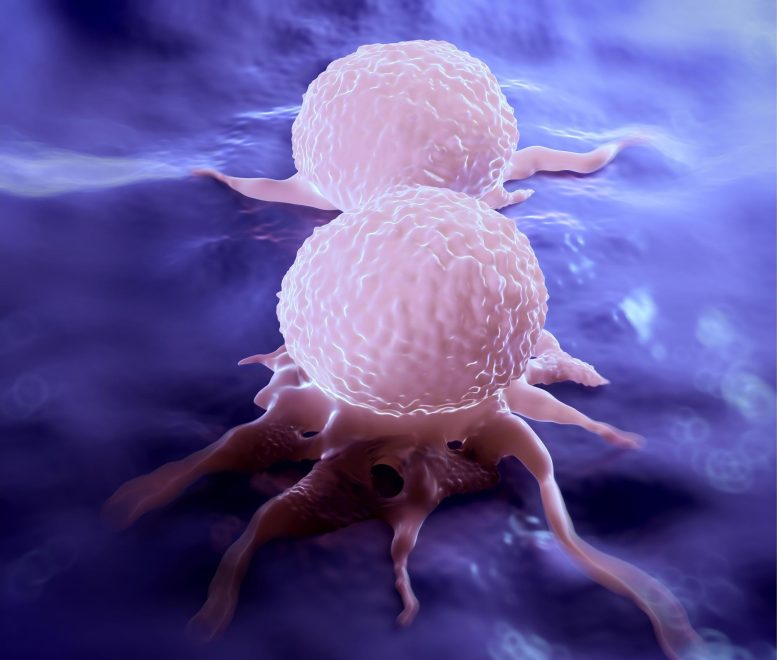
Researchers identified N-acetylcysteine as a potential enhancer of alpelisib for resistant breast cancer, paving the way for innovative combination therapies.
Many cancer treatments often fail to achieve the desired outcomes. A common reason for this is that tumors can develop resistance to cancer medications. One such example is alpelisib, a drug approved in Switzerland for the treatment of advanced breast cancer. Researchers at the University of Basel’s Department of Biomedicine have discovered that the loss of the neurofibromin 1 (NF1) gene results in a diminished response to alpelisib.
However, the research team also found that N-acetylcysteine, a dietary supplement, can restore the sensitivity of cancer cells to this treatment. These findings have been recently published in the scientific journal Cell Reports Medicine.
Loss of Gene Triggers Resistance
At the moment, patients with advanced and metastatic breast cancer lack effective treatment options. The PI3K signaling pathway is often overactive in breast cancer due to mutations promoting tumor development. The approval of the PI3K inhibitor Alpelisib was therefore keenly anticipated.
“Unfortunately, it turned out that the success of the medication is severely limited by resistance,” says Professor Mohamed Bentires-Alj, head of the research group. “Hence, we urgently need to find out more about how resistance arises.”
So his team went looking for the genetic basis of the resistance – in other words, trying to find out which genes had changed to turn cancer cells resistant. The result: mutations that switched off production of the NF1 protein made the tumors resistant to treatment with alpelisib. It is known that NF1 suppresses the growth of tumors through a variety of signaling pathways, but the gene had not yet been linked to resistance to alpelisib.
Further experiments run by the researchers confirmed that the loss of NF1 also leads to resistance in human cancer cells and in tissue cultured from tumors. “So the absence of NF1 is the elephant in the room; it throws everything into disarray within the cell and hinders successful treatment,” says Bentires-Alj.
A Promising Pairing With an Expectorant
An analysis shows that the loss of NF1 affects the cell’s energy reserves: “They stop producing as much energy using mitochondria; instead, they switch to other energy production pathways,” says the lead author of the study, Dr. Priska Auf der Maur.
Given these changes, the researchers conducted experiments with the known antioxidant N-acetylcysteine, which has a similar effect on energy metabolism and therefore was expected to emulate the effects of NF1 loss. This substance is a well-known dietary supplement, as well as an ingredient in many cough medicines.
Surprisingly, N-acetylcysteine had the opposite effect: it restored the effectiveness of alpelisib in resistant cancer cells. In fact, it increased it. This occurs via an additional intervention in another signaling pathway that also plays an important role in tumor growth, as the researchers discovered through further analysis. Interestingly, the loss of NF1 also plays a role in resistance to other medications. A combination therapy with N-acetylcysteine could also be a possibility in these cases.
“As N-acetylcysteine is a safe and widespread additive, this result is highly relevant for clinical research,” says Bentires-Alj. He thinks that a combination of N-acetylcysteine with alpelisib could improve the treatment of advanced breast cancer. The next step would now be to run clinical studies with breast cancer patients to confirm the positive effects observed in the lab.
Reference: “N-acetylcysteine overcomes NF1 loss-driven resistance to PI3Kα inhibition in breast cancer” by Priska Auf der Maur, Marcel P. Trefny, Zora Baumann, Milica Vulin, Ana Luisa Correia, Maren Diepenbruck, Nicolas Kramer, Katrin Volkmann, Bogdan-Tiberius Preca, Pedro Ramos, Cedric Leroy, Tobias Eichlisberger, Katarzyna Buczak, Federica Zilli, Ryoko Okamoto, Roland Rad, Michael Rugaard Jensen, Christine Fritsch, Alfred Zippelius, Michael B. Stadler and Mohamed Bentires-Alj, 11 April 2023, Cell Reports Medicine.
DOI: 10.1016/j.xcrm.2023.101002
Never miss a breakthrough: Join the SciTechDaily newsletter.
Follow us on Google and Google News.