

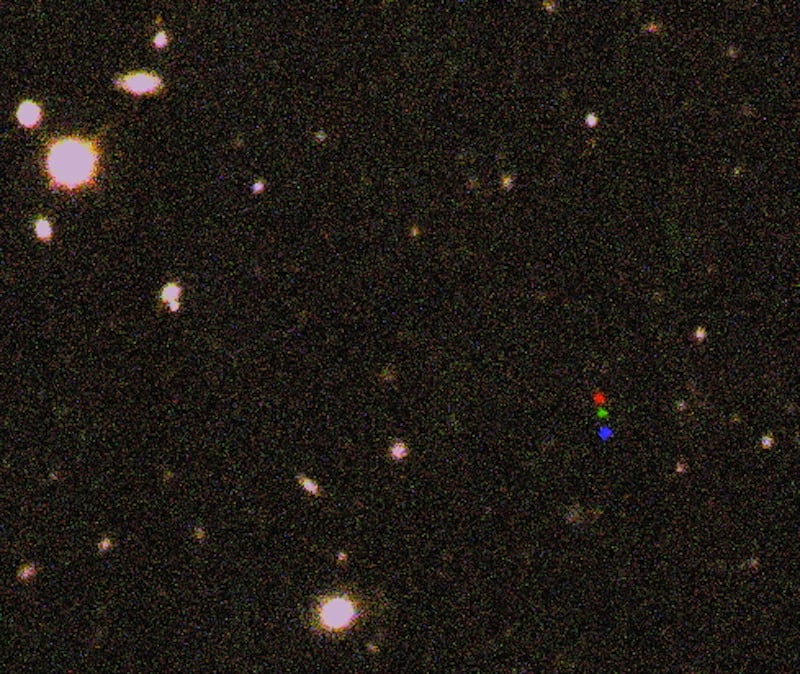
Using ground-based observatories, scientists discovered a distant dwarf planet, dubbed 2012 VP113, located beyond the known edge of our solar system.
Washington, D.C.—The Solar System has a new most-distant member, bringing its outer frontier into focus.
New work from Carnegie’s Scott Sheppard and Chadwick Trujillo of the Gemini Observatory reports the discovery of a distant dwarf planet, called 2012 VP113, which was found beyond the known edge of the Solar System. This is likely one of thousands of distant objects that are thought to form the so-called inner Oort cloud. What’s more, their work indicates the potential presence of an enormous planet, perhaps up to 10 times the size of Earth, not yet seen, but possibly influencing the orbit of 2012 VP113, as well as other inner Oort cloud objects.
Their findings were published today (March 27, 2014) in the journal Nature.
The known Solar System can be divided into three parts: the rocky planets like Earth, which are close to the Sun; the gas giant planets, which are further out; and the frozen objects of the Kuiper belt, which lie just beyond Neptune’s orbit. Beyond this, there appears to be an edge to the Solar System where only one object, Sedna, was previously known to exist for its entire orbit. But the newly found 2012 VP113 has an orbit that stays even beyond Sedna, making it the furthest known in the Solar System.
“This is an extraordinary result that redefines our understanding of our Solar System,” says Linda Elkins-Tanton, director of Carnegie’s Department of Terrestrial Magnetism.
Sedna was discovered beyond the Kuiper Belt edge in 2003, and it was not known if Sedna was unique, as Pluto once was thought to be before the Kuiper Belt was discovered. With the discovery of 2012 VP113, it is now clear Sedna is not unique and is likely the second known member of the hypothesized inner Oort cloud, the likely origin of some comets.
2012 VP113’s closest orbit point to the Sun brings it to about 80 times the distance of the Earth from the Sun, a measurement referred to as an astronomical unit or AU. For context, the rocky planets and asteroids exist at distances ranging between .39 and 4.2 AU. Gas giants are found between 5 and 30 AU, and the Kuiper belt (composed of thousands of icy objects, including Pluto) ranges from 30 to 50 AU. In our solar system, there is a distinct edge at 50 AU. Only Sedna was known to stay significantly beyond this outer boundary at 76 AU for its entire orbit.
“The search for these distant inner Oort cloud objects beyond Sedna and 2012 VP113 should continue, as they could tell us a lot about how our Solar System formed and evolved,” says Sheppard.
Sheppard and Trujillo used the new Dark Energy Camera (DECam) on the NOAO 4-meter (13-foot) telescope in Chile for discovery. DECam has the largest field-of-view of any 4-meter or larger telescope, giving it unprecedented ability to search large areas of the sky for faint objects. The Magellan 6.5-meter (21.3-foot) telescope at Carnegie’s Las Campanas Observatory was used to determine the orbit of 2012 VP113 and obtain detailed information about its surface properties.
From the amount of sky searched, Sheppard and Trujillo determined that about 900 objects with orbits like Sedna and 2012 VP113 and sizes larger than 1000 km may exist and that the total population of the inner Oort cloud is likely bigger than that of the Kuiper Belt and main asteroid belt.
“Some of these inner Oort cloud objects could rival the size of Mars or even Earth. This is because many of the inner Oort cloud objects are so distant that even very large ones would be too faint to detect with current technology,” says Sheppard.
Both Sedna and 2012 VP113 were found near their closest approach to the Sun, but they both have orbits that go out to hundreds of AU, at which point they would be too faint to discover. In fact, the similarity in the orbits found for Sedna, 2012 VP113, and a few other objects near the edge of the Kuiper Belt suggests that an unknown massive perturbing body may be shepherding these objects into these similar orbital configurations. Sheppard and Trujillo suggest a Super Earth or an even larger object at hundreds of AU could create the shepherding effect seen in the orbits of these objects, which are too distant to be perturbed significantly by any of the known planets.
There are three competing theories for how the inner Oort cloud might have formed. As more objects are found, it will be easier to narrow down which of these theories is most likely accurate. One theory is that a rogue planet could have been tossed out of the giant planet region and could have perturbed objects out of the Kuiper Belt to the inner Oort cloud on its way out. This planet could have been ejected or still be in the distant solar system today. The second theory is that a close stellar encounter could have put objects into the inner Oort cloud region. A third theory suggests inner Oort cloud objects are captured extra-solar planets from other stars that were near our Sun in its birth cluster.
The outer Oort cloud is distinguished from the inner Oort cloud because in the outer Oort cloud, starting around 1500 AU, the gravity from other nearby stars perturbs the orbits of the objects, causing objects in the outer Oort cloud to have orbits that change drastically over time. Many of the comets we see were objects that were perturbed out of the outer Oort cloud. Inner Oort cloud objects are not highly affected by the gravity of other stars and thus have more stable and more primordial orbits.
Reference: “A Sedna-like body with a perihelion of 80 astronomical units” by Chadwick A. Trujillo and Scott S. Sheppard, 26 March 2014, Nature.
DOI: 10.1038/nature13156
Never miss a breakthrough: Join the SciTechDaily newsletter.
Follow us on Google and Google News.
6 Comments
Forgive me, but it looks pretty clearly in your diagram like Sedna’s apogee is still way more distant than 2012 VP113’s, with a much larger orbit circumference as well. How is Sedna then not still considered the farthest?
Based on the information we have, it looks like Sedna’s closest orbit point to the Sun is closer than 2012 VP113’s closest orbit point to the Sun; so 2012 VP113 is considered the farthest.
Quote: The known Solar System can be divided into three parts: the rocky planets like Earth, which are close to the Sun; the gas giant planets, which are further out; and the frozen objects of the Kuiper belt, which lie just beyond Neptune’s orbit. Beyond this, there appears to be an edge to the Solar System where only one object, Sedna, was previously known to exist for its entire orbit. But the newly found 2012 VP113 has an orbit that stays even beyond Sedna, making it the furthest known in the Solar System.” …If this is the case then why does the above diagram show Sedna to have a much larger orbit than VP113? Not drawn to scale? Or, is Sedna’s orbit actually the green ellipse and VP113 the orange one?
Not sure about the scale, but believe that they are stating that Sedna’s orbit comes closer to the Sun…”2012 VP113’s closest orbit point to the Sun brings it to about 80 times the distance of the Earth from the Sun….Sedna’s was measured at 76 AU.”
I think that the nearest star has perturbed the outer Oort Cloud object. Ringed structure is always the natural occurrence of not only Gas Giants but also even stars like Sun in any Galaxy. For that matter the structure like Oort cloud which is the origin of several dwarf planets, ice and comets are a general phenomena with all the stars in the Galaxy. Moreover Galactic Cannibalism is a known phenomena, like Andromeda devouring its neighbors and Milky Way trying to devour its neighbors Large and Small Magellanic Clouds. Thus during the Galactic cannibalism the stars of the outer rings (Since our Sun is also a star of the outer arm of our Galaxy) may perturb with one another resulting in such planets of the Star beyond even 150 AU, wherein between 30AU and 50AU the terrestrial planets are confined. Beyond 70 AU distances such rings and planets may exist because of intermixing of stars during Galactic Cannibalism. We should note that the distance between two nearest stars is of the order of more than 4 light years and intervening them, we should expect many many garbage of dwarf planets and it need not be clean space. Thank You.
We are currently near the highest point of our oscillation above the galactic plane. Is it possible to peer below our lowest point below the galactic plane to observe our future trajectory directly and discover whether we oscillate through denser regions or is it just empty space. Aren’t we currently approximately 4 light years above the galactic plane? I wouldn’t begin to know where to point but we know our direction(future trajectory in a flat plane) but we also know we will descend through the galactic plane to a point some 3.5 light years below it so with those relatively short cosmic distances and our know forward trajectory speed is it possible to “shine the headlights” as it were toward our future points and discover if there are objects that are close passers by that we may pick up changing the Oort Cloud and Kuiper Belt significantly?