
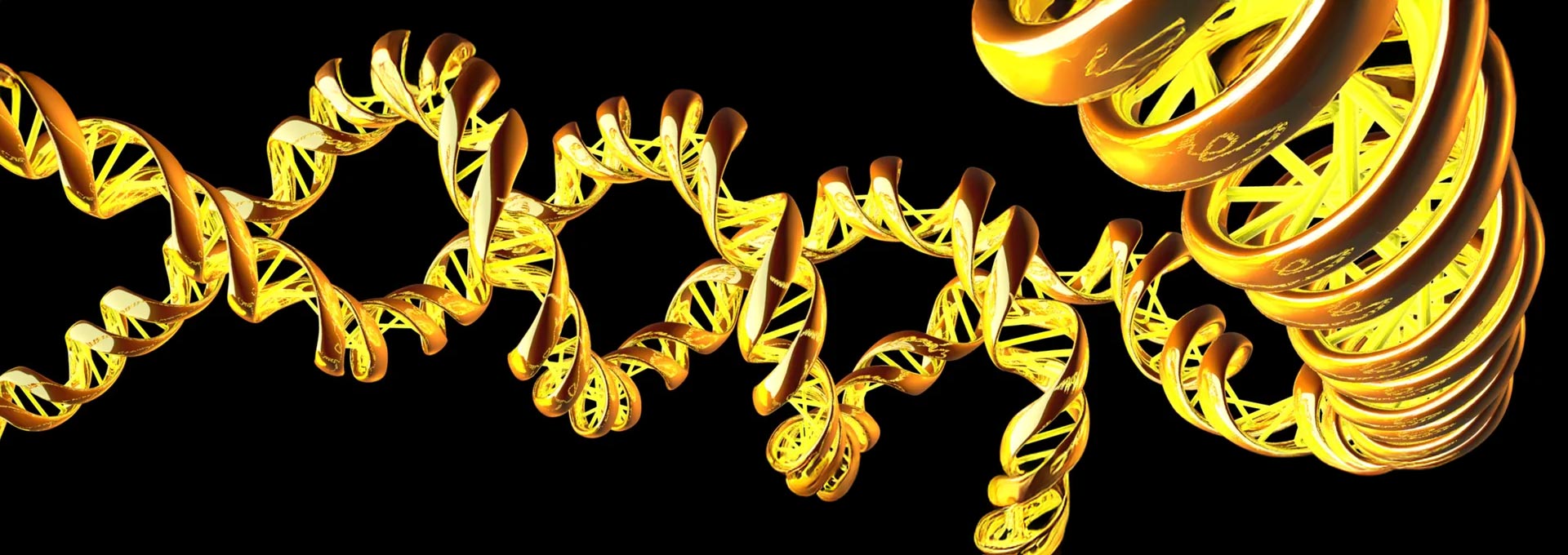
New research shows that SMC proteins loop and twist DNA consistently in both humans and yeast, impacting DNA structure and function, crucial for addressing genetic diseases.
Scientists from the Kavli Institute at Delft University of Technology and the IMP Vienna BioCenter have uncovered a new property of the molecular motors that organize our chromosomes. Six years ago, they discovered that SMC motor proteins create long loops in DNA. Now, they’ve found that these proteins also introduce significant twists into the loops they form.
This discovery deepens our understanding of chromosome structure and function, shedding light on how DNA is managed within cells. It also offers valuable insight into how disruptions in DNA twisting and looping can contribute to health issues, including developmental disorders like cohesinopathies. The researchers published their findings in Science Advances.
DNA Compaction and Cellular Function
Imagine trying to fit two meters of rope into a space smaller than the tip of a needle. That’s the task every cell in your body faces when packing its DNA into its microscopic nucleus. To accomplish this, nature has developed remarkable strategies. DNA is twisted into tight coils upon coils, forming structures called supercoils (see pictures for a visualization), and wrapped around specialized proteins for efficient storage.

DNA Loops and Chromosome Dynamics
However, packing DNA isn’t enough — cells also need to access and manage this tightly packed genetic material. When genetic information is needed, specific sections of DNA are temporarily unpacked and read. During cell division, the DNA must fully unwind, duplicate, and separate into two new cells.
This process is controlled by specialized protein machines known as SMC complexes (Structural Maintenance of Chromosomes). These molecular motors create long loops in the DNA, which play a critical role in regulating chromosome structure and function. Researchers at Delft and other institutions recently discovered that these DNA loops are central to how chromosomes organize and operate—an essential breakthrough in understanding cellular biology.
Innovations in DNA Research
In the lab of Cees Dekker at TU Delft, postdocs Richard Janissen and Roman Bath now provide clues that help to crack this puzzle. They developed a new way to use ‘magnetic tweezers’ by which they could watch individual SMC proteins make looping steps in DNA. Importantly, they were also able to resolve if the SMC protein would change the twist in the DNA. And strikingly, the team found that it did: the human SMC protein cohesin does indeed not only pull DNA into a loop, but also twists the DNA in a left-handed way by 0.6 turns in each step of creating the loop.

Evolutionary Consistency of SMC Proteins
What’s more, the team found that this twisting action isn’t unique to humans. Similar SMC proteins in yeast behave the same way. Strikingly, all the various types of SMC proteins from human and yeast add the same amount of twist – they turn DNA 0.6 times at every at every DNA loop extrusion step. This shows that the DNA extrusion and twisting mechanisms stayed the same for very long times during evolution. No matter whether DNA is looped in humans, yeast, or any other cell – nature employs the same strategy.
Implications for Genetic Research and Health
These new findings will provide essential clues for resolving the molecular mechanism of this new type of motor. Additionally, they make clear that DNA looping also affects the supercoiling state of our chromosomes, which directly affects processes like gene expression. Finally, these SMC proteins are related to various diseases such as Cornelia de Lange Syndrome, and a better understanding of these processes is vital for tracking down the molecular origins of these serious illnesses.
Reference: “All eukaryotic SMC proteins induce a twist of −0.6 at each DNA loop extrusion step” by Richard Janissen, Roman Barth, Iain F. Davidson, Jan-Michael Peters and Cees Dekker, 13 December 2024, Science Advances.
DOI: 10.1126/sciadv.adt1832
Never miss a breakthrough: Join the SciTechDaily newsletter.
Follow us on Google and Google News.
2 Comments
Good.for.dna.is.pray.namaz.and.quran.allways.etc
Awesome 👌 👏