

This January, the night sky offers a stunning display featuring the Quadrantid meteor shower and a rare alignment of four bright planets visible in a single view. Witness Mars at opposition, shining brightly all night, and catch the close approach of Venus and Saturn around mid-month. These astronomical events provide a perfect opportunity for both seasoned skywatchers and newcomers to gaze upwards and marvel at the cosmic wonders.
Four Planets in One View!
Each evening this month, marvel at a breathtaking view of four bright planets visible at once. Plus, don’t miss a close encounter between Venus and Saturn, the Moon passing in front of Mars, and a dazzling meteor shower.
This month, four bright planets greet you in the early evening. Venus and Saturn cozy up on the 17th and 18th, while Mars is at its brightest in the past two years. The Moon occults Mars for those in the U.S. and Eastern Canada on January 13. Plus, the Quadrantid meteors peak on the morning of January 3 before dawn.
Skywatching Highlights
January 3 – Quadrantid meteor shower peaks: This is a moderate shower, usually delivering 20 to 30 meteors per hour under clear, dark skies at its peak. No interference from the Moon makes this year’s peak a better bet for meteor watching.
January 13 – Moon Occults Mars: For skywatchers in the continental U.S. and Eastern Canada, the Moon will appear to pass in front of Mars this evening. Times vary by location, so check your favorite skywatching app for details.
January 17-18 – Venus and Saturn conjunction: Over a couple of weeks, the two planets come within just a couple of finger widths’ distance apart in the sky (about 2 degrees). They’re at their closest on the 17th and 18th.
All month – Four planets Visible: In the first couple of hours after dark, you’ll find Venus and Saturn in the southwest, Jupiter high overhead, and Mars in the east. (Uranus and Neptune are there too, but a telescope is needed to see them.) Planets always appear a long a line on the sky to the “alignment” isn’t special. What’s less common is seeing four or five bright planets at once, which doesn’t happen every year. Is it a “planet parade”? This isn’t a technical term in astronomy, so call it what you wish!
All month – Mars at Opposition: The Red Planet is directly opposite the Sun from Earth and shines brightly all night. It’s in the east as night falls and in the southwest at dawn.
Video Transcript
Cue the planet parade, Saturn and Venus cross paths, Mars expresses its opposition, and the outlook for the Quadrantid meteors.
In January, you’ll have the opportunity to take in four bright planets in a single, sweeping view.

All month after dark, you’ll find Venus and Saturn in the southwest for the first couple of hours, while Jupiter shines brightly high overhead, and Mars rises in the east. Uranus and Neptune are there too, technically, but they don’t appear as “bright planets.” These multi-planet viewing opportunities aren’t super rare, but they don’t happen every year, so it’s worth checking it out.
Now, these events are sometimes called “alignments” of the planets, and while it’s true that they will appear more or less along a line across the sky, that’s what planets always do. That line is called the ecliptic, and it represents the plane of the solar system in which the planets orbit around the Sun. This is, incidentally, why we sometimes observe planets appearing to approach closely to each other on the sky, as we view them along a line while they careen around the cosmic racetrack.
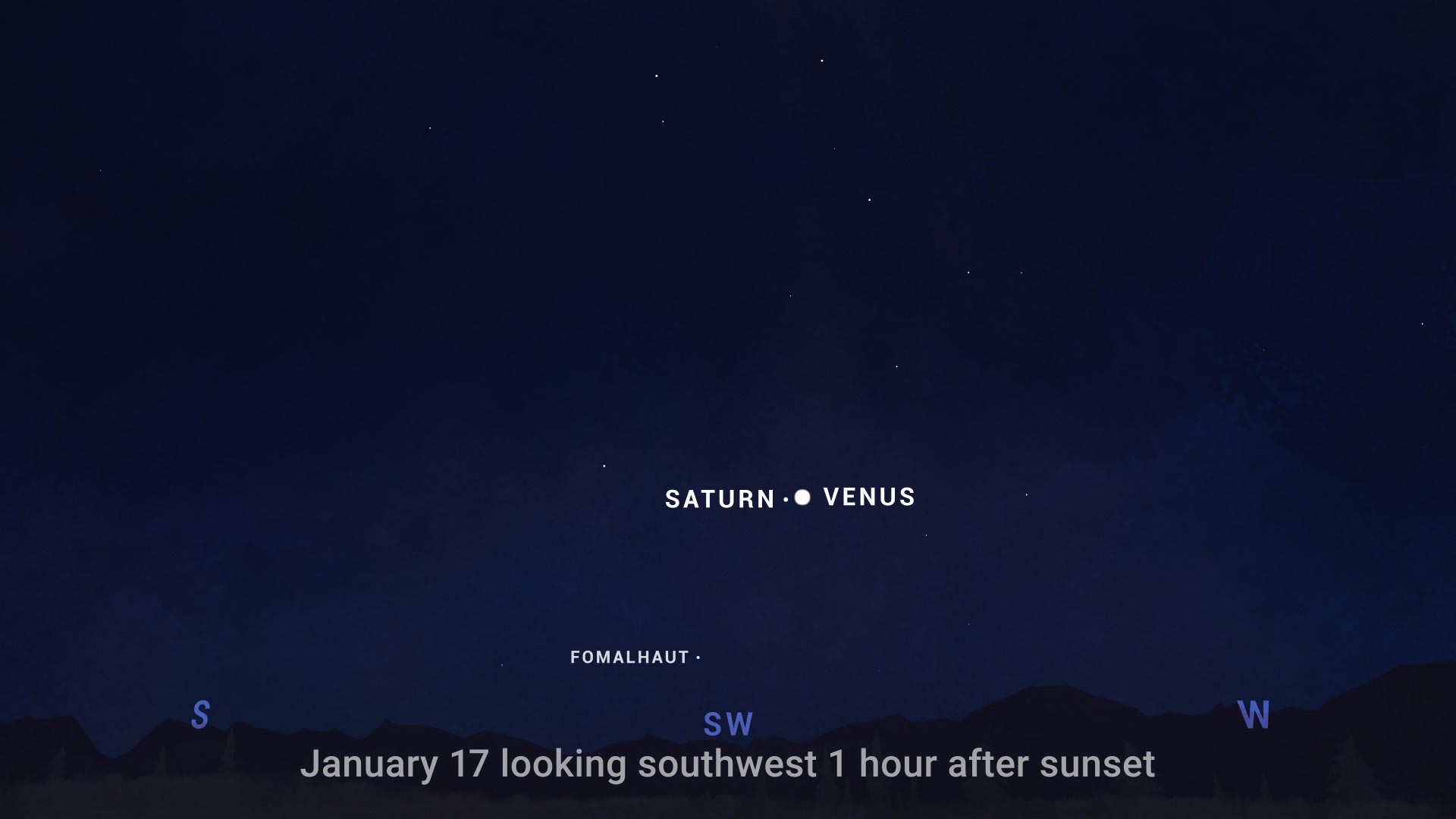
This is exactly what we’ll be seeing from Venus and Saturn as they head for a super close approach in mid-January. After the beginning of the month, they quickly get closer and closer each evening, appearing at their most cozy on the 17th and 18th before going their separate ways. Remember, they’re really hundreds of millions of miles apart in space, so when you observe them, you’re staring clear across the solar system!
Mars reaches “opposition” this month, which is when the planet lies directly on the opposite side of Earth from the Sun, forming a straight line. This is around the time when the planet is at its closest to Earth, making it appear at its biggest and brightest. For Mars, oppositions happen about every two years. This one won’t be the most spectacular ever, but it’s still closer than average, and provides a great opportunity to observe the nearby planet where NASA has five missions currently operating.
And on the 13th, the full Moon cozies up to Mars, appearing super close to the Red Planet that evening. Across the U.S. and Eastern Canada, the Moon will appear to pass in front of Mars over a couple of hours, as the pair rise into the eastern sky. Mars also will be the lone planet in the sky on January mornings. You’ll find it hanging out in the west in morning twilight.
The Quadrantid meteors peak in the early morning hours on January 3rd. Interference from moonlight won’t be a problem, as the Moon is a mere crescent and sets early in the night. The way to see the most meteors is to observe after midnight from clear, dark skies away from bright city lights, and let your eyes adapt to the dark. The meteor rate will be highest as dawn approaches, and you’ll see more meteors from rural locations than in the suburbs. Now, this is a shower best seen from the Northern Hemisphere, and observers in the Northwest and Pacific region will likely have the best viewing this year.
Here are the phases of the Moon for January:

Never miss a breakthrough: Join the SciTechDaily newsletter.
Follow us on Google and Google News.
2 Comments
If you live in a large city, there will be no dazzling.
“Blood Soaked Eyes” is a form of extreme stupidity written by a pathological moron.