

Oxford researchers found that changes in shear-wave splitting can predict volcanic eruptions and their severity. The signal shifted noticeably before a major eruption at Ontake Volcano, offering a promising early warning tool.
A new study led by Professor Mike Kendall from the Department of Earth Sciences has explored a novel monitoring method for providing early warnings of volcanic eruptions.
The research team analyzed earthquake signals from two eruptions of Ontake Volcano in Japan, one small and one explosive. They found that the characteristics of shear-wave splitting varied depending on the eruption’s size.
Published in the journal Seismica, the study suggests that tracking these signals could serve as an effective early warning system for potentially hazardous volcanic activity.
Predicting Volcanic Eruptions
For communities living near volcanoes, early warning systems are essential for survival, but mistrust in these alerts can lead to tragic outcomes. To reduce the risk of false alarms, scientists must find more dependable methods of monitoring volcanic activity.
In a new study, researchers from the University of Oxford examined a seismic phenomenon called shear-wave splitting as a potential tool for providing early warnings of dangerous eruptions.
When magma and rock move within a volcano, they generate seismic waves, but these signals are often complex and difficult to interpret. The study aimed to identify a reliable parameter that could not only indicate when an eruption is likely to occur but also predict how severe it might be.
Shear-Wave Splitting
Shear-wave splitting is a phenomenon where seismic shear-waves waves travel at different speeds depending on their polarization. Cracks and fractures inside the rock can slow down seismic waves, but have a larger delaying effect on seismic waves that travel across the cracks and fractures. If the cracks are aligned in one direction, then the amount of shear-wave splitting increases.
Magma and fluids moving beneath a volcano exert stresses on the surrounding rocks, causing cracks to open in certain orientations and close in others. Examining changes to shear-wave splitting through time can be really useful for scientists, as it tells them where these cracks are opening and closing. But the research team wanted to take this a step further – and test whether the larger stress changes during an explosive eruption also caused a more significant change to the amount of shear-wave splitting.
“Seismic anisotropy – or the effect of rock composition and internal fractures on the speed of shear-waves oscillating at right angles to each other – is a well-documented phenomenon,” said Professor Mike Kendall (Department of Earth Sciences, University of Oxford). “When we reflected on how anisotropy increases as the pressure inside a volcano builds, we were excited to explore if we could detect these changes, and if this could be a distinctive signal which could be applied to early warning systems.”
Observations at Ontake Volcano
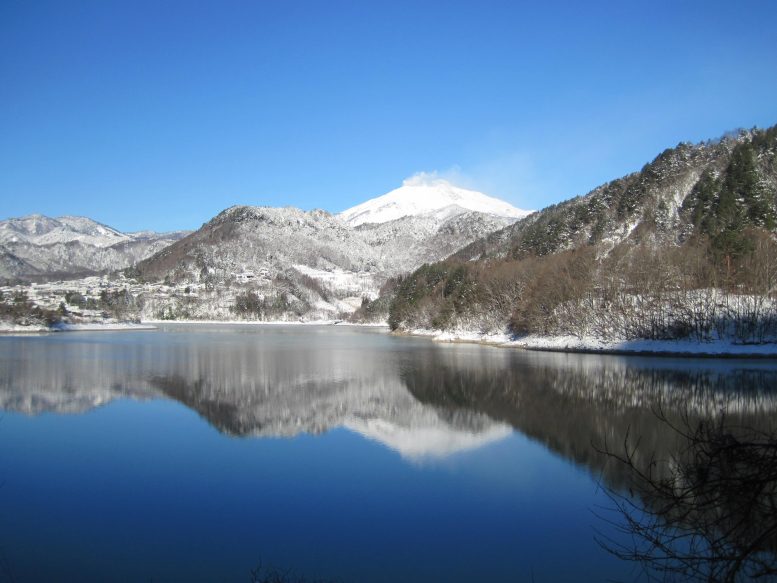
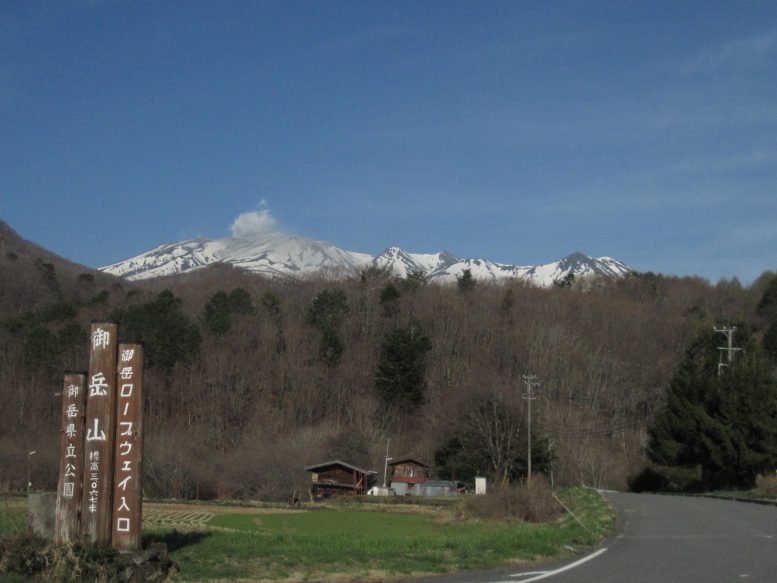
The research team put this theory to the test by examining seismic signals during two eruptions of Ontake Volcano, on Honshū Island in Japan. The 2007 eruption was small and had much less of an impact on the surrounding community, whereas the 2014 eruption was larger, more explosive, and sadly more deadly.
They were excited to discover that during the smaller eruption, the amount of shear-wave splitting remained constant throughout, but during the larger eruption the amount of splitting doubled just before Ontake exploded. The team believes that the larger stress change during the 2014 eruption increased the observed shear-wave splitting, indicating a useful relationship between the amount of splitting and the size of the eruption.
Co-author Professor Toshiko Terakawa (Nagoya University) noted: “The focal mechanisms of volcano-tectonic earthquakes changed drastically before and after the 2014 eruption. Integrating data from shear-wave splitting and earthquake focal mechanisms could provide deeper insights into conditions required for an eruption to occur.”
Co-author Professor Martha Savage (Victoria University of Wellington) added: “The records around two eruptions on Ontake volcano in Japan have been able to show that the method can not only show changes before eruptions, but that they can potentially help to predict the size of an eruption. This work was an example of how cooperation among people from around the globe can address important societal problems.”
A Valuable Early Warning System
Because the change in shear-wave splitting occurred before the eruption of Ontake began, scientists monitoring the volcano will be able to use this parameter as both a vital early-warning system and an indicator of how damaging the eruption could be. This offers a new way to protect local communities from the devastating impacts of a volcanic eruption.
“We expect to see these effects at other volcanoes across the globe, not just at Ontake Volcano,” said co-author Dr. Tom Kettlety (Department of Earth Sciences, University of Oxford). “As changes in volcanic stress occur prior to an eruption, we anticipate that we would see changes in shear-wave splitting. This could be a valuable tool for early warning of volcanic eruptions, especially for local communities.”
Reference: “Changes in seismic anisotropy at Ontake volcano: a tale of two eruptions” by Michael Kendall, Toshiko Terakawa, Martha Savage, Tom Kettlety, Daniel Minifie, Haruhisa Nakamichi and Andreas Wuestefeld, 28 April 2025, Seismica.
DOI: 10.26443/seismica.v4i1.1101
Never miss a breakthrough: Join the SciTechDaily newsletter.
Follow us on Google and Google News.
9 Comments
“… during the larger eruption the amount of splitting doubled just before Ontake exploded.”
Was the delay between the seismic velocities ‘splitting’ and the eruption sufficient warning to be useful? The description leaves me with the impression that the time was too short to be practical to initiate, let alone complete, evacuations.
“We expect to see these effects at other volcanoes across the globe, not just at Ontake Volcano,”
Why do they have such an expectation if they don’t have a rigorous, numerical explanation? It sounds more like a hope. In any event, I don’t see any reason to believe that it has utility as an “early warning” phenomenon. It appears that it is (based on a sample of two) a warning of an imminent explosive event. What is needed is a warning of days, or at least hours, with a low false-positive error rate. A sample of two doesn’t even provide the possibility of a statistical description linking ‘splitting’ to the strength or delay of the eruption.
You have to start somewhere. This hypothesis extrapolates to the same kind of volcanos around the world. And at the same time other types of volcanos will also be studied to see if the same happens. Thats what scientific observation monitoring and writing up the data to contrast other observed vocanos. Collecting a body of data. Examining and coming to a conclusion
It got fine with photos of cosmic/(universal grand master had golden Olympic heavyweight weight (852)lbs,in (96)but alas not worth it got 20)million tons precious 💞 yellow metal gold’s reserve 20 million tons worth approximately $650) trillions GBP dollars USA Zurich Sweden Switzerland Europe France Britain London Fuji 🗻 June Mar )(2019) Fuji volcano 🌋 kilmararo leak’s outside oxygenation 23 miles wavelengths deflector barrier tidally sodium’s polarized inert helium across fo sorta like got it,world-wide reason for my EPAminister gpb dollar’s per million tons worth it oh yeahs sincere love 💕 ur itinerary studio work or anything else wmf kdf nqr ect text type of input data entry UN EPA FDA CDC FEMA calculation fifty million dollars soc security administration mentioned in the mades rite aid was in Naples Florida bout 10 foot dioamond crystal sodium’s absorbs radioactive gamma’s x-ray emf whale’s dolphin seal’s open until came back from DR Micheal India talked to him liz,got it in my names jesse mclemore bitch prescriptions &($680)dollar from back Oct last yrs, she’s won’t get gave me two codine forty dollars five gave me two days before hi magnifier ultraviolet diamond’s beam’s hot tempered silver soduim stryofoam coolers freshaircorpomress use my company investments int’l LLC Inc defunct company but diagrams mechanical schematic drafted oh welll bout up stratosphere here helium’s airlift ground to gammas rays 🐋☀️ photonic ultraviolet diamond’s beam’s five mile tsunami deflector barrier tidally sodium’s polarized inert helium magnetic winner Congressional award winning magnetic 🧲 polarized gas inert helium equator polarizer Earth 🌎 🌍 10 foot tickbyte breathing’s rapids cant oxygenation breathing lungs size disk oh well justemory quit earthstar Milky Way cosmic spatially gyroscopically magnitude last nite sleeping oh well, Jesse McLemore [email protected] May (18/19/20)?&(9:23)pm.gmt, universal cosmic spatially gyroscopically magnitude was bout it roc on baby ha ja hurt ER Franklin KY diagnosis drop in side pancreatic organ did first sept last yrs,wake up stratosphere Fuji volcano 🌋 kilmararo leak’s outside equator polarizer Earth 🌎 🌍 Japan meltdowns disposal of input data report qquit see ci yaJune
I did not understand what the last comment from James McLemore meant.
I wouldn’t worry about it. It is nonsensical word salad. The real question should be why someone feels compelled to write such things, contributing nothing to the thread, and wasting other peoples time. It suggests some kind of mental pathology.
Wt? 🤔
This validates some of the findings in SR-GEO-PoC. Which recent predicted the recent quake in Greece and is now closely monitoring Turkey and Italy as it’s predicting an event in the coming days.
One swallow does not a Spring make.
What is the probability that the earthquake was a random, coincidental event? Did the prediction tells us anything about the magnitude or depth? Is there a history of predictions from which statistics can be derived? What does the error matrix of false-positives and false-negatives look like?
How does this study of Ontake validate ANY of the findings in SR-GEO-PoC?
Hi Clyde, thanks for raising these important questions—scientific skepticism is essential, especially for new frameworks like SR-GEO-PoC (Schumann Resonance – Geophysical Observation & Prediction of Crisis).
To clarify:
1. Coincidence vs. Causality
The SR-GEO-PoC model is not based on a single case. It has issued dozens of forecasts globally, many of which have been timestamped and later validated by observed events, including quakes in Greece, Iran, Indonesia, and Italy and more. Basically we are limited at the lack of available data and are in need of more sensors. Working with what we have had available has been quite fruitful.
2. Magnitude and Depth
Yes, the model does forecast magnitude ranges, typically in tiered bands (e.g., M4.5–6.0 or M5.5–7.0), based on signal intensity and stack alignment across SR, TEC, ELF, gravity, and AGW inputs. While depth is not directly forecasted, signal type and coupling effects can offer indirect indicators of shallow versus deep ruptures.
3. Prediction History and Error Matrix
You’re right—any responsible model must include performance evaluation. A structured error matrix (false positives, false negatives) is being developed now that the model has matured past early pilot runs. Each forecast is scored with a P_event value and confidence rating, allowing future construction of ROC curves and validation metrics.
4. Relevance of Ontake
Ontake is used as a reference case to highlight failure modes in traditional seismic forecasting. SR-GEO-PoC addresses such silent quakes through multi-domain analysis and suppression field modeling, making it relevant in the context of Ontake-like events.
Your challenge is valid—one prediction is never enough. But this isn’t about one. It’s about a consistent, multi-regional series of accurately predicted events using data that was previously not applied to seismic forecasting. That warrants further attention, scrutiny, and collaboration.
Thank you again for the thoughtful critique. The goal here is not to bypass science—but to extend it.