
Close Menu
    Facebook X (Twitter) Instagram
    SciTechDaily
    • Biology
    • Chemistry
    • Earth
    • Health
    • Physics
    • Science
    • Space
    • Technology
    Facebook X (Twitter) Pinterest YouTube RSS
    SciTechDaily
    Home»Space»Euclid Space Telescope Reveals How the Milky Way Tears Apart Star Clusters
    Space

    Euclid Space Telescope Reveals How the Milky Way Tears Apart Star Clusters

    By University of SurreySeptember 9, 2024No Comments2 Mins Read
    Facebook Twitter Pinterest Telegram LinkedIn WhatsApp Email Reddit
    Share
    Facebook Twitter LinkedIn Pinterest Telegram Email Reddit
    Euclid Mission
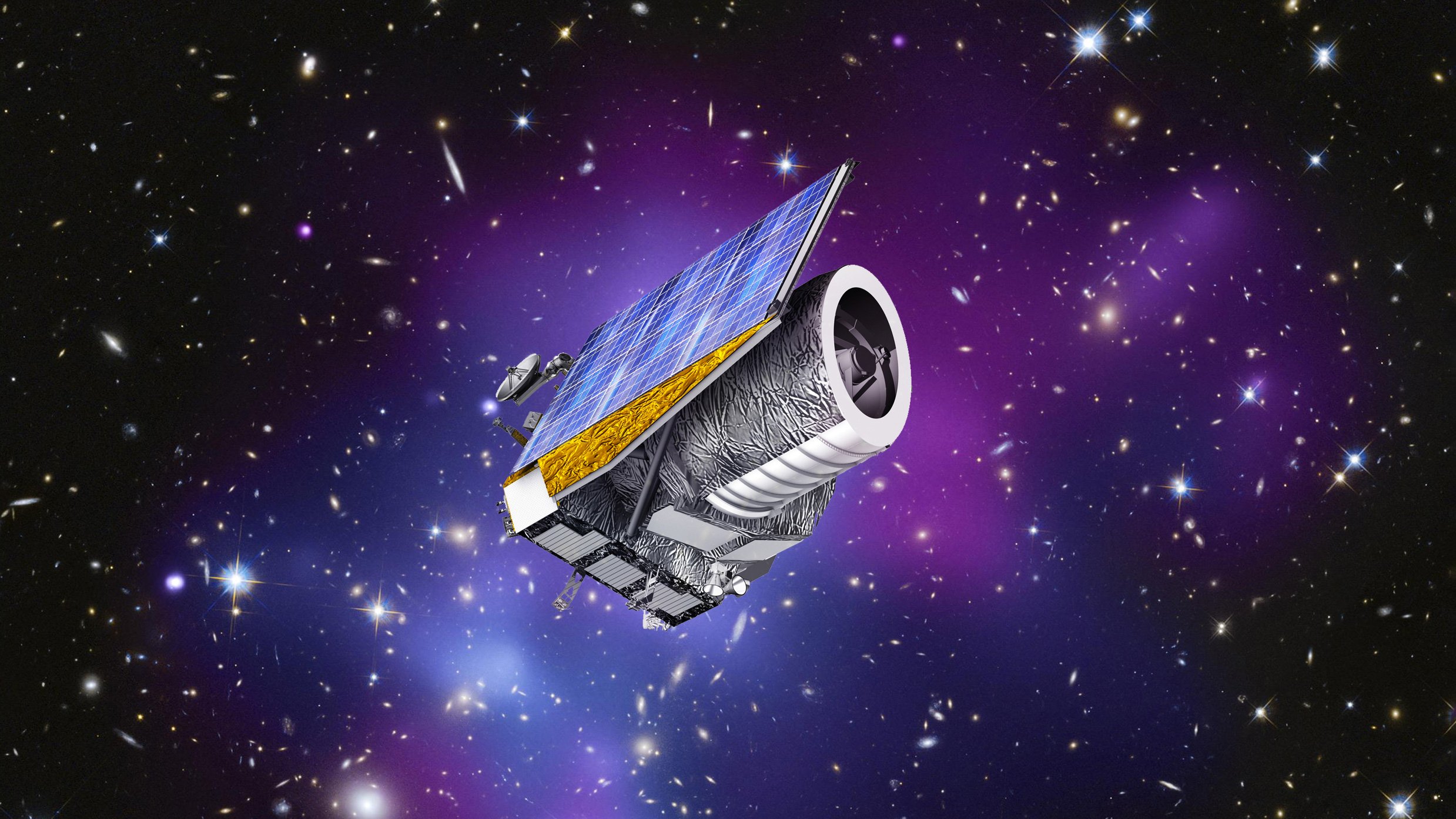
    Launched on July 1, the Euclid mission is designed to study dark matter and dark energy to answer big questions about why our universe is expanding faster and faster. Credit: ESA/C. Carreau

    Researchers at the University of Surrey have confirmed their astrophysical models using new data from the Euclid space telescope, demonstrating how the Milky Way’s gravity affects star clusters.

    As the European Space Agency (ESA) publishes the first findings from its Euclid space telescope, scientists from the University of Surrey are celebrating fresh insights from the data.

    Dr. Denis Erkal, Associate Professor of Astrophysics at the University of Surrey, studies how the gravity of the Milky Way pulls clusters of stars apart, creating streams of stars trailing across the galaxy.

    Now, his model for how this happens (video below) has been confirmed by data from Euclid.


    Dynamical evolution of M10 (NGC6254) in the Milky Way potential over 2 billion years. The simulation starts when M10 is at apocenter (2.03 billion years ago) and then evolves to the present. As M10 orbits the Milky Way, its stars get tidally stripped and begin to orbit the Milky Way, forming rivers of stars on the sky. Euclid has observed the inner region of this globular cluster and shown that its tidal disruption matches this N-body simulation. Credit: University of Surrey

    Dr. Erkal said:

    “For a long time, my modelling predicted how the gravity of our Galaxy would pull apart clusters of stars like Messier 10.

    “This first data from Euclid shows M10 behaving almost exactly as our models predicted it would. With future data from Euclid, we can explore how many of the star clusters in our Galaxy are getting pulled apart.

    “Euclid has brought thousands of scientists together across hundreds of universities. By getting involved, Surrey has been able to continue our pioneering research into these streams of stars.”

    Dr. Erkal also worked with Dr. Michelle Collins to help the Euclid team identify possible new galaxies in the telescope’s images.

    Dr. Collins said:

    “These stunning first images are just the tip of the iceberg. Euclid’s powerful equipment can reveal small dwarf galaxies, identify free-floating rogue planets, and help us understand dark matter.

    “This telescope can reveal millions of new objects in a single day. We’re only just beginning to realise its potential.”

    Never miss a breakthrough: Join the SciTechDaily newsletter.
    Follow us on Google and Google News.

    Astronomy Astrophysics Euclid Mission University of Surrey
    Share. Facebook Twitter Pinterest LinkedIn Email Reddit

    Related Articles

    Unveiling the Universe: Euclid’s First Images Illuminate Dark Matter Mysteries

    Galactic Wonders Unveiled: Euclid’s Deep Dive Into the Perseus Cluster

    Euclid’s Starry-Eyed Solution: Navigating the Dark Universe’s Mysteries

    Cosmic Detectives: NASA’s Roman and ESA’s Euclid Will Team Up To Investigate Dark Energy

    Euclid “Dark Universe” Explorer: First Test Images Tease of Riches To Come

    Euclid Space Telescope To Shed Light on the Dark Universe – “A Revolution in Physics Is Almost Guaranteed”

    Euclid Spacecraft Fueled for Launch – New Space Telescope Will Explore the Dark Universe

    Galactic Archeologists Discover “Fossil” of One of the First Ever Galaxies

    Rate of Nuclear Reaction in Exploding Stars Identified by Mimicking Excited Quantum States With Exotic Nuclei

    Leave A Reply Cancel Reply

    • Facebook
    • Twitter
    • Pinterest
    • YouTube

    Don't Miss a Discovery

    Subscribe for the Latest in Science & Tech!

    Trending News

    Popular Sugar-Free Sweetener Linked to Liver Disease, Study Warns

    What Is Hantavirus? The Deadly Disease Raising Alarm Worldwide

    Scientists Just Discovered How the Universe Builds Monster Black Holes

    Scientists Unveil New Treatment Strategy That Could Outsmart Cancer

    A Simple Vitamin May Hold the Key to Treating Rare Genetic Diseases

    Scientists Think the Real Fountain of Youth May Be Hiding in Your Gut

    Ravens Don’t Follow Wolves, They Predict Them

    This Common Knee Surgery May Be Doing More Harm Than Good

    Follow SciTechDaily
    • Facebook
    • Twitter
    • YouTube
    • Pinterest
    • Newsletter
    • RSS
    SciTech News
    • Biology News
    • Chemistry News
    • Earth News
    • Health News
    • Physics News
    • Science News
    • Space News
    • Technology News
    Recent Posts
    • Why Are So Many New Fathers Dying? Scientists Say the U.S. Has a Dangerous Blind Spot
    • Scientists Identify Simple Supplement That Greatly Reduces Alzheimer’s Damage
    • You May Have a Dangerous Type of Cholesterol Even if Your Tests Look Normal
    • Study Reveals Dangerous Flaw in AI Symptom Checkers
    • New MRI Breakthrough Captures Stunningly Clear Images of the Eye and Brain
    Copyright © 1998 - 2026 SciTechDaily. All Rights Reserved.
    • Science News
    • About
    • Contact
    • Editorial Board
    • Privacy Policy
    • Terms of Use

    Type above and press Enter to search. Press Esc to cancel.