

What is the universe expanding into if it’s already infinite?
The universe expands by itself, not into any external space, with galaxies continuously moving away from the Milky Way. Initiated by the Big Bang, this expansion is accelerating due to dark energy, which comprises most of the universe’s total energy. The complexities of expansion challenge both foundational physics and lead to theories like the multiverse, aiming to reconcile quantum mechanics with gravity.
Expanding Without Boundaries
When you bake a loaf of bread or a batch of muffins, the dough goes into a pan. As it bakes, the dough expands, pushing against the sides of the pan. If there are chocolate chips or blueberries in the batter, they spread farther apart as the dough rises.
The expansion of the universe works similarly — but with one key difference. While dough expands into the pan, the universe doesn’t expand into anything. It expands within itself.
This idea can feel like a brain teaser because the universe includes everything that exists. There’s no external “pan” holding it. If such a container existed, it would be part of the universe too — and would expand right along with it.

Understanding Cosmic Expansion
Even for someone like me, a teaching professor in physics and astronomy who has studied the universe for years, this concept is hard to wrap my head around. It’s as tricky as asking what lies farther north than the North Pole.
A helpful way to picture the universe’s expansion is to consider how galaxies move. Scientists know the universe is expanding because they observe galaxies drifting away from the Milky Way. They define expansion by how fast these galaxies move apart. This approach helps describe the universe’s growth without needing an external space for it to expand into.
Origins of the Universe
The universe started with the Big Bang 13.8 billion years ago. The Big Bang describes the origin of the universe as an extremely dense, hot singularity. This tiny point suddenly went through a rapid expansion called inflation, where every place in the universe expanded outward. But the name Big Bang is misleading. It wasn’t a giant explosion, as the name suggests, but a time where the universe expanded rapidly.
The universe then quickly condensed and cooled down, and it started making matter and light. Eventually, it evolved to what we know today as our universe.
Discovery of Expansion
The idea that our universe was not static and could be expanding or contracting was first published by the physicist Alexander Friedman in 1922. He confirmed mathematically that the universe is expanding.
While Friedman proved that the universe was expanding, at least in some spots, it was Edwin Hubble who looked deeper into the expansion rate. Many other scientists confirmed that other galaxies are moving away from the Milky Way, but in 1929, Hubble published his famous paper that confirmed the entire universe was expanding, and that the rate it’s expanding at is increasing.
The Mystery of Accelerating Expansion
This discovery continues to puzzle astrophysicists. What phenomenon allows the universe to overcome the force of gravity keeping it together while also expanding by pulling objects in the universe apart? And on top of all that, its expansion rate is speeding up over time.
Many scientists use a visual called the expansion funnel to describe how the universe’s expansion has sped up since the Big Bang. Imagine a deep funnel with a wide brim. The left side of the funnel – the narrow end – represents the beginning of the universe. As you move toward the right, you are moving forward in time. The cone widening represents the universe’s expansion.
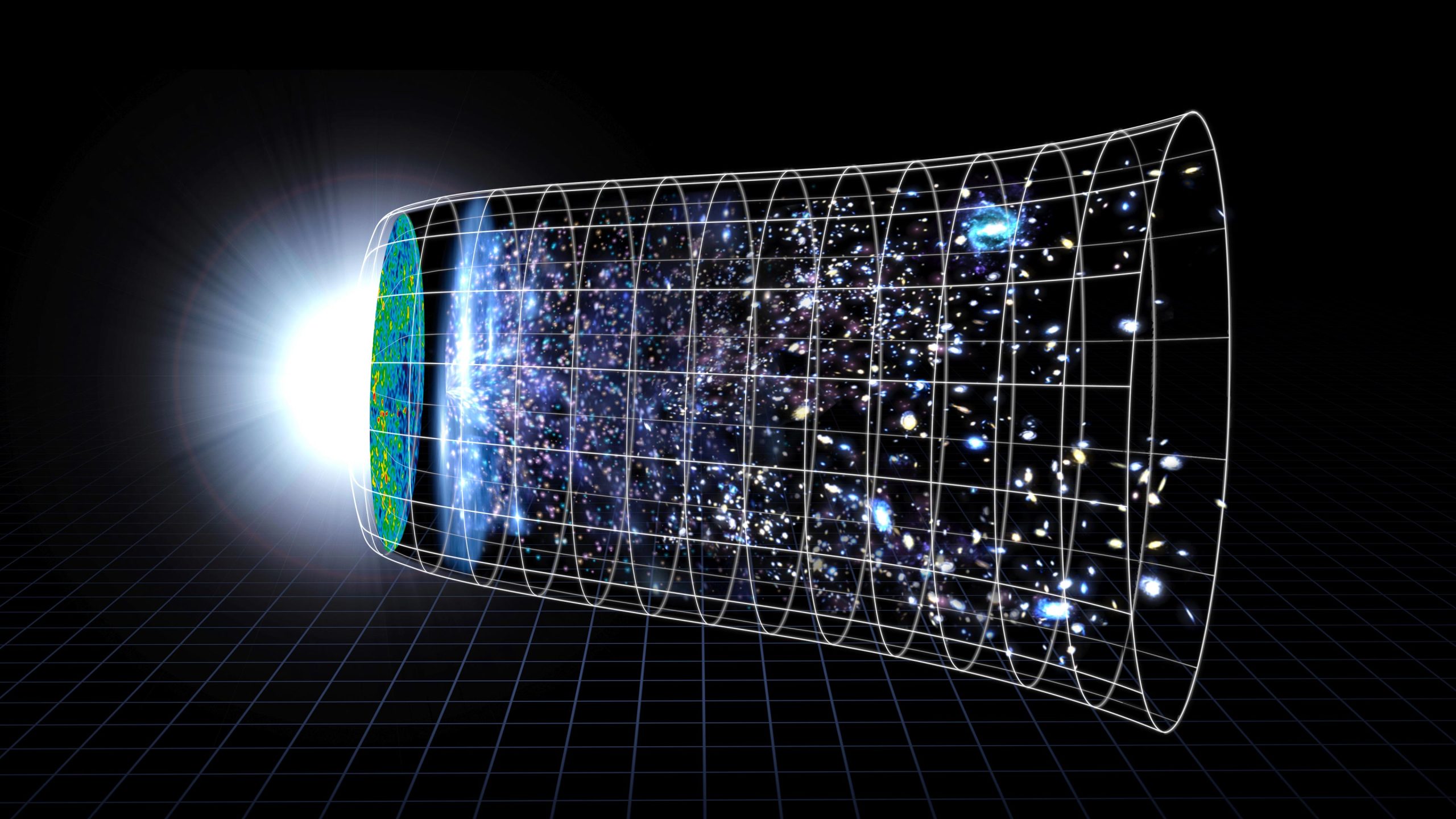
Scientists haven’t been able to directly measure where the energy causing this accelerating expansion comes from. They haven’t been able to detect it or measure it. Because they can’t see or directly measure this type of energy, they call it dark energy.
According to researchers’ models, dark energy must be the most common form of energy in the universe, making up about 68% of the total energy in the universe. The energy from everyday matter, which makes up the Earth, the Sun, and everything we can see, accounts for only about 5% of all energy.

Outside the Expansion Funnel
So, what is outside the expansion funnel?
Scientists don’t have evidence of anything beyond our known universe. However, some predict that there could be multiple universes. A model that includes multiple universes could fix some of the problems scientists encounter with the current models of our universe.
One major problem with our current physics is that researchers can’t integrate quantum mechanics, which describes how physics works on a very small scale, and gravity, which governs large-scale physics.
Bridging Theories at Different Scales
The rules for how matter behaves at the small scale depend on probability and quantized, or fixed, amounts of energy. At this scale, objects can come into and pop out of existence. Matter can behave as a wave. The quantum world is very different from how we see the world.
At large scales, which physicists call classical mechanics, objects behave how we expect them to behave on a day-to-day basis. Objects are not quantized and can have continuous amounts of energy. Objects do not pop in and out of existence.
The quantum world behaves kind of like a light switch, where energy has only an on-off option. The world we see and interact with behaves like a dimmer switch, allowing for all levels of energy.
But researchers run into problems when they try to study gravity at the quantum level. At the small scale, physicists would have to assume gravity is quantized. But the research many of them have conducted doesn’t support that idea.

Theoretical Implications and Future Outlook
One way to make these theories work together is the multiverse theory. There are many theories that look beyond our current universe to explain how gravity and the quantum world work together. Some of the leading theories include string theory, brane cosmology, loop quantum theory, and many others.
Regardless, the universe will continue to expand, with the distance between the Milky Way and most other galaxies getting longer over time.
Written by Nicole Granucci, Instructor of Physics, Quinnipiac University.
Adapted from an article originally published in The Conversation.
Never miss a breakthrough: Join the SciTechDaily newsletter.
Follow us on Google and Google News.
24 Comments
Accustomed to being misled by pseudoscience and deleting comments is a hobby of the SPACE column.
However, the act of deleting comments can be perceived as evasive and unprofessional, akin to the proverbial ostrich burying its head in the sand.
Scientific research guided by correct theories can help people avoid detours, failures, and exaggeration. The physical phenomena observed by researchers in experiments are always appearances, never the natural essence of things. The natural essence of things needs to be extracted and sublimated based on mathematical theories via appearances , rather than being imagined arbitrarily.
Please respect the interaction and balance of topological vortices and their fractal structures.
This method have it’s limitations based on our sensorics arrays which the nature equip us with.
The universe is not algebra, or formulas, or fractions. The universe is the superposition, deflection and entanglement of geometric shapes, is the interaction and balance of topological vortices and their fractal structures. The particles imagined in physics are no different from the gods with own responsibilities imagined in mythology.
The ScieTechDaily column is, quite obviously, posting articles about science. The original posted on the Conversation is written by a physics instructor.
If your comments, which almost always propose “topological vortices” as fundamental for physics – a pseudoscience claim without even an attempt to quantification and test – are deleted, the science interested readers are likely thankful for such cleaning up of science pages. Everyone is entitled to their opinion, but your opinion is suited for pseudoscience sites.
VERY GOOD!!!
From cosmic accretion disks to quantum spins, as physical entities, vortex gravitational fields are ubiquitous. Topological vortices are both mathematical and physical realities. As you understand it, for today’s physics, topological vortices are mathematics and pseudoscience.
If the universe is infinite, which it well may be, it would not become larger with time if it is expanding nor would it get smaller with time if you run the clock backwards as astrophysicists like to surmise to justify the “singularity”” hypothesis. The math is simple, infinity minus any finite number equals infinity.
Once I saw “dark energy” in the first paragraph, there was no reason to read further.
Because you don’t like such well established facts of nature?
You can’t very well write about cosmology and not mention the standard dark energy-dark matter (lambda-CDM) theory.
“Assuming that the lambda-CDM model of cosmology is correct,[1] dark energy dominates the universe, contributing 68% of the total energy in the present-day observable universe while dark matter and ordinary (baryonic) matter contribute 26% and 5%, respectively, and other components such as neutrinos and photons are nearly negligible.[2][3][4][5] “
Refer to my comment on the Nov. 12 article ‘ Reimagining the Drake Equation ‘, and then have a good think about lambda-CDM being well established facts of nature. That you still call it ‘ theory ‘ says that there are still significant gaps. Imagination may or may not be more important than knowledge, but there would be no progress without it.
…Also, refer to the Jan. 1 article, addressing a ‘ lumpy ‘ universe. Keep an open mind… there’s plenty of universe left to be revealed.
Slight boo-boo Hubble discovered that the universe is expanding, but did not know the expansion was accelerating. That came later. At least I think that is correct.
True.
After Hubble’s discovery it was assumed that the expansion will slow over time – the only questions were by how much and what will be the eventual fate of the universe.
The accelerating expansion was discovered sometime in the 1990s.
I didn’t see that. But interestingly, while he couldn’t confirm it, his paper mention that there could well be such a “de Sitter cosmology” effect. Rather prescient.
“In the de Sitter cosmology, displacements of the spectra arise from two sources, an apparent slowing down of atomic vibrations and a general tendency of material particles to scatter. The latter involves an acceleration and hence introduces the element of time. The relative importance of these two effects should determine the form of the relation between distances and observed velocities; and in this connection it may be emphasized that the linear relation found in the present discussion is a first approximation representing a restricted range in distance.”
The fun part is when you actually believe that you have found out most likely the unification theory of everything which doesnt contradict any of the current Newtonian and Einsteinian theories, but actually they are just a subset of your theory, but yet no one wanna read the draft since “you are not professional physicist”. It is kinda sad to waiting and looking how the other struggling to achieve even a fraction of what you have discovered but been silenced to reveal.
These are all common sense.
Thank you for your understanding.
However, in the struggle against rampant pseudoscience, there is only anger and no sadness.
No, we are not angry at you two, we are saddened at best.
Yes, it is a quality bar to get published in peer review journals, as it should be. Science and science theory is a meritocracy.
Happy Merry Christmas , the universe is larger than we can imagine , our lives will play through and in the end you will have only existed in the time you spent living . try to enjoy your existence .
Yes. Very nice! Spin of each topological vortex occupies a certain space and maintains its own existence at a specific time.
At this point they’re just making sh!t up, just like the theologians.
There was little speculation in the article, bar two obvious points (see my own article response).
That they are making sh!t up is you making sh!t up. 😜
The specific answer to the question is excellent!
The context description is also god, only marred by some arguable claims.
The Big Bang theory is most generally a description of the space expansion process that produces the universe, and modern observations has made extraneous claims of an initial singularity questionable. “Surprise: the Big Bang isn’t the beginning of the universe anymore We used to think the Big Bang meant the universe began from a singularity. Nearly 100 years later, we’re not so sure.”
“Lastly, and perhaps most importantly, we can no longer speak with any sort of knowledge or confidence as to how — or even whether — the universe itself began. By the very nature of inflation, it wipes out any information that came before the final few moments: where it ended and gave rise to our hot Big Bang. Inflation could have gone on for an eternity, it could have been preceded by some other nonsingular phase, or it could have been preceded by a phase that did emerge from a singularity.” [Ethan Siegel, Starts With A Bang.]
Quantization of gravity can be done in the usual manner, and the resulting effective field theory works. [“Quantum gravity as a low energy effective field theory”, John Donoghue, Scholarpedia] All such theories work up to the Planck scale, and it is only if you want to incorporate that elusive goal which leads into trouble.
But then again, some modified gravity theories such as MOND and the here mention loop string theory runs afoul on grounds of relativity. They predict that light and gravity has different transmission speeds, but the 2917 binary neutron star merger multimessenger observation rejected that. “Troubled Times for Alternatives to Einstein’s Theory of Gravity
New observations of extreme astrophysical systems have “brutally and pitilessly murdered” attempts to replace Einstein’s general theory of relativity.”. [Katia Moskvitch, Quanta Magazine.]
I have a theory that Temporality, Polarity, And Magnetics originate in a 3d toros pattern, all 3 mediated, mixed, and balanced by gravity as an intrinsic property of the point singularity, holding it together. Together they create the tetrahedron of the projection of reality which would be similar to triangular penrose tiling as the quantum foam. As you scale up, these things connect in “strings” like Tesla demonstrated, and other geodesics shapes in more wild ways than could ever be imagined which is why infinitys appear so regularly, with Teslas 3 6 9 forming the basis of all reality and how it mixes and forms scalar and complex life like DNA, cells, animals, humans, etc. With Pansychism, consciousness is an intrinsic property of physical matter at the most basic and highest fractal scales. Starting with 1D point singularity with gravity, and the 3 energetic dimensions in the toros pattern around it. All the way up to the 9th physical dimension, and the 10-12 energetic dimensions emonating from the 9D Brane also holds toroidal patterns across every physical scale. The 10th is infinite light/consciousness holding everything together in a 10D geodesics pattern of light which permiates the layers of physical reality and holds it together. Then 11-12D set up for (Infinite combinations of info encoding & fractal repeat along a lattice maintained by the physical dimensionality of the consciousness within, we would be 3D physical reality with solid matter being consciously compacted to 2d faces and light behaving as a singularity without physical mass but still holding energy and informational encoding in toroidal wave patterns. I have an entire framework and theoretical papers detailing this in much more depth.
The Big Bang is the basis of cosmology, and the presence of DM and DE, which are not detected in observations, is important. The main postulate of BB: instantaneous appearance of space, matter and energy. Based on this, models of the formation of stars and galaxies were obtained. Why everything appeared at this particular moment, and not at some other time, is unclear. Recent observations with the Webb Telescope indicate serious shortcomings of these models, in particular the inability to explain the unusually rapid emergence of formed galaxies. Here we show that instead of instantaneous birth, the Universe undergoes an evolutionary development from chaotic space to metric space, when stable formations of elastons appear, possessing elastic energy and giving birth to stars, galaxies, and volumes of flat space, bypassing the singularity. This model avoids many of the problems faced by the Big Bang. Clouds of gas and dust are the by-product, not the cause, of the evolution of space objects. There are two types of boundaries available in our model, and both have very important physical functions. The first type of boundaries separating elastons from Euclidean space, which becomes ideal for fulfilling conservation laws. The second type of boundaries-the boundary between Euclidean and external non-metrizable space is a thermalizer serving as a source of CMBR. https://www.academia.edu/117320193/Early_Galaxies_and_Elastons