
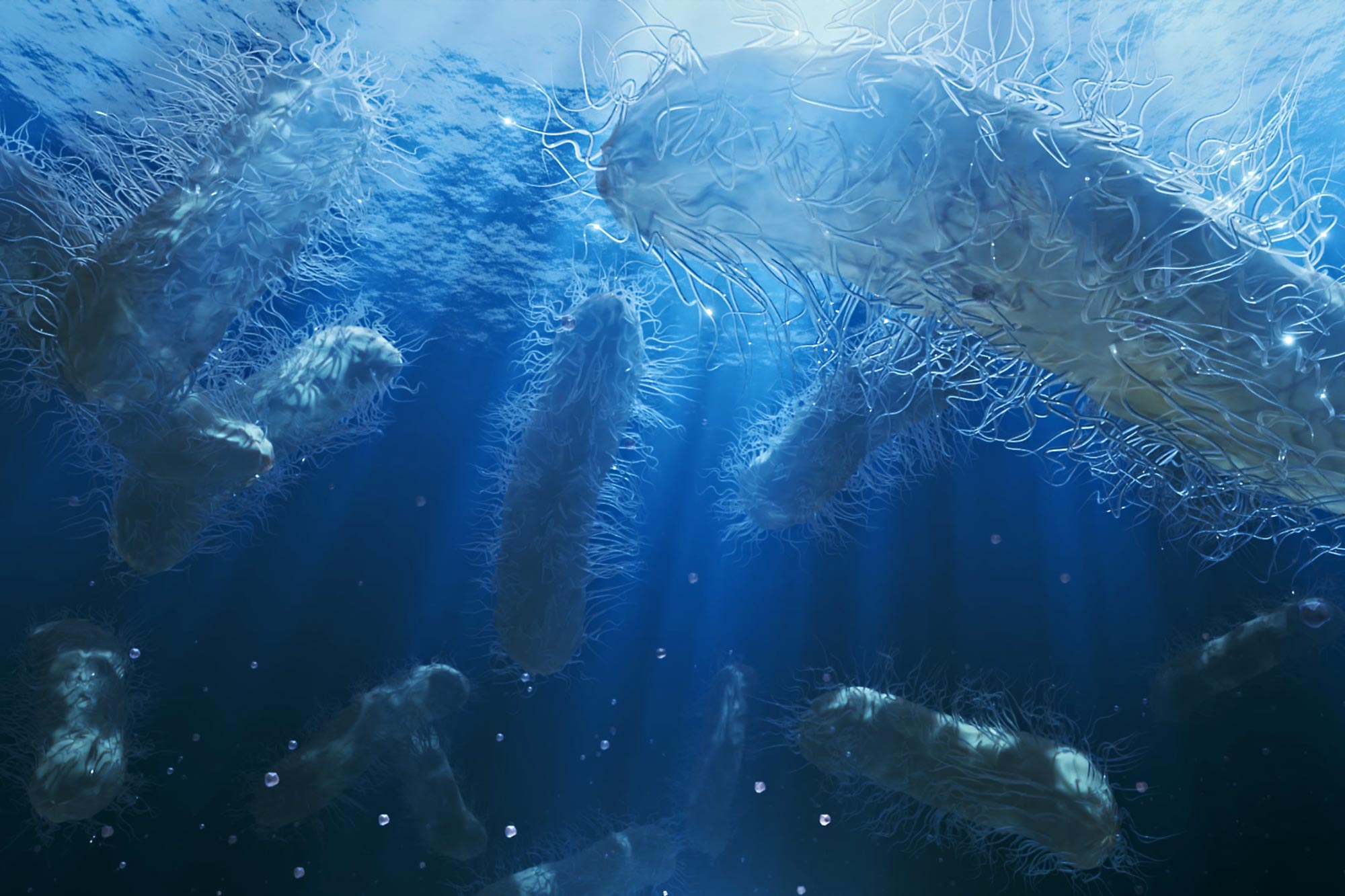
High pressure in the deep ocean may squeeze nutrients from sinking “marine snow,” feeding deep-sea microbes and altering how carbon moves through the ocean.
For decades, scientists have considered the deep ocean a nutrient-poor environment where microbes survive on scarce resources. New research from the University of Southern Denmark (SDU), however, suggests this view may be incomplete.
Biologists from SDU’s Department of Biology report that nutrients in the deep ocean may be more available than previously thought. Their findings indicate that microbes may access a previously unrecognized source of dissolved organic food.
The study found that sinking organic particles known as marine snow begin releasing dissolved carbon and nitrogen when they reach depths of 2–6 kilometers (1.2–3.7 miles). These nutrients then become available to microbes living in the surrounding seawater. According to the researchers, the release occurs because of the extreme hydrostatic pressure found at such depths.
Like a giant juicer
“The pressure acts almost like a giant juicer,” says first author of the study, biologist and Associate Professor Peter Stief from research centers Nordcee and Danish Center for Hadal Research, “It squeezes dissolved organic compounds out of the particles, and microbes can use them immediately.”
The research team has published their findings in the journal Science Advances.
The researchers estimate that these sinking particles may release up to 50% of their original carbon and between 58% and 63% of their nitrogen during their descent.
How today’s oil and gas was created
The discovery also has implications for the global carbon cycle. If marine snow loses large amounts of carbon before reaching the seafloor, less carbon may end up stored in deep-sea sediments than scientists once assumed.
Instead, the released carbon remains dissolved in deep ocean water. It may stay there for hundreds or even thousands of years before slowly returning to the surface ocean and eventually the atmosphere.
Carbon that becomes buried in sediments follows a very different path. Once trapped in seafloor deposits, it can remain locked away for millions of years. Over long periods, this buried carbon can accumulate in massive quantities. Much of the oil and gas extracted today formed through this process.
“This process affects how much carbon the ocean can store and for how long,” says Peter Stief, “It’s relevant for understanding climate processes and for improving future models.”
Special-built pressure tank
In the ocean, marine snow forms when small pieces of organic material clump together. These particles can include dead algae, microbes, and other organic debris drifting through the water. As they gather and sink through the water column, the clusters often resemble tiny snowflakes, which is how marine snow gets its name.
To investigate the process in the lab, the researchers created artificial marine snow using diatoms. These microscopic algae naturally aggregate in the ocean and frequently form marine snow.
The team placed the particles in specially designed pressure tanks to simulate deep-sea conditions. The tanks rotated continuously, which kept the particles suspended so they did not settle at the bottom.
Under these conditions, the scientists observed that as much as half of a particle’s carbon content could leak out during its descent. Most of the released material consisted of proteins and carbohydrates, substances that deep water microbes can easily consume.
Next step is an expedition to the Arctic
Their tests showed that microbes respond rapidly. Within two days, bacterial abundance increased 30-fold, and respiration rates rose sharply. This indicates that the leaked organic matter serves as a fast and valuable energy source at great depth.
The team found the same leakage behavior across multiple diatom species, suggesting that the mechanism is widespread in the ocean.
The next step is to search for evidence of the observed process directly in the ocean, more specifically to search for matching molecular fingerprints in surface and deep waters. The researchers hope to be able to do this in an upcoming expedition to the Arctic with the German research vessel Polarstern.
Reference: “The ocean’s biological carbon pump under pressure” by Jack J. Middelburg, 4 February 2026, Science Advances.
DOI: 10.1126/sciadv.aef3182
This work was supported by the Danish National Research Foundation, the European Union’s Horizon 2020 Research and Innovation, and the Independent Research Fund Denmark.
Never miss a breakthrough: Join the SciTechDaily newsletter.
Follow us on Google and Google News.