

Research from the University of Washington revealed that COVID-19 restrictions led to accelerated brain aging in adolescents, more so in girls, with an average maturation increase of 4.2 years.
This was attributed to reduced social interaction and increased stress, highlighting the unique vulnerability of teenage girls during the pandemic. Ongoing studies will focus on whether these changes are reversible or permanent.
Impact of COVID-19 on Adolescent Mental Health
During the COVID-19 pandemic, governments around the world implemented restrictive measures — such as stay-at-home orders and school closures — to mitigate the spread of the respiratory illness. It’s been well-documented that this disruption of daily routines and social activities had a negative impact on the mental health of adolescents.
Adolescence, the period of transition between childhood and adulthood, is marked by dramatic changes in emotional, behavioral, and social development. It’s also a time when a sense of self-identity, self-confidence, and self-control are developed. The pandemic reduced social interaction for teenagers and led to documented reports of anxiety, depression, and stress, especially for girls.
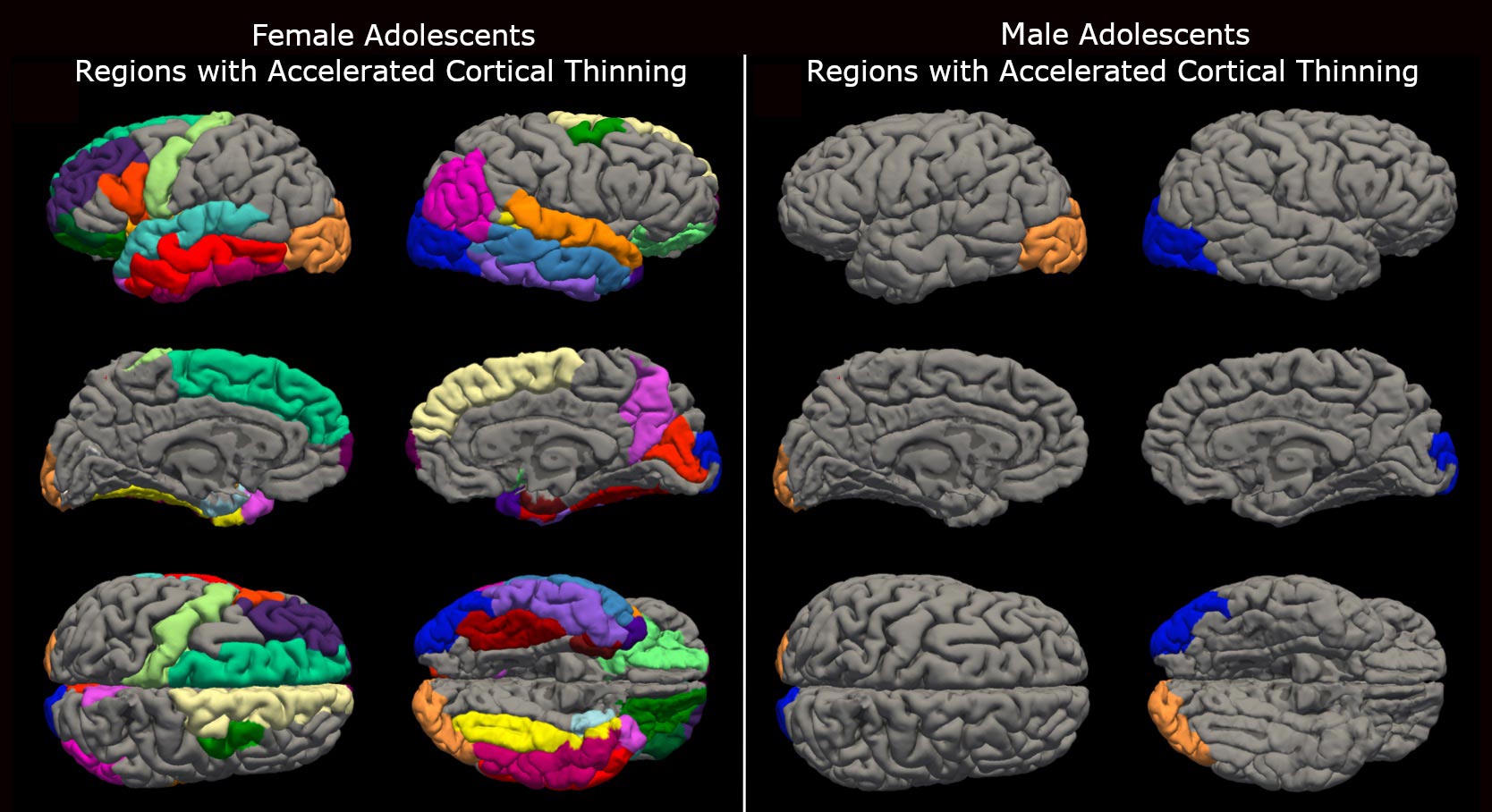
Accelerated Brain Maturation in Adolescents During the Pandemic
New research from the University of Washington, published online today (September 9) in the Proceedings of the National Academy of Sciences, found the pandemic also resulted in unusually accelerated brain maturation in adolescents. This maturation was more pronounced in girls. When measured in terms of the number of years of accelerated brain development, the mean acceleration was 4.2 years in females and 1.4 years in males.
“We think of the COVID-19 pandemic as a health crisis,” said Patricia Kuhl, senior author and co-director of the UW Institute for Learning & Brain Sciences (I-LABS), “but we know that it produced other profound changes in our lives, especially for teenagers.”
Study Methodology and Key Findings
Brain maturation is measured by the thickness of the cerebral cortex, the outer layer of tissue in the brain. The cerebral cortex naturally thins with age, even in teens. Chronic stress and adversity are known to accelerate cortical thinning, which is associated with an increased risk for the development of neuropsychiatric and behavioral disorders. Many of these disorders, such as anxiety and depression, often emerge during adolescence — with females at a higher risk.
The UW research began in 2018 as a longitudinal study of 160 teens between 9 and 17 years, with the original objective of evaluating changes in brain structure during typical adolescence.
The cohort was slated to return in 2020, but the pandemic delayed the repeat tests until 2021. By then, the original intent to study typical teen development was no longer viable.
“Once the pandemic was underway, we started to think about which brain measures would allow us to estimate what the pandemic lockdown had done to the brain,” said Neva Corrigan, lead author and research scientist at I-LABS. “What did it mean for our teens to be at home rather than in their social groups — not at school, not playing sports, not hanging out?”
Gender Differences in Brain Development and Future Research Directions
Using the original 2018 data, researchers created a model of expected cortical thinning during the teen years. They then re-examined the brains of the adolescents, over 80% of whom returned for the second set of measurements. The teens’ brains showed a general effect of accelerated thinning across adolescence, but this was much more pronounced in females. The cortical thinning effects in females were seen all over the brain, in all lobes and both hemispheres. In males, the effects were only seen in the visual cortex.
The greater impact on female brains as opposed to male brains could be due to differences in the importance of social interaction for girls versus boys, Kuhl said. She added that female teenagers often rely more heavily on the relationships with other girls, prioritizing the ability to gather, talk to each other, and share feelings. Boys tend to gather for physical activity.
“Teenagers really are walking a tightrope, trying to get their lives together,” Kuhl said. “They’re under tremendous pressure. Then a global pandemic strikes and their normal channels of stress release are gone. Those release outlets aren’t there anymore, but the social criticisms and pressures remain because of social media. What the pandemic really seems to have done is to isolate girls. All teenagers got isolated, but girls suffered more. It affected their brains much more dramatically.”
The cerebral cortex is unlikely to get thicker again, Kuhl said, but the potential for recovery might take the form of slower thinning over time, after the return of normal social interactions and outlets. Further research will be needed to see if this is the case.
“It is possible that there might be some recovery,” Kuhl said. “On the other hand, it’s also possible to imagine that brain maturation will remain accelerated in these teens.”
In older populations, measures of cognitive brain function, such as processing speed and the ability to complete typical tasks, correlate with how much the cerebral cortex has thinned. That kind of data is not yet available for teenagers, Kuhl said, but it could be where future research is headed.
“The pandemic provided a test case for the fragility of teenagers’ brains,” Kuhl said. “Our research introduces a new set of questions about what it means to speed up the aging process in the brain. All the best research raises profound new questions, and I think that’s what we’ve done here.”
Reference: “COVID-19 lockdown effects on adolescent brain structure suggest accelerated maturation that is more pronounced in females than in males” by Neva M. Corrigan, Ariel Rokem and Patricia K. Kuhl, 9 September 2024, Proceedings of the National Academy of Sciences.
DOI: 10.1073/pnas.2403200121
Ariel Rokem, a UW research associate professor of psychology and data science fellow at the eScience Institute, is a co-author. The research was funded by a grant from the Bezos Family Foundation.
Never miss a breakthrough: Join the SciTechDaily newsletter.
Follow us on Google and Google News.
4 Comments
This study tries to make a causal link between brain thinning and social deprivation in girls more than boys, due to COVID lockdowns. “What the pandemic really seems to have done is to isolate girls. All teenagers got isolated, but girls suffered more. It affected their brains much more dramatically.” There is no mention of a mechanism by which social isolation would lead to thinning of the cerebral cortex, apart from some nebulous statement that stress can do this. COVID lockdowns are regarded as the stressor that thinned girls’ brains, but not boys brains as much.
There is no mention of whether these kids contracted COVID-19 during the pandemic, or had vaccinations. The spike protein and the virus have been shown to enter the brain. It is more likely that a viral infection in the brain is causing cortical thinning, than a lack of social interactions for girls.
There is also some sexism here, assuming that social interactions are more important for girls than for boys. “The greater impact on female brains as opposed to male brains could be due to differences in the importance of social interaction for girls versus boys, Kuhl said. She added that female teenagers often rely more heavily on the relationships with other girls, prioritizing the ability to gather, talk to each other, and share feelings. Boys tend to gather for physical activity.” That is coming from a woman, not a man, and she has a shallow understanding of male adolescence and its pressures on boys.
In all, this is a poor study. You don’t need to show thinner brains to know that COVID lockdowns messed up kids in every way. Just remember that the lockdowns were advised by medical experts. So much for the damned experts.
Some of us knew beforehand the lockdowns were a bad idea. No one listened.
No one will listen the next time either, even if the research like this start to swamp the media. People in power are too daft to act upon reason.
The following are non-clinical, anecdotal observations of several local public school educators in my Central Texas area regarding Covid-era students:
Many now (in fall semester of 2024) in current ages 10-15, from 2020 through early September 2024 exhibit much social dysfunction, markedly more in girls, including aggressive, even violent, malevolent & pugnacious behavior.
There have been some notable physical growth differences, mostly in numerous girls now entering sixth grade (11-12) who are much taller than their male peers, beyond normal comparative male/female early adolescent growth patterns.
Also, there is a widespread inability to learn by listening, requiring unusual efforts to gain comprehension.
The long term behavioral damage of the pandemic stresses and possible organic effects could be a factor in the rise of public school mass casualty incidents, as well.
Time will tell, and much more multi-arena clinical analyses are needed across the board. The Covid pandemic appears to be this generation’s parallel to the polio epidemic of the last century.
i think it has been made in a lab aka woohun instustutute of china.