
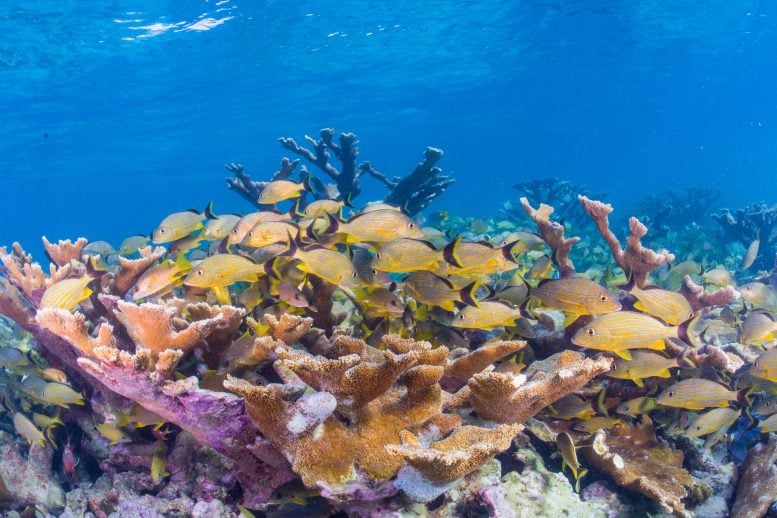
Isotope evidence from fossil otoliths shows Caribbean reef food chains have shrunk by up to 70%, signaling a major loss of trophic complexity.
Coral reefs across the Caribbean are facing severe decline. Researchers have recorded widespread bleaching, steep losses in coral cover, and significant reductions in fish and shark populations over the past several decades. Yet one important issue has remained unclear: has the basic flow of energy through reef ecosystems also been altered?
New research led by scientists at the Smithsonian Tropical Research Institute (STRI) and published in Nature shows that it has. According to the findings, present-day Caribbean reef food chains are 60-70% shorter than they were 7,000 years ago. Fish that once occupied distinct dietary niches now show far less specialization, weakening the intricate network of energy pathways that previously supported reef life.
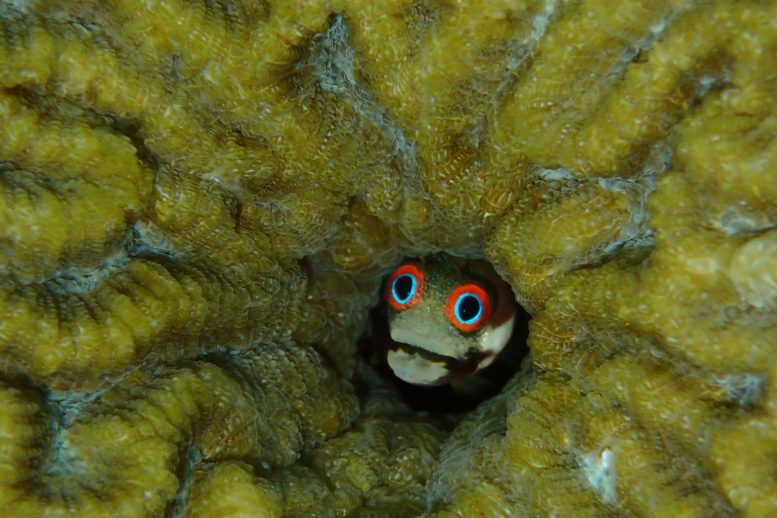
To uncover this long-term change, scientists turned to an unusual source of evidence: thousands of microscopic fish ear stones known as otoliths preserved in ancient reef sediments, along with a highly sensitive method for analyzing nitrogen isotopes trapped within them.
Otolith Isotope Analysis Reveals 7,000 Years of Food Web Change
The ratio of nitrogen isotopes in an otolith reflects what a fish consumed during its lifetime, effectively preserving a chemical record of its role in the food web. By examining otoliths and corals from 7,000-year-old fossil reefs and comparing them with samples from nearby modern reefs in Panama and the Dominican Republic, the team reconstructed the structure of reef fish communities before and after centuries of human influence.
The comparison revealed striking changes. Fish that typically fed higher in the food chain, such as grunts and cardinalfishes, are now feeding at lower trophic levels. Meanwhile, species that once occupied lower positions, including gobies, have shifted upward. As a result, the gap between trophic levels has narrowed by roughly 60% in both study regions.
At the same time, differences in diet within fish families have declined by 20–70%, indicating that individuals who once specialized in particular prey types now rely on many of the same food sources as other members of their group.
“What struck us is how consistent the pattern is,” said Jessica Lueders-Dumont, a postdoctoral marine biogeochemist who led the study. “In every fish family we examined, in both Panama and the Dominican Republic, the dietary diversity has contracted. These reefs have lost an entire dimension of ecological complexity that we didn’t even know was missing.”
Fossil Reef Excavations Provide Prehuman Baseline
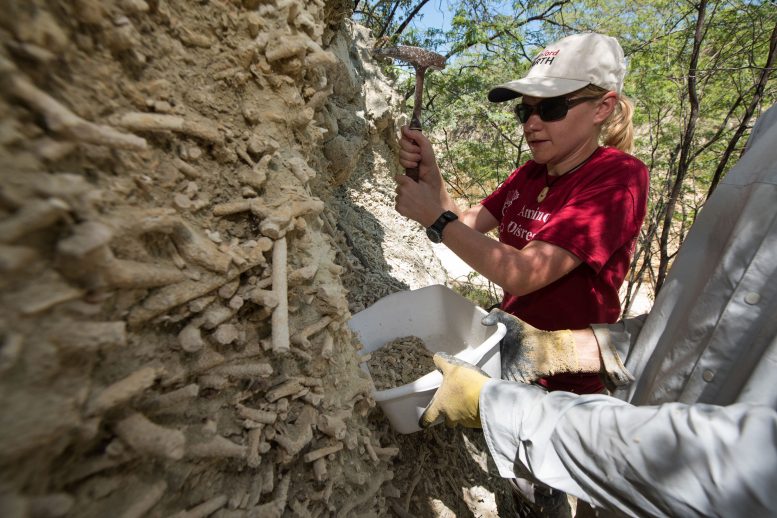
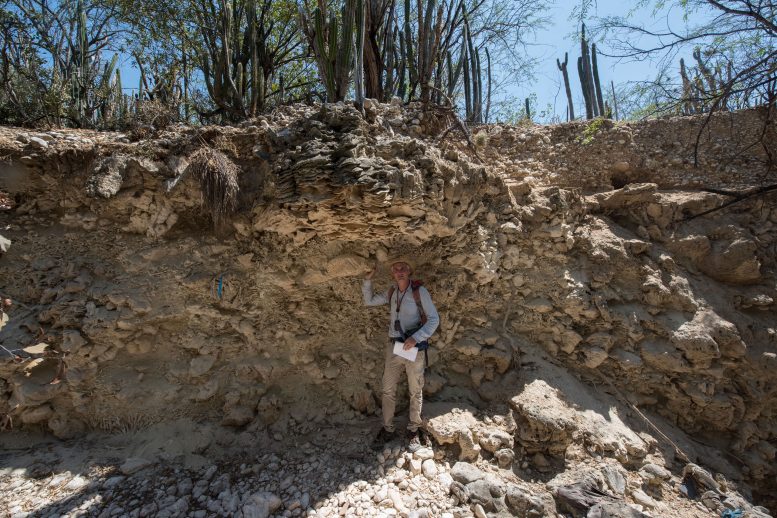
The findings build on more than ten years of field research at STRI in Panama. Starting in the early 2010s, a team led by STRI scientist Aaron O’Dea removed tons of sediment from exceptionally well-preserved fossil reefs in Bocas del Toro, Panama, and the Enriquillo Basin in the Dominican Republic. These 7,000-year-old mid-Holocene reef deposits offer a rare snapshot of Caribbean ecosystems before significant human disturbance. Previous work at these sites has already provided important insights into historical coral communities and the ecological impacts of predator declines.
“Otoliths are incredible structures, and when we first started finding them in our fossil reef samples, I realized we had an opportunity to reconstruct not just what corals were like before humans, but also the fishes that live on reefs,” said O’Dea.
Sorting and cataloguing thousands of otoliths from bulk reef sediment required meticulous effort. Much of this work was carried out by STRI researcher Brígida de Gracia, a Ngäbe paleontologist, along with Chien-Hsiang Lin of Academia Sinica in Taiwan. By building detailed reference collections and refining taxonomic identifications, they established the foundation that made the broader analysis possible.
Nitrogen Isotope Technique Unlocks Ancient Diets
“Picking otoliths from sediment, grain by grain, is challenging, but you develop an intimate relationship with these ancient reefs,” said de Gracia. “Every otolith tells the story of a fish that lived thousands of years ago. To see those stories come alive through isotope chemistry is incredibly rewarding.”
The nitrogen isotope method central to the research was developed by Lueders-Dumont in co-author Daniel Sigman’s laboratory at Princeton University. This technique isolates and measures nitrogen preserved within the mineral structure of the otoliths. The organic material has been sealed inside the surrounding calcium carbonate for millennia, protecting it from degradation and allowing scientists to retrieve detailed dietary information long after the fish lived.

Researchers concentrated on four fish families representing a range of ecological roles: gobies (small bottom-dwellers), silversides (pelagic schooling fish), cardinalfishes (nocturnal predators), and grunts (larger omnivores that roam between reef and mangrove habitats). Importantly, most of these species are not directly targeted by fisheries. This suggests that the observed dietary shifts reflect broad changes in ecosystem structure rather than the direct effects of fishing pressure.
Conservation Implications of Shortened Reef Food Chains
These results carry important implications for reef conservation. When all individuals within a population depend on the same limited set of resources (rather than each specializing on different prey), a disruption in food availability can impact the entire group at once. In contrast, prehistoric reefs supported multiple energy pathways that likely helped buffer the system against environmental shocks. The reduction in trophic complexity, therefore, represents a hidden weakness, one that is not easily detected by conventional reef monitoring but could heighten the risk of cascading ecosystem failure.
“We already knew that modern Caribbean reefs are home to fewer corals and fewer sharks,” said O’Dea. “Now we can see that the fish that remain are feeding and behaving differently too. It strengthens the case that modern Caribbean reefs are not simply diminished versions of what came before; they are potentially functioning in different ways.”
Beyond documenting decline, the research introduces a powerful new approach for evaluating reef health. “We now have a way to explore how entire systems function,” said Lueders-Dumont. “These tiny ear stones are opening a window into how energy moves through reef ecosystems on time scales previously unimaginable to ecologists.”
Reference: “Fossil isotope evidence for trophic simplification on modern Caribbean reefs” by Jessica A. Lueders-Dumont, Aaron O’Dea, Erin M. Dillon, Brigida de Gracia, Chien-Hsiang Lin, Sergey Oleynik, Seth Finnegan, Daniel M. Sigman and Xingchen Tony Wang, 11 February 2026, Nature.
DOI: 10.1038/s41586-025-10077-z
Never miss a breakthrough: Join the SciTechDaily newsletter.
Follow us on Google and Google News.
5 Comments
The authors state unabashedly in the opening of their abstract that “Caribbean reefs have experienced major human-driven changes to their coral and fish communities. That claim is based on only two temporal samples: ~7,000 years BP and the last 100 years. Have the changes been taking place gradually over the last 7,000 years, or was there an abrupt change at some point? If there was an abrupt change, when did it happen. Have there been oscillations for 7,000 years? There sampling program doesn’t allow for answering those questions. All we know with any certainty is that there have been isotopic changes in the sampled otoliths. How, when, and where we only know with a resolution of 7,000 years — two data points! It seems to me that is is presumptuous to claim that the changes are “human-driven” unless it can be demonstrated that the changes took place abruptly over the last century. The facts supporting that hypothesis are not in evidence.
Good questions. One hopes that this research will stimulate further research to resolve those questions. That is how science works; by fit and starts, and by getting grants, which depends on publications and citation indices, to progress.
In general, I agree with you, rob. However, perhaps those providing grants should tighten up on approval if the applicants have a history of poor experiment design or claims that aren’t supported by their research.
I rather think that steady government funding of that sort of project could be better, which would take a dedicated government agency to undertake the type of long-term systematic project necessary. That type of work is now unfashionable given the modern viewpoint of economics. Privatisation of assorted government-run science institutes has led to ragged science; New Zealand has provided a classic example of that type of thinking since 1985.
Post WWII, the US science research budgets have been consistently large. What has changed is the type of ‘science’ that gets funded. The quality of the research, experimental design, and conclusions have, however, declined in recent decades. I routinely document here, with quotations, inadequate statements about what was measured, claims and conclusions without support, and an insufficient consideration of alternative hypotheses. Our peer review procedure is failing society.
Recent articles here, at SciTechDaily, such as https://scitechdaily.com/scientists-discover-crystals-that-spin-twist-and-heal-themselves/ , have all the ‘buzz’ words and assertions that one looking for investors would be inclined to use. However, in reading it I don’t know what that authors are trying to say. I’m not a stranger to mineralogy, but their use of the term ‘crystal’ does not conform to the accepted definition. One name, the corresponding author, keeps showing up in similar opaque publications. I suspect he is a front for a publication mill, or participant, but I haven’t been able to come up with incontrovertible proof. However, his ‘word salads’ give me pause. I think that such unhelpful articles get published because peer review isn’t up to the task.