
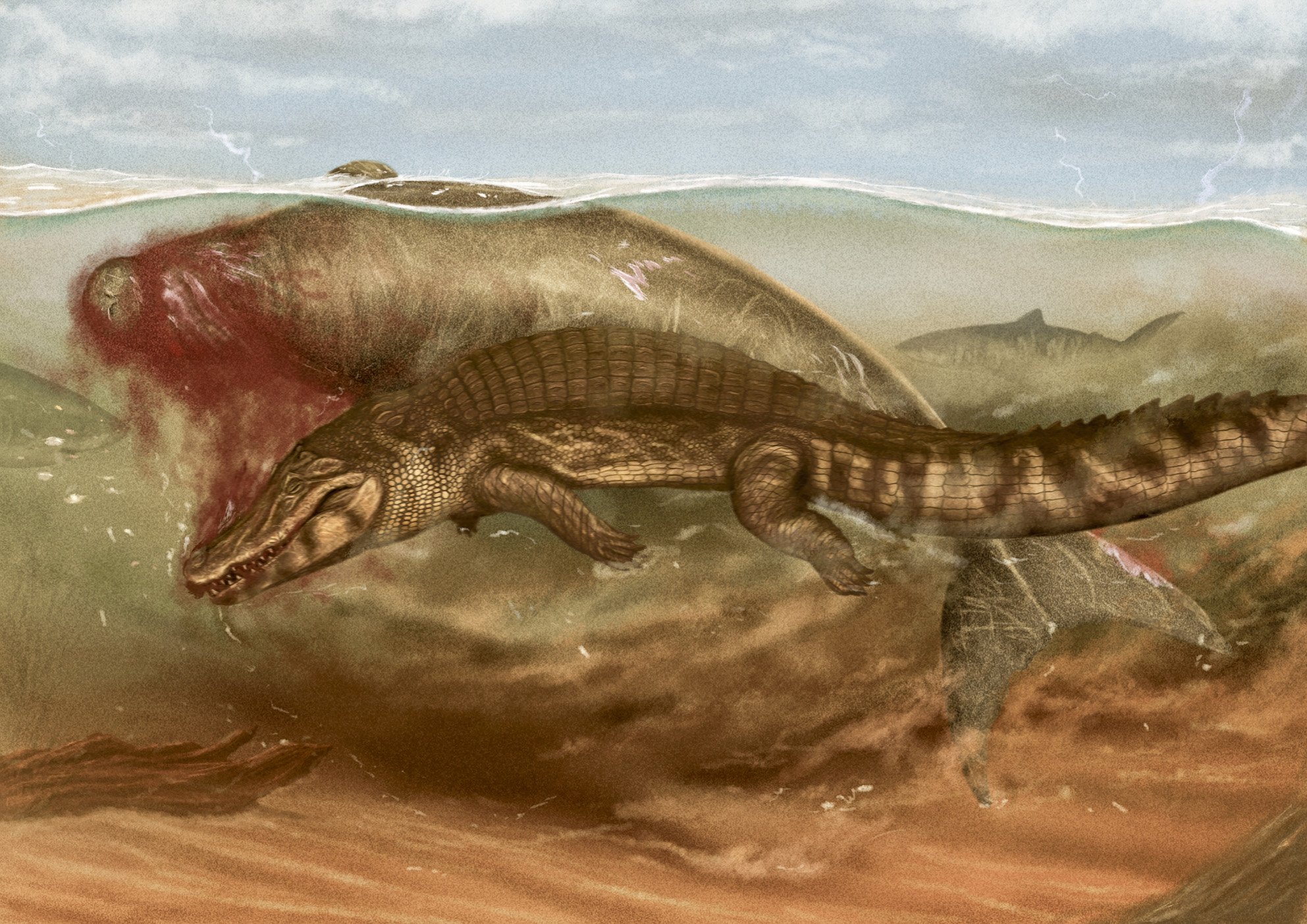
New research documents the predation of a Miocene-era sea cow by both a crocodile and a shark, revealing significant parallels in ancient and modern food chains and providing a rare glimpse into the complex ecological interactions of that period.
A recent study has uncovered fascinating insights into ancient predation patterns, revealing that a prehistoric sea cow was hunted by not just one, but two different predators—a crocodilian and a shark. This discovery sheds light on the complex food chain that existed millions of years ago.
Published in the peer-reviewed Journal of Vertebrate Paleontology, the findings mark one of the few examples of a creature being preyed upon by different animals during the Early to Middle Miocene epoch (23 million to 11.6 million years ago).
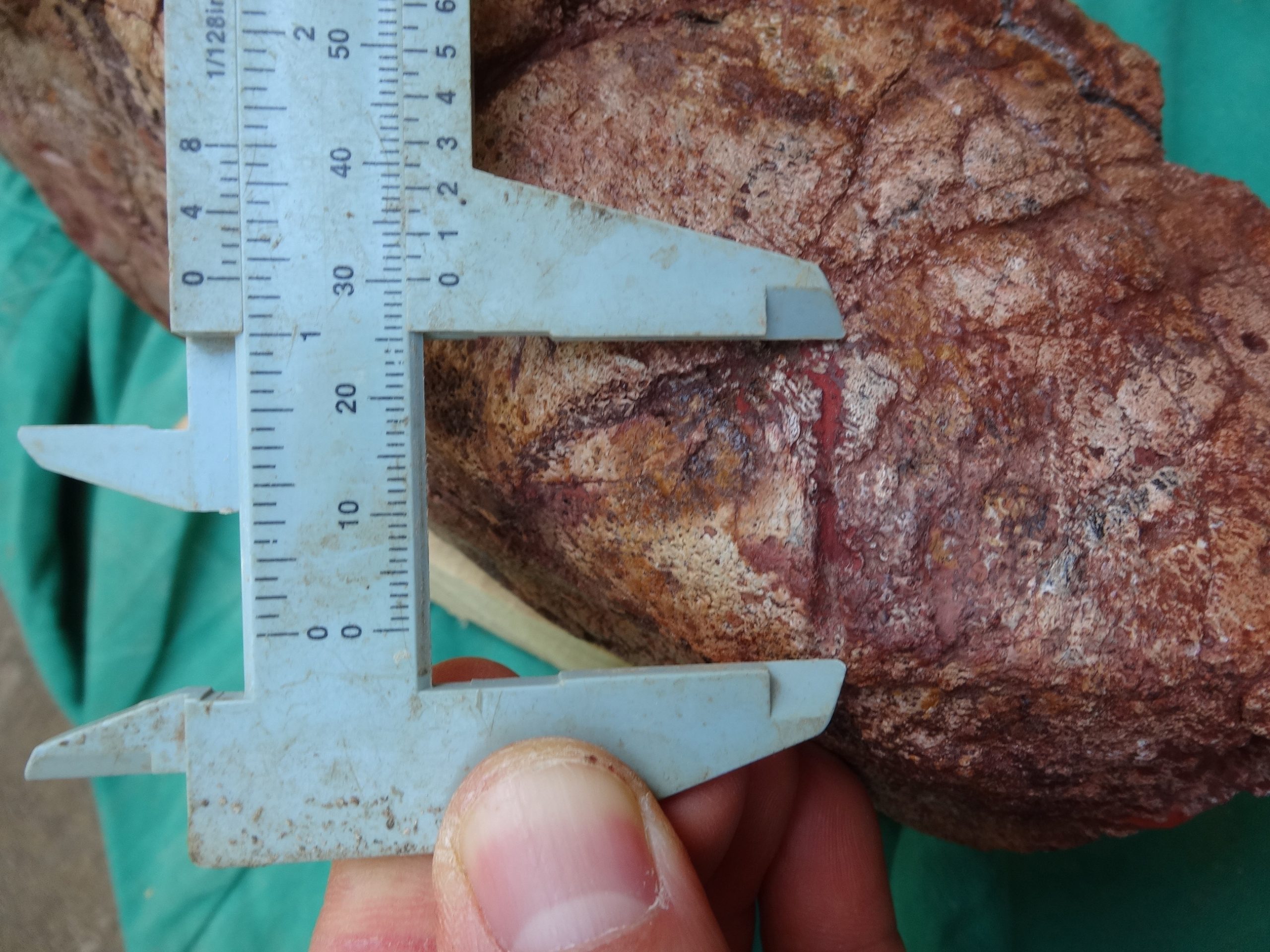
Predation marks in the skull indicate that the dugongine sea cow, belonging to the extinct genus Culebratherium, was first attacked by the ancient crocodile and then scavenged by a tiger shark (Galeocerdo aduncus) in what is now northwestern Venezuela.
“Conspicuous” deep tooth impacts concentrated on the sea cow’s snout, suggest the crocodile first tried to grasp its prey by the snout in an attempt to suffocate it.
Two further large incisions, with a round starting impact, demonstrate the crocodile then dragged the sea cow, followed by tearing it. Marks on the fossils with striations and slashing, indicate the crocodile likely then executed a ‘death roll’ while grasping its prey – a behavior commonly observed in modern crocodiles.
Additional Findings from the Fossil Record
A tooth of a tiger shark (Galeocerdo aduncus) found in the sea cow’s neck, along with shark bite marks observed throughout the skeleton, show how the remains of the creature was then picked apart by the scavengers.
The team of experts from the University of Zurich, the Natural History Museum of Los Angeles County, as well as Venezuelan institutes Museo Paleontológico de Urumaco and the Universidad Nacional Experimental Francisco de Miranda, state their findings add to evidence that suggests the food chain, millions of years ago, behaved in a similar way to the present day.
“Today, often when we observe a predator in the wild, we find the carcass of prey which demonstrates its function as a food source for other animals too; but fossil records of this are rarer.
“We have been unsure as to which animals would serve this purpose as a food source for multiple predators. Our previous research has identified sperm whales scavenged by several shark species, and this new research highlights the importance of sea cows within the food chain,” explains lead author Aldo Benites-Palomino, from the Department of Paleontology at Zurich.
While evidence of food chain interactions is not scarce in the fossil record, they are mostly represented by fragmentary fossils exhibiting marks of ambiguous significance. Differentiating between marks of active predation and scavenging events is therefore often challenging.
“Our findings constitute one of the few records documenting multiple predators over a single prey, and as such provide a glimpse of food chain networks in this region during the Miocene.”
Excavation and Discovery of the Fossil Site
The team’s find was made in outcrops of the Early to Middle Miocene Agua Clara Formation, south of the city of Coro, Venezuela.
Among remains, they found a fragmentary skeleton that includes a partial skull and eighteen associated vertebrae.
Describing the dig, co-author Professor of Palaeobiology Marcelo R Sanchez-Villagra explained the discovery as “remarkable” – in particular for where it was uncovered, a site 100 kilometers away from previous fossil finds.
“We first learned about the site through word of mouth from a local farmer who had noticed some unusual “rocks”. Intrigued, we decided to investigate,” says Sanchez-Villagra, who is the Director at the Palaeontological Institute & Museum at Zurich.
“Initially, we were unfamiliar with the site’s geology, and the first fossils we unearthed were parts of skulls. It took us some time to determine what they were—sea cow remains, which are quite peculiar in appearance.
“By consulting geological maps and examining the sediments at the new locality, we were able to determine the age of the rocks in which the fossils were found.
“Excavating the partial skeleton required several visits to the site. We managed to unearth much of the vertebral column, and since these are relatively large animals, we had to remove a significant amount of sediment.
“The region is known for evidence of predation on aquatic mammals, and one factor that enabled us to observe such evidence was the excellent preservation of the fossil’s cortical layer, which is attributed to the fine sediments in which it was embedded.
“After locating the fossil site, our team organized a paleontological rescue operation, employing extraction techniques with full casing protection.
“The operation took about seven hours, with a team of five people working on the fossil. The subsequent preparation took several months, especially the meticulous work of preparing and restoring the cranial elements.”
Reference: “Trophic interactions of sharks and crocodylians with a sea cow (Sirenia) from the Miocene of Venezuela” by Aldo Benites-Palomino, Gabriel Aguirre-Fernández, Jorge Velez-Juarbe, Jorge D. Carrillo-Briceño, Rodolfo Sánchez and Marcelo R. Sánchez-Villagra, 28 August 2024, Journal of Vertebrate Paleontology.
DOI: 10.1080/02724634.2024.2381505
Never miss a breakthrough: Join the SciTechDaily newsletter.
Follow us on Google and Google News.
2 Comments
Dead bones buried rapidly in sedimentary detritus…and that is all we see
…the rest is extrapolated based on presumptions not provable.
It looks like some people take pride in their ignorance, like this Samueltard.