
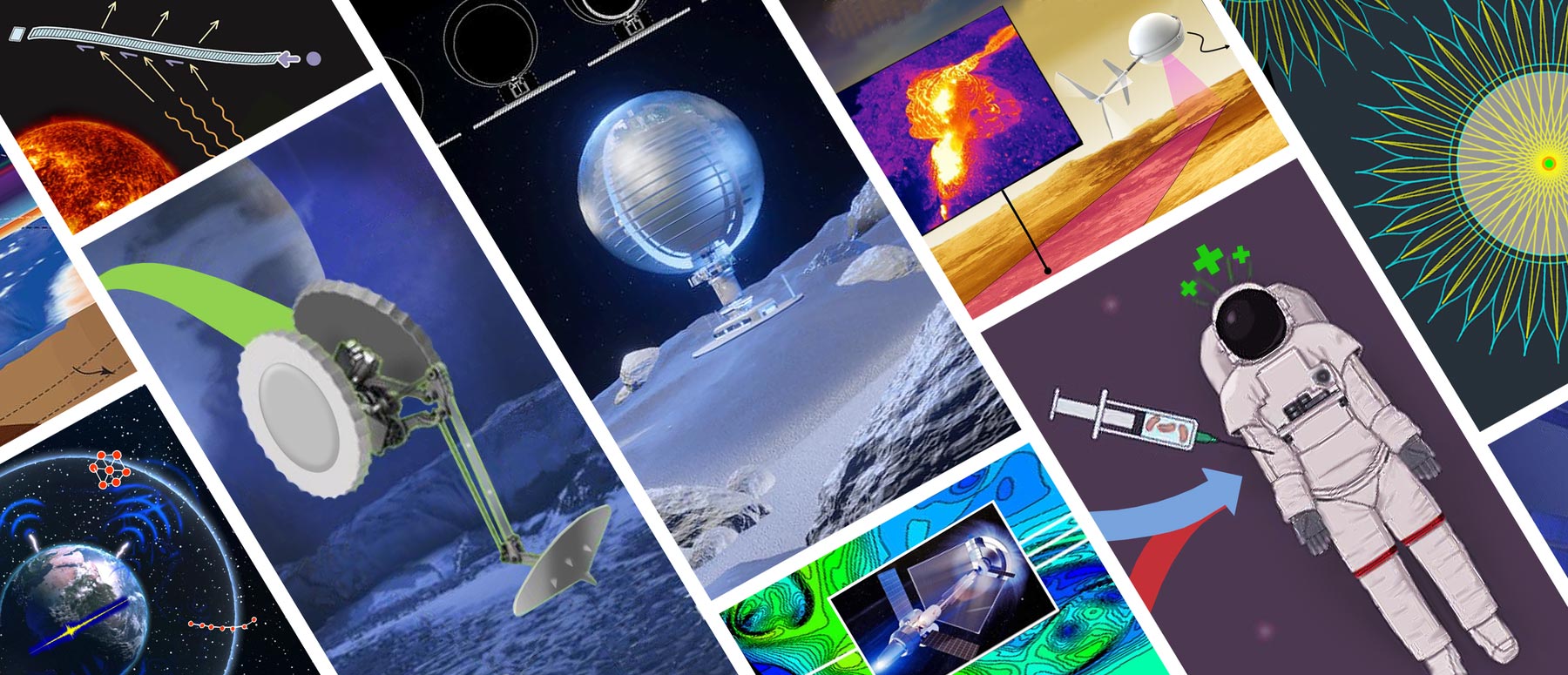
NASA’s NIAC program is investing in visionary ideas that could revolutionize space exploration. From fusion-powered spacecraft to lunar habitats made of glass and robots designed to explore icy moons, these concepts could pave the way for future missions across the solar system and beyond.
NASA has selected 15 innovative ideas for its 2025 Phase I NIAC (NASA Innovative Advanced Concepts) program, aimed at developing transformative technologies for future space missions. These concepts, chosen from various companies and institutions across the United States, cover a wide range of innovative aerospace solutions.
The NIAC program supports early-stage technology studies, providing funding to explore ideas that could shape the future of space exploration and potentially lead to commercialization. For 2025, a total of up to $2.625 million in grants will be awarded to evaluate these promising technologies.
Exploring the Future of Space Missions
“Our next steps and giant leaps rely on innovation, and the concepts born from NIAC can radically change how we explore deep space, work in low Earth orbit, and protect our home planet,” said Clayton Turner, associate administrator for NASA’s Space Technology Mission Directorate in Washington. “From developing small robots that could swim through the oceans of other worlds to growing space habitats from fungi, this program continues to change the possible.”
The newly selected concepts include feasibility studies to explore the Sun’s influence on our solar system, build sustainable lunar habitats from glass, explore Saturn’s icy moon, and more. All NIAC studies are in the early stages of conceptual development and are not considered official NASA missions.
Groundbreaking Technologies from Visionary Scientists
Ryan Weed, Helicity Space LLC in Pasadena, California, proposes a constellation of spacecraft powered by the Helicity Drive, a compact and scalable fusion propulsion system, that could enable rapid, multidirectional exploration of the heliosphere and beyond, providing unprecedented insights on how the Sun interacts with our solar system and interstellar space. Demonstrating the feasibility of fusion propulsion could also benefit deep space exploration including crewed missions to Mars.
Martin Bermudez, Skyeports LLC in Sacramento, California, presents the concept of constructing a large-scale, lunar glass habitat in a low-gravity environment. Nicknamed LUNGS (Lunar Glass Structure), this approach involves melting lunar glass compounds to create a large spherical shell structure. This idea offers a promising solution for establishing self-sustaining, large-scale habitats on the lunar surface.
Justin Yim, University of Illinois in Urbana, proposes a jumping robot appropriately named LEAP (Legged Exploration Across the Plume) as a novel robotic sampling concept to explore Enceladus, a small, icy moon of Saturn that’s covered in geysers, or jets. The LEAP robots could enable collection of pristine, ocean-derived material directly from Enceladus’ jets and measurement of particle properties across multiple jets by traveling from one to another.
“All advancements begin as an idea. The NIAC program allows NASA to invest in unique ideas enabling innovation and supporting the nation’s aerospace economy,” said John Nelson, program executive for NASA’s Innovative Advanced Concepts in Washington.
Meet the 2025 NIAC Fellows
The NIAC researchers, known as fellows, will investigate the fundamental premise of their concepts, identify potential challenges, and look for opportunities to bring these concepts to life.
In addition to the projects mentioned above, the following selectees received 2025 NIAC Phase I grants:
- Michael Hecht, Massachusetts Institute of Technology, Cambridge: EVE (Exploring Venus with Electrolysis)
- Selim Shahriar, Northwestern University, Evanston, Illinois: SUPREME-QG: Space-borne Ultra-Precise Measurement of the Equivalence Principle Signature of Quantum Gravity
- Phillip Ansell, University of Illinois, Urbana: Hy2PASS (Hydrogen Hybrid Power for Aviation Sustainable Systems)
- Ryan Benson, ThinkOrbital Inc., Boulder, Colorado: Construction Assembly Destination
- Gyula Greschik, Tentguild Engineering Co, Boulder, Colorado: The Ribbon: Structure Free Sail for Solar Polar Observation
- Marco Quadrelli, NASA’s Jet Propulsion Laboratory in Southern California: PULSAR: Planetary pULSe-tAkeR
- Ben Hockman, NASA’s Jet Propulsion Laboratory in Southern California: TOBIAS: Tethered Observatory for Balloon-based Imaging and Atmospheric Sampling
- Kimberly Weaver, NASA’s Goddard Space Flight Center in Greenbelt, Maryland: Beholding Black Hole Power with the Accretion Explorer Interferometer
- John Mather, NASA’s Goddard Space Flight Center in Greenbelt, Maryland: Inflatable Starshade for Earthlike Exoplanets
- Robert Hinshaw, NASA’s Ames Research Center in California’s Silicon Valley: MitoMars: Targeted Mitochondria Replacement Therapy to Boost Deep Space Endurance
- Christine Gregg, NASA’s Ames Research Center in California’s Silicon Valley: Dynamically Stable Large Space Structures via Architected Metamaterials
- Saurabh Vilekar, Precision Combustion, North Haven, Connecticut: Thermo-Photo-Catalysis of Water for Crewed Mars Transit Spacecraft Oxygen Supply
NASA’s Space Technology Mission Directorate funds the NIAC program, as it is responsible for developing the agency’s new cross-cutting technologies and capabilities to achieve its current and future missions.
Never miss a breakthrough: Join the SciTechDaily newsletter.
Follow us on Google and Google News.