
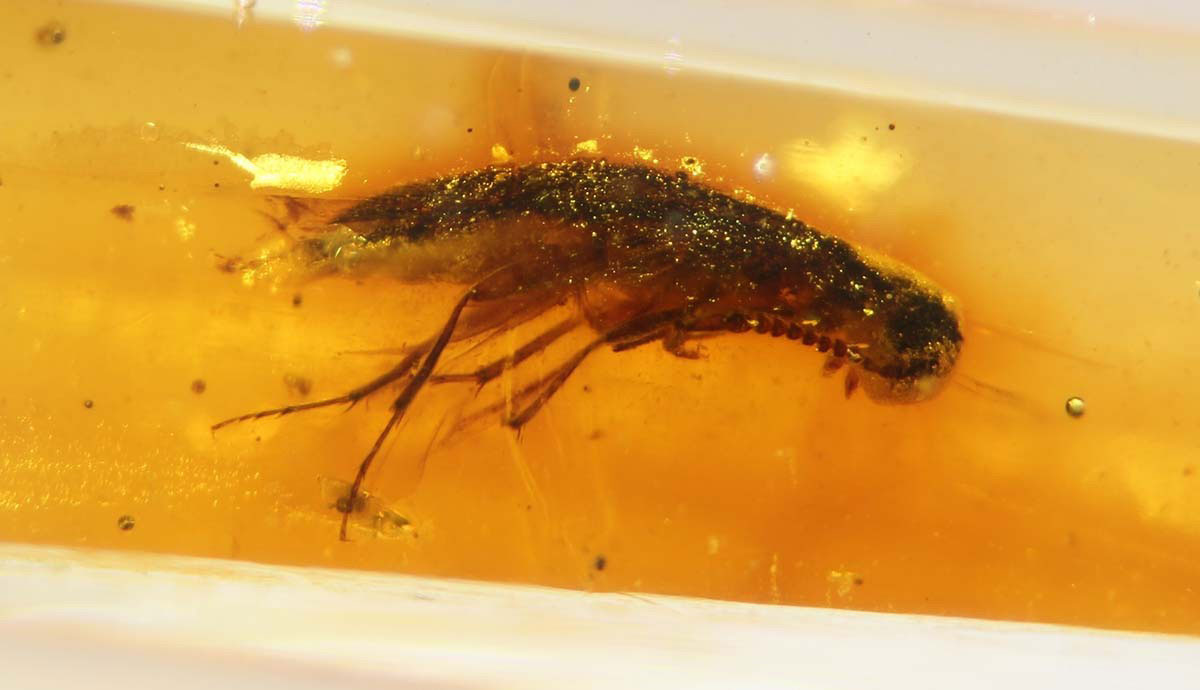
Amber from Ecuador has revealed 112-million-year-old insects and plants, offering a rare glimpse into Gondwana’s ancient forests.
Researchers have reported the first discovery of amber deposits in South America that contain preserved insects. Found in a quarry in Ecuador, the samples are described in Communications Earth & Environment. This discovery captures a moment in time from a forest that existed 112 million years ago on the ancient supercontinent Gondwana, offering scientists a rare chance to investigate an ecosystem that has remained largely unknown.
Amber (fossilized tree resin) has been found in deposits stretching as far back as 320 million years. However, the fossil record shows a significant rise in the number of amber samples between 120 million and 70 million years ago, during the Cretaceous era (143.1 million to 66 million years ago). One of amber’s most valuable features is its ability to trap bio-inclusions, which are pieces of ancient plants or animals preserved inside the resin. These inclusions provide researchers with a window into organisms, such as insects and flowers, that are otherwise rarely preserved.
Up until now, nearly all of the major amber deposits identified worldwide have come from the Northern Hemisphere. This has left scientists with limited knowledge of the biodiversity and ecological dynamics of the Southern Hemisphere during the Cretaceous, a time when the modern continents were breaking away from Gondwana.
Ecuadorian Quarry Reveals Bio-Inclusions
Xavier Delclòs and colleagues analyzed samples of amber and the surrounding rock from the Genoveva quarry in Ecuador. The amber, dated to approximately 112 million years ago, is part of a recently discovered deposit in the Hollín Formation, a sedimentary rock layer lying across the Oriente Basin in Ecuador. The authors identified two different types of amber: one that formed underground around the roots of resin-producing plants, and another that formed when resin was exposed to air.
In the 60 analyzed samples of aerial amber, the authors identified 21 bio-inclusions, consisting of members of five insect orders — including Diptera (flies), Coleoptera (beetles), and Hymenoptera (which includes ants and wasps) — along with a fragment of spider web. They also identified a wide variety of plant fossils in the rock samples, including spores, pollen, and other remains.
The authors conclude that the characteristics of the bio-inclusions and surrounding fossils suggest that the amber formed in a humid and densely vegetated forest environment, dominated by resin-producing trees, and located in the southern part of Gondwana. They argue that the discovery of the amber deposit is of critical importance for future studies of this period.
Reference: “Cretaceous amber of Ecuador unveils new insights into South America’s Gondwanan forests” by Xavier Delclòs, Enrique Peñalver, Carlos Jaramillo, Edwin Cadena, César Menor-Salván, José Luís Román, Rafael Francisco Castaño-Cardona, David Peris, Marcelo Carvalho, Daniela Quiroz-Cabascango, Mónica R. Carvalho, Patrick Blomenkemper, Fabiany Herrera, Patricio Santamarina, Maxime Santer, Galo Carrera and Mónica M. Solórzano-Kraemer, 18 September 2025, Communications Earth & Environment.
DOI: 10.1038/s43247-025-02625-2
Never miss a breakthrough: Join the SciTechDaily newsletter.
Follow us on Google and Google News.
3 Comments
QUE MIRA BOBO!!!
Nothing new here. That’s how they made dinosaurs in Jurassic Park. The eternal search for yet more grant money to study useless stuff.
Fossils of 100 million years+ old in Amber should be Carbon 14 dated. It should be Carbon14-dead. This would prove deep time. If the test results shows the same ratio of Carbon 14 as mammoths, then it would prove young Earth. Let’s get it done. This controversy needs to be put to rest.