
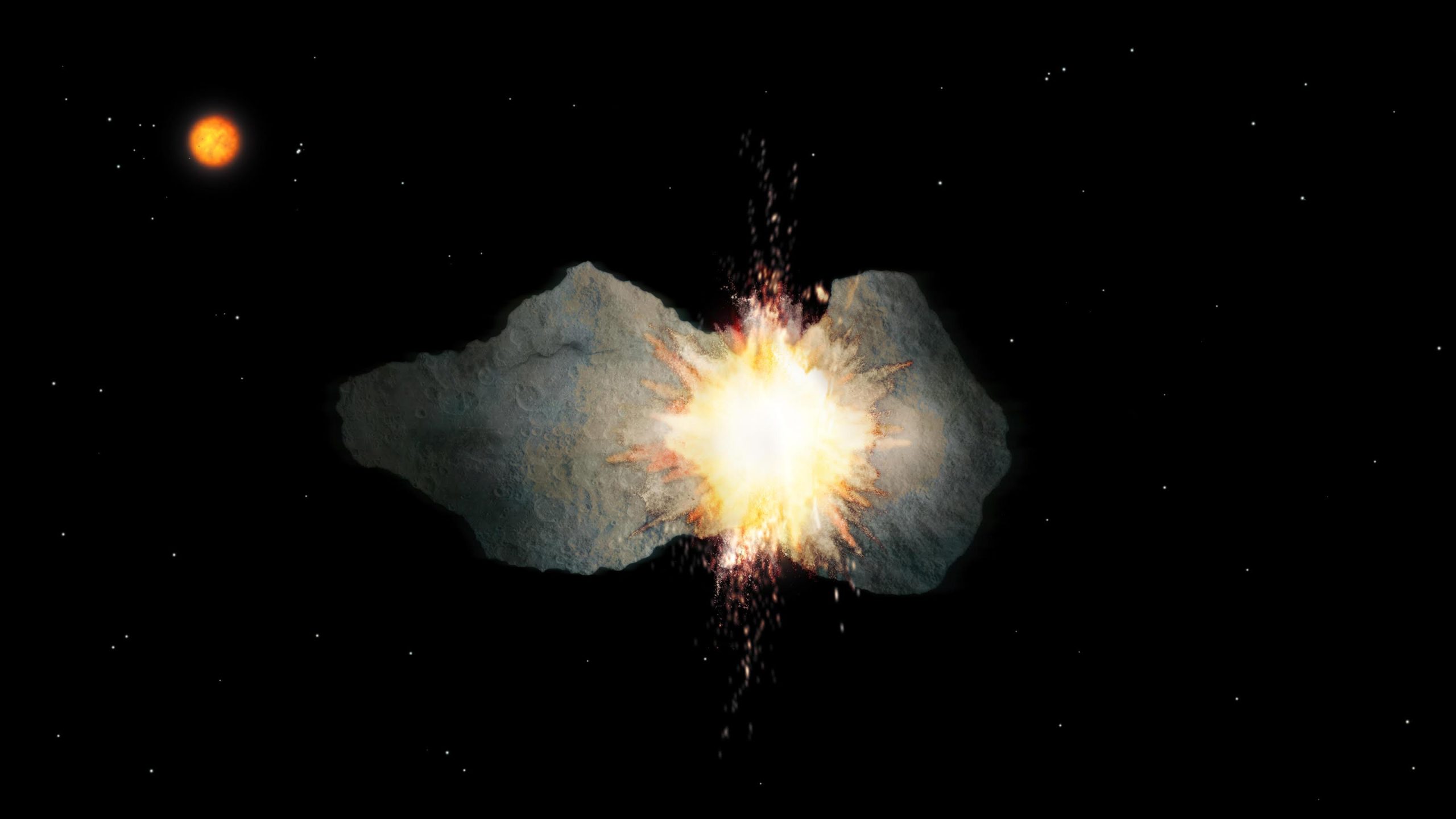
Gaia uncovers how cosmic collisions sculpt the strange spins of asteroids.
Asteroids don’t all spin the same way, and new data from ESA’s Gaia mission shows why. A study found that collisions and internal friction work in opposition, creating a distinct split in asteroid rotation patterns. This discovery provides new insight into asteroid composition and evolution, with potential benefits for planetary defense strategies.
How Collisions Shape Asteroid Spins
Whether an asteroid spins smoothly on its axis or tumbles in a chaotic dance depends on how often it has been struck by other objects in space. New results presented at the EPSC-DPS2025 Joint Meeting in Helsinki, based on data from the European Space Agency’s Gaia mission, show how these collisions shape asteroid motion. The findings also provide a new way to determine the physical makeup of asteroids – information that could prove essential for deflecting any that might one day threaten Earth.
“By leveraging Gaia’s unique dataset, advanced modelling and A.I. tools, we’ve revealed the hidden physics shaping asteroid rotation, and opened a new window into the interiors of these ancient worlds,” said Dr. Wen-Han Zhou of the University of Tokyo, who presented the results at EPSC-DPS2025.
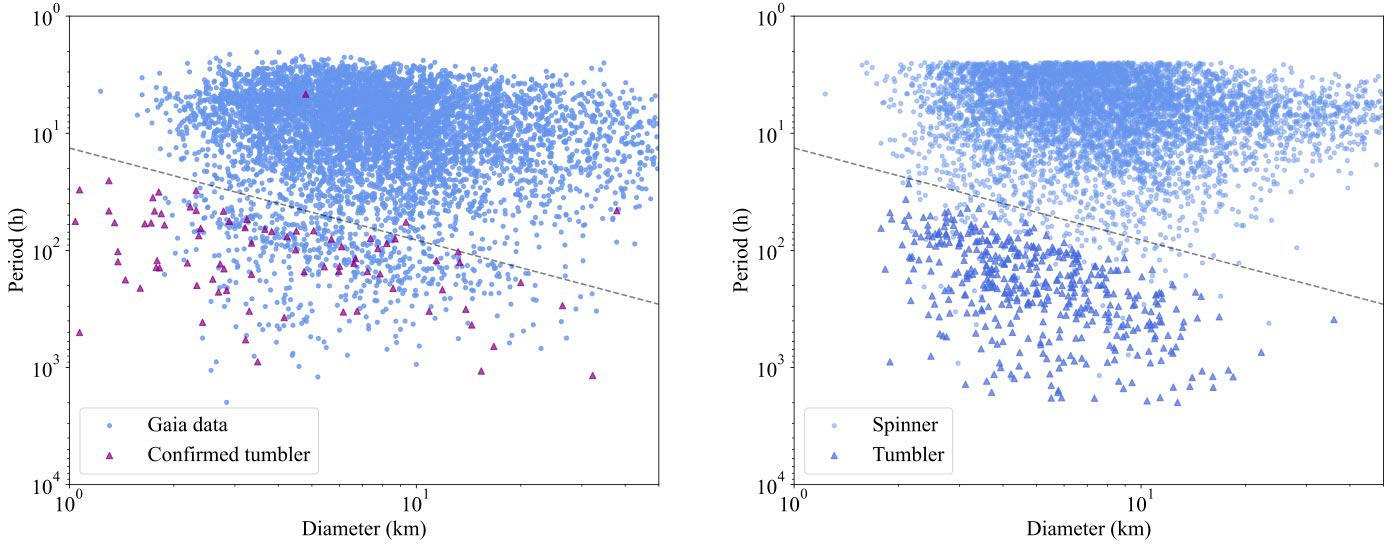
Gaia’s full-sky survey generated a massive database tracking how asteroids reflect light as they rotate. These measurements, called light curves, reveal changes in brightness over time. When scientists plotted rotation periods against asteroid diameters, they spotted a surprising feature—a distinct gap that divides two distinct types of rotators.
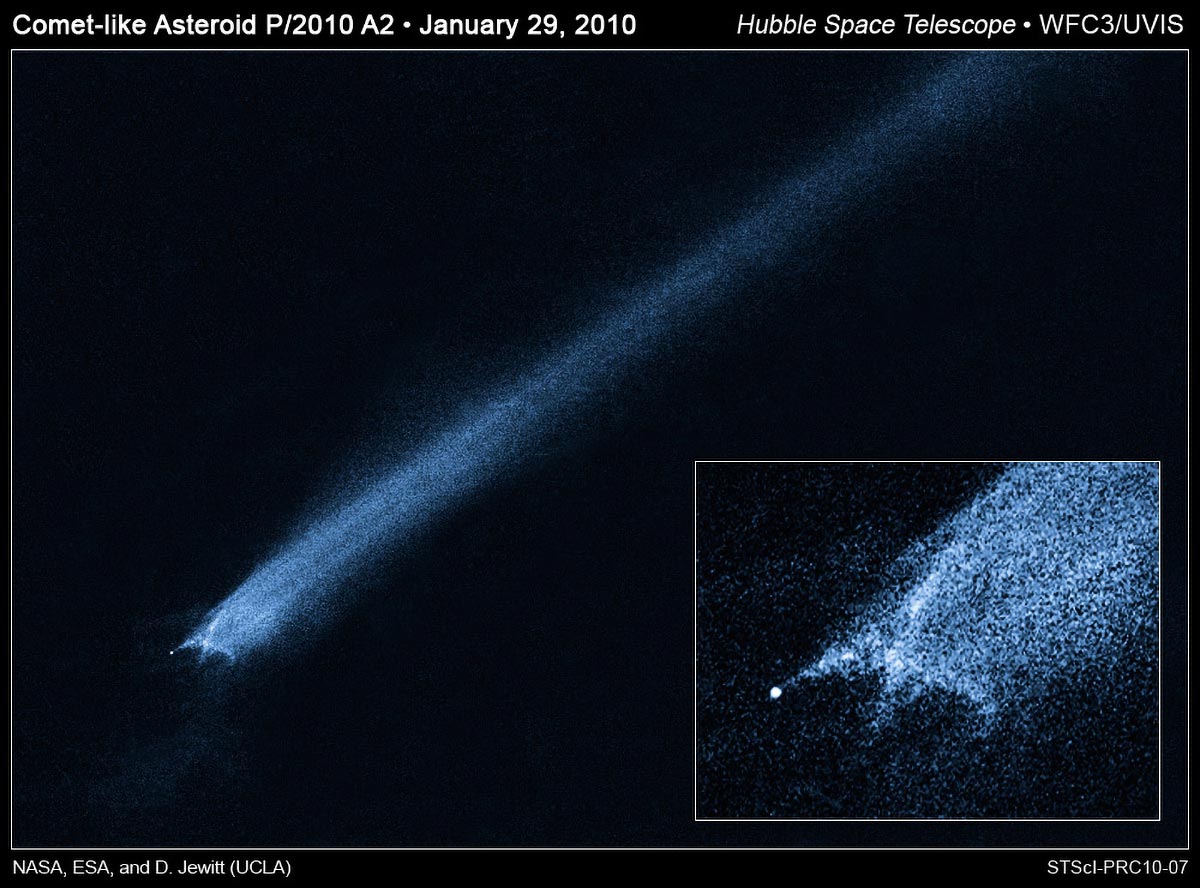
Cracking the Asteroid Spin Mystery
A research team led by Zhou, who conducted much of the work at the Observatoire de la Côte d’Azur in France, has now uncovered the reason for that gap, solving several long-standing questions about asteroid rotation.
“We built a new model of asteroid-spin evolution that considers the tug of war between two key processes, namely collisions in the Asteroid Belt that can jolt asteroids into a tumbling state, and internal friction, which gradually smooths their spin back to a stable rotation,” said Zhou. “When these two effects balance, they create a natural dividing line in the asteroid population.”
Machine Learning Confirms the Hidden Pattern
By applying machine learning to Gaia’s asteroid catalogue and comparing the results with their model’s predictions, Zhou’s team found that the location of the gap matched almost perfectly. Asteroids below the gap tend to tumble slowly, taking less than 30 hours to complete a rotation, while those above it spin much faster and more steadily.
Why So Many Asteroids Tumble.
For years, astronomers have wondered why so many asteroids wobble rather than spin cleanly around a single axis, and why smaller ones are more likely to tumble slowly. Zhou’s study points to the combined influence of collisions and sunlight. Tumbling often begins when an asteroid is already rotating slowly, leaving it more vulnerable to being knocked off balance by even small impacts.
Normally, sunlight gradually changes an asteroid’s spin. Its surface absorbs solar heat and re-emits it in different directions, and the tiny push from those escaping photons builds up over time. Depending on its orientation, that push can either speed up or slow down the spin. For asteroids that rotate smoothly, the heating and cooling occur in consistent directions, allowing the effect to accumulate.
Why Tumbling Asteroids Stay Stuck
For tumbling asteroids, the situation is different. Their irregular motion means that sunlight is absorbed and re-emitted from constantly shifting areas of the surface. Instead of producing a steady force, the effect averages out in all directions, leaving no consistent push. As a result, their rotation changes extremely slowly, trapping them in the slow-spinning zone identified in Gaia’s data.
This insight is not only a breakthrough in understanding asteroid behavior but also a practical tool. Knowing how internal structure affects rotation helps scientists infer what lies inside these objects. Gaia’s observations suggest that most asteroids are loose rubble piles filled with cavities and coated in thick layers of dust and rock fragments.
Implications for Deflecting Dangerous Asteroids
Such information has direct relevance for planetary defense. A rubble-pile asteroid would respond very differently to a kinetic impact, like NASA’s DART mission, than a solid rock would. The ability to estimate an asteroid’s internal structure could guide future strategies for deflecting those that pose a threat to Earth. With Gaia’s expanding dataset, astronomers may soon be able to map the internal properties of thousands of potentially hazardous asteroids.
A Future Flood of Asteroid Data
“With forthcoming surveys like the Vera C. Rubin Observatory’s Legacy Survey of Space and Time (LSST), we’ll be able to apply this method to millions more asteroids, refining our understanding of their evolution and make-up,” said Zhou.
Reference: “Understanding the Long-term Rotational Evolution of Asteroids with Gaia” by Wen-Han Zhou, Patrick Michel, Marco Delbo, Wenchao Wang, Bonny Y. Wang, Josef Durech and Josef Hanuš, 8 July 2025, .
DOI: 10.5194/epsc-dps2025-893
Never miss a breakthrough: Join the SciTechDaily newsletter.
Follow us on Google and Google News.