
Close Menu
    Facebook X (Twitter) Instagram
    SciTechDaily
    • Biology
    • Chemistry
    • Earth
    • Health
    • Physics
    • Science
    • Space
    • Technology
    Facebook X (Twitter) Pinterest YouTube RSS
    SciTechDaily
    Home»Space»Galactic Game Changer: Unveiling the Hidden Satellites of the Milky Way
    Space

    Galactic Game Changer: Unveiling the Hidden Satellites of the Milky Way

    By Tohoku UniversityJuly 20, 2024No Comments4 Mins Read
    Facebook Twitter Pinterest Telegram LinkedIn WhatsApp Email Reddit
    Share
    Facebook Twitter LinkedIn Pinterest Telegram Email Reddit
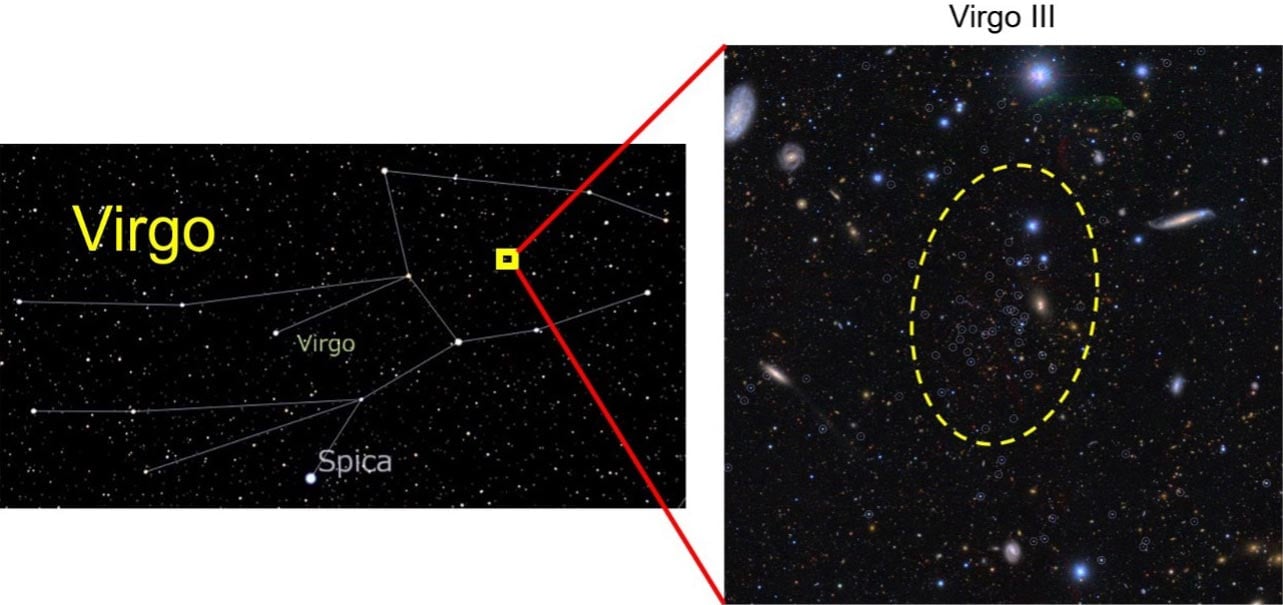
    Dwarf Galaxy in Virgo Constellation
    The position of a newly found dwarf galaxy (Virgo III) in the constellation Virgo (left) and its member stars (right; those circled in white). The member stars are concentrated inside the dashed line in the right panel. Credit: NAOJ/Tohoku University

    Researchers discovered two new satellite galaxies of the Milky Way using the Subaru telescope, hinting at a higher number of satellites than previously thought and indicating a shift from a deficit to a surplus in expected galaxy counts.

    For years, astronomers have worried about how to explain why the Milky Way has fewer satellite galaxies than the standard dark matter model predicts. This is called the “missing satellites problem.” In order to bring us closer to solving this problem, an international team of researchers used data from the Hyper Suprime-Cam (HSC) Subaru Strategic Program (SSP) to discover two completely new satellite galaxies.

    These results were recently published in the Publications of the Astronomical Society of Japan by a team of researchers from Japan, Taiwan, and America.

    The Role of Satellite Galaxies in Understanding Dark Matter

    We live in a galaxy called The Milky Way, which has other, smaller galaxies orbiting it called satellite galaxies. Studying these satellite galaxies can help researchers unravel mysteries surrounding dark matter, and better understand how galaxies evolve over time.

    “How many satellite galaxies does the Milky Way have? This has been an important question for astronomers for decades,” remarks Masahi Chiba, a professor at Tohoku University.
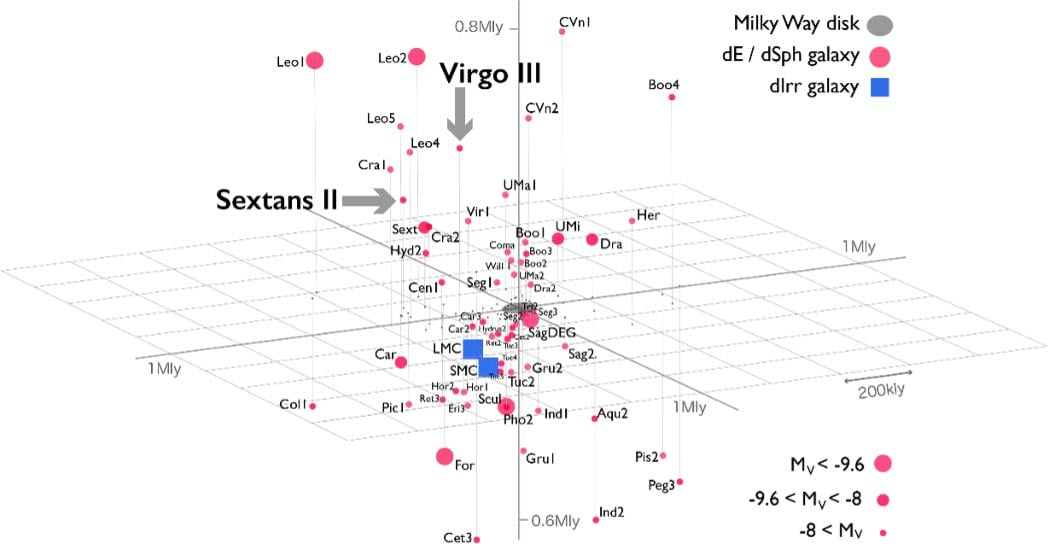
    Satellite Galaxies Around Milky Way
    Satellite galaxies around the Milky Way Galaxy. The plane of the Galactic disk is on the horizontal plane. The blue squares are the Large and Small Magellanic Clouds, and the red circles are other satellite galaxies. The fainter their absolute visual magnitude, the smaller the dot size. Credit: NAOJ/Tohoku University

    Discoveries of Dwarf Galaxies With the Subaru Telescope

    The research team recognized the possibility that there are likely many undiscovered, small satellite galaxies (dwarf galaxies) that are far away and difficult to detect. The powerful ability of the Subaru telescope — which sits atop an isolated mountain above the clouds in Hawaii — is well-suited to find these galaxies. In fact, this research team previously found three new dwarf galaxies using the Subaru telescope.

    Now, the team has discovered an additional two new dwarf galaxies (Virgo III and Sextans II). With this discovery, a total of nine satellite galaxies have been found overall by different research teams. This is still much fewer than the 220 satellite galaxies predicted by the standard theory of dark matter.
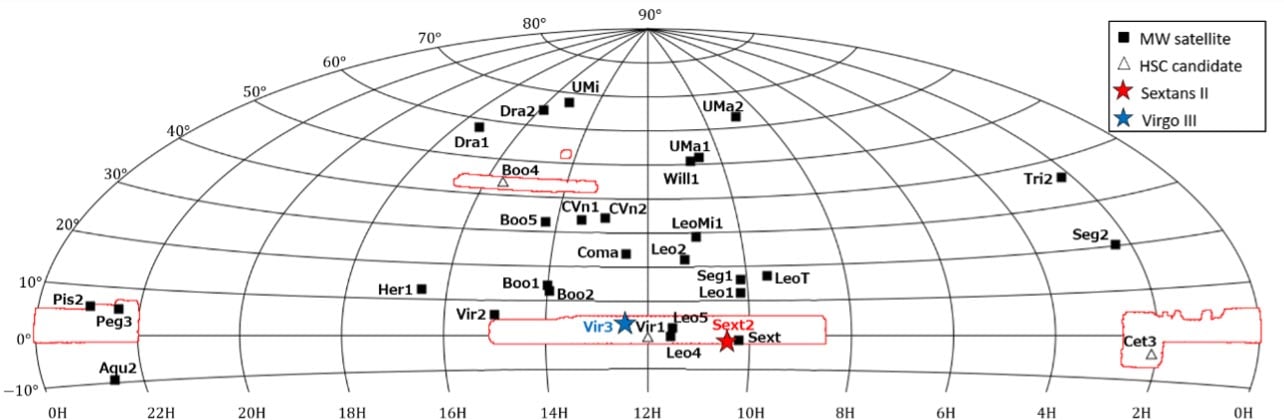
    Area Observed by HSC-SSP
    The area observed by the HSC-SSP (area surrounded by red lines). Previously known satellite galaxies are indicated by black squares, and newly discovered satellite galaxies are indicated by white triangles and stars. Credit: NAOJ/Tohoku University

    The Changing Perspective on Satellite Galaxy Numbers

    However, the footprint of the HSC-SSP does not cover the entire Milky Way. If the distribution of those nine satellite galaxies across the entire Mily Way is similar to what was found in the footprint captured by the HSC-SSP, the research team calculates that there actually may be closer to 500 satellite galaxies. Now, we are faced with a “too many satellites problem,” rather than a “missing satellites problem.”

    To better characterize the actual amount of satellite galaxies, more high-resolution imaging and analysis is required. “The next step is to use a more powerful telescope that captures a wider view of the sky,” explains Chiba, “Next year, the Vera C. Rubin Observatory in Chile will be used to fulfill that purpose. I hope that many new satellite galaxies will be discovered.”

    Reference: “Final results of the search for new Milky Way satellites in the Hyper Suprime-Cam Subaru Strategic Program survey: Discovery of two more candidates” by Daisuke Homma, Masashi Chiba, Yutaka Komiyama, Masayuki Tanaka, Sakurako Okamoto, Mikito Tanaka, Miho N Ishigaki, Kohei Hayashi, Nobuo Arimoto, Robert H Lupton, Michael A Strauss, Satoshi Miyazaki, Shiang-Yu Wang and Hitoshi Murayama, 8 June 2024, Publications of the Astronomical Society of Japan.
    DOI: 10.1093/pasj/psae044

    Never miss a breakthrough: Join the SciTechDaily newsletter.
    Follow us on Google and Google News.

    Astronomy Astrophysics Milky Way Popular Tohoku University
    Share. Facebook Twitter Pinterest LinkedIn Email Reddit

    Related Articles

    Astrophysicists Predict Milky Way is Headed For Catastrophic Collision

    Astronomers Reveal Previously Unknown Details About The Milky Way

    Astronomers Map the Spiral Structure on the Far Side of the Milky Way

    Astrophysicists Show Milky Way Had a Blowout Bash 6 Million Years Ago

    Astronomers Reveal the Rotation of the Hot Gas Around the Milky Way

    VISTA Telescope Discovers a New Component of Milky Way

    Planck Space Telescope Reveals the Magnetic Field Lines of the Milky Way

    Hubble Reveals the First Visual Evidence of Changes in the Milky Way

    New Survey Maps Where Stars Are Born

    Leave A Reply Cancel Reply

    • Facebook
    • Twitter
    • Pinterest
    • YouTube

    Don't Miss a Discovery

    Subscribe for the Latest in Science & Tech!

    Trending News

    Breakthrough Bowel Cancer Trial Leaves Patients Cancer-Free for Nearly 3 Years

    Natural Compound Shows Powerful Potential Against Rheumatoid Arthritis

    100,000-Year-Old Neanderthal Fossils in Poland Reveal Unexpected Genetic Connections

    Simple “Gut Reset” May Prevent Weight Gain After Ozempic or Wegovy

    2.8 Days to Disaster: Scientists Warn Low Earth Orbit Could Suddenly Collapse

    Common Food Compound Shows Surprising Power Against Superbugs

    5 Simple Ways To Remember More and Forget Less

    The Atomic Gap That Could Cost the Semiconductor Industry Billions

    Follow SciTechDaily
    • Facebook
    • Twitter
    • YouTube
    • Pinterest
    • Newsletter
    • RSS
    SciTech News
    • Biology News
    • Chemistry News
    • Earth News
    • Health News
    • Physics News
    • Science News
    • Space News
    • Technology News
    Recent Posts
    • ADHD Isn’t Just a Deficit: Study Reveals Powerful Hidden Strengths
    • Scientists Uncover “Astonishing” Hidden Property of Light
    • Scientists Discover Stem Cells That Could Regrow Teeth and Bone
    • Scientists Discover Natural Molecule That Stops Alzheimer’s Protein Clumps From Forming
    • Early Cannabis Use May Stall Key Brain Skills in Teens
    Copyright © 1998 - 2026 SciTechDaily. All Rights Reserved.
    • Science News
    • About
    • Contact
    • Editorial Board
    • Privacy Policy
    • Terms of Use

    Type above and press Enter to search. Press Esc to cancel.