
Researchers have developed a model for revealing what the color of a galaxy tells about its distance, to be used for measuring cosmic structures.
Using telescopic observations and spectroscopy, researchers analyze the universe’s structure and age, studying how dark matter and dark energy influence galaxy formation and distribution.
Cosmic Evolution
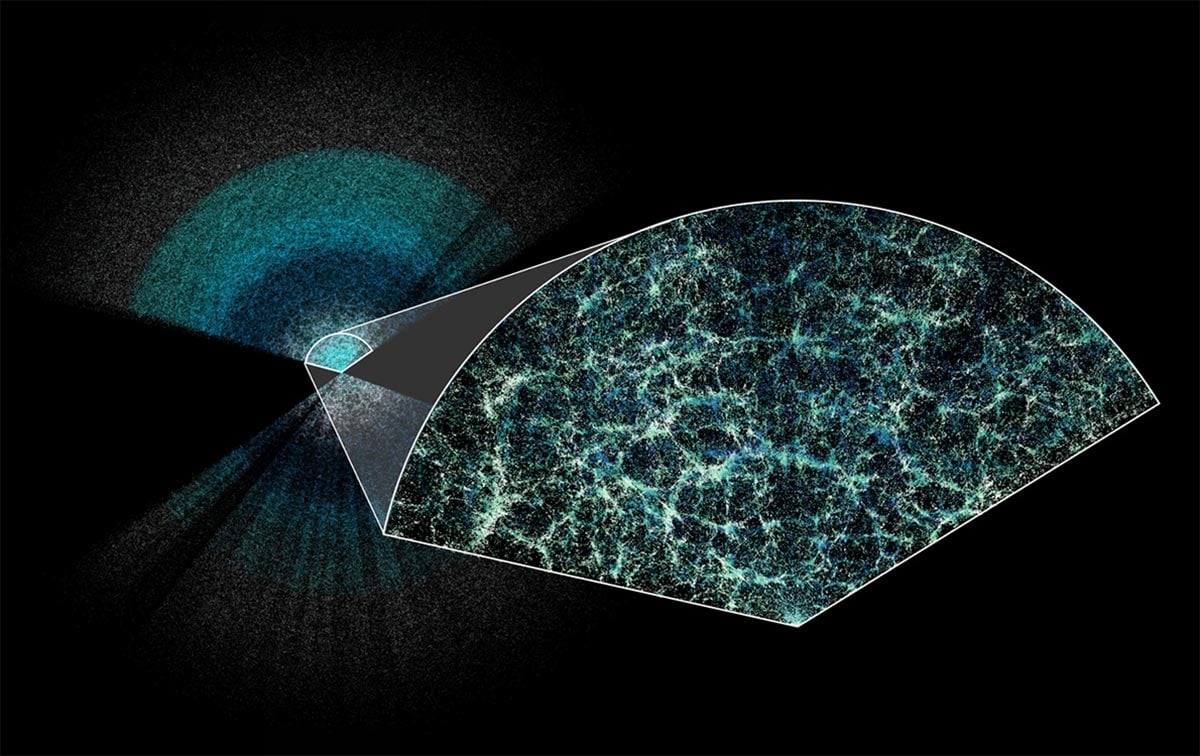
Our universe is around 13.8 billion years old. Over the vastness of this time, the tiniest of initial asymmetries have grown into the large-scale structures we can see through our telescopes in the night sky: galaxies like our own Milky Way, clusters of galaxies, and even larger aggregations of matter or filaments of gas and dust.
How quickly this growth takes place depends, at least in today’s universe, on a sort of wrestling match between natural forces: Can dark matter, which holds everything together through its gravity and attracts additional matter, hold its own against dark energy, which pushes the universe ever further apart?
“If we can precisely measure the structures in the sky, then we can observe this struggle,” says LMU astrophysicist Daniel Grün.
This is where telescopic observation projects come in, capturing large swaths of the sky very precisely in images. For example, there is the Dark Energy Survey with the Blanco telescope in Chile and the recently commissioned Euclid satellite. LMU scientists have been involved in both projects, including in leadership roles, for years.
Challenges in Cosmic Distance Measurement
Although precisely determining the distances of individual structures and galaxies from us is not always easy, it is vitally important. After all, the further away a galaxy is, the longer its light has been traveling to us, and the older therefore is the snapshot of the universe revealed by its observation.
An important source of information is the observed color of a galaxy, which is measured by ground-based telescopes like Blanco or satellites like Euclid. A new study by a team led by Jamie McCullough and Daniel Grün, which has been published in the journal MNRAS, has analyzed the largest dataset to date and sheds light on what the color of various galaxies actually says about their true distance.
Spectroscopy and Redshift
In principle, the distance of a galaxy can be precisely determined by means of spectroscopy. This involves measuring the spectral lines of distant galaxies. As the universe as a whole is expanding, these appear to have a longer wavelength, the further away from us a galaxy is located. This is because the lightwaves of distant galaxies are stretched out on the long journey to us.
This effect, known as redshift, also changes the apparent colors that the instruments measure in the image of the galaxy. They appear redder than they are in reality. This is similar to the Doppler effect we hear in the apparent pitch of an ambulance’s siren as it passes us and moves away.
“If we can combine distance information with measurements of the shape of galaxies, we can infer large-scale structures from the light distortions.”
Jamie McCullough
Galaxy Diversity and Data Integration
Jamie McCullough is a doctoral researcher at LMU and at Stanford University. For her analysis, she used spectroscopic measurements from the Dark Energy Spectroscopic Instrument (DESI) in conjunction with the largest dataset to date for the precise measurement of galaxy colors (KiDS-VIKING).
Specifically, the authors combined spectroscopic data from DESI of a total of 230,000 galaxies with the colors of these galaxies in the KiDS-VIKING survey and used this information to determine the relationship between the distance of a galaxy from us and its observed color and brightness. No two galaxies in the universe are the same, but for each class of similar galaxies, there is a special relationship between observed color and redshift.
“If we can combine distance information with measurements of the shape of galaxies, we can infer large-scale structures from the light distortions,” says Jamie McCullough.
The results of the study make it possible to statistically determine the true distance of each galaxy observed in images taken by Euclid or the Dark Energy Survey.
Interactive flight through millions of galaxies
This 360-degree video shows an interactive flight through millions of galaxies, mapped with coordinate data from DESI. Credit: DESI
Advances in Understanding Cosmic Structures
Analyzing the observed distortions of the galaxy images, scientists will be able to learn something about the behavior of cosmic structures today and billions of years ago and understand them better. This will yield insights into the evolutionary history of the universe.
To be able to observe the course of structure formation over time, you do not need to wait billions of years; it is enough to measure the structure at various distances from the Earth. With images alone, this is almost impossible, as you cannot just tell the distance of a galaxy to ours from its appearance in an image. The study by Jamie McCullough contains the key to this problem by furnishing a model for what the apparent “color” of a galaxy tells us about its distance from us.
The Cosmic Forces at Play
The major goal of this precise observation and distribution of galaxies at various distances is to derive insights into the great wrestling match between the natural forces of dark matter and dark energy.
“To really see what’s happening, you have to be able to observe the individual rounds of this match,” says Grün. This is because dark energy is poised to catch up and potentially arrest the formation of larger accumulations of mass in the universe altogether.
“Only then will we understand what dark matter and dark energy actually are, and which of them will ultimately prevail.”
Reference: “DESI complete calibration of the colour–redshift relation (DC3R2): results from early DESI data” by J McCullough, D Gruen, A Amon, A Roodman, D Masters, A Raichoor, D Schlegel, R Canning, F J Castander, J DeRose, R Miquel, J Myles, J A Newman, A Slosar, J Speagle, M J Wilson, J Aguilar, S Ahlen, S Bailey, D Brooks, T Claybaugh, S Cole, K Dawson, A de la Macorra, P Doel, J E Forero-Romero, S Gontcho A Gontcho, J Guy, R Kehoe, A Kremin, M Landriau, L Le Guillou, M Levi, M Manera, P Martini, A Meisner, J Moustakas, J Nie, W J Percival, C Poppett, F Prada, M Rezaie, G Rossi, E Sanchez, H Seo, G Tarlé, B A Weaver, Z Zhou, H Zou and DESI Collaboration, 03 June 2024, Monthly Notices of the Royal Astronomical Society.
DOI: 10.1093/mnras/stae1316
Never miss a breakthrough: Join the SciTechDaily newsletter.
Follow us on Google and Google News.
2 Comments
That’s like a fistfight between two African-Americans in the tunnel. We can’t see it.
Everything about cosmology seems rather circular. One fundamental assumption holds it altogether; that the frequency of light (or perhaps Planck’s constant) does not lengthen (decay) with distance travelled=time. Which leaves only the priests to tell us how it all began