
Close Menu
    Facebook X (Twitter) Instagram
    SciTechDaily
    • Biology
    • Chemistry
    • Earth
    • Health
    • Physics
    • Science
    • Space
    • Technology
    Facebook X (Twitter) Pinterest YouTube RSS
    SciTechDaily
    Home»Health»“Health Foods” Unveiled: Are They Nutrient Boosters or Hidden Hazards?
    Health

    “Health Foods” Unveiled: Are They Nutrient Boosters or Hidden Hazards?

    By Toho UniversityOctober 30, 2024No Comments2 Mins Read
    Facebook Twitter Pinterest Telegram LinkedIn WhatsApp Email Reddit
    Share
    Facebook Twitter LinkedIn Pinterest Telegram Email Reddit
    Nutrition Facts Pen
    A Toho University study revealed that fortified foods and dietary supplements boost nutrient levels in the Japanese diet. While effective in meeting dietary standards for many, they pose a risk of too much vitamin B6 for some.

    Fortified foods and supplements improve nutrient intake among Japanese, per Toho University research, though some risk excessive vitamin B6.

    A team from Toho University’s Faculty of Medicine, led by Professor Keiko Asakura and Assistant Professor Minami Sugimoto, studied the dietary habits of the Japanese population based on data from 2012. They focused on how fortified foods and dietary supplements—often referred to as “health foods”—contribute to overall nutrient intake.

    The insights gained from this research are expected to help shape health policies in Japan to enhance nutritional intake. The findings were published recently in the journal BMC Nutrition.

    The key points are as follows:

    • Users of fortified foods and/or dietary supplements had a higher intake of vitamins and minerals from base diets (i.e., diets excluding fortified foods and dietary supplements) than non-users, and a higher proportion met the adequate intake levels set by dietary reference standards.
    • Fortified foods and/or dietary supplements contributed to the adequate intake of certain nutrients in their users.
    • However, 2% of the users of fortified foods and/or dietary supplements had a risk of excessive vitamin B6 intake.
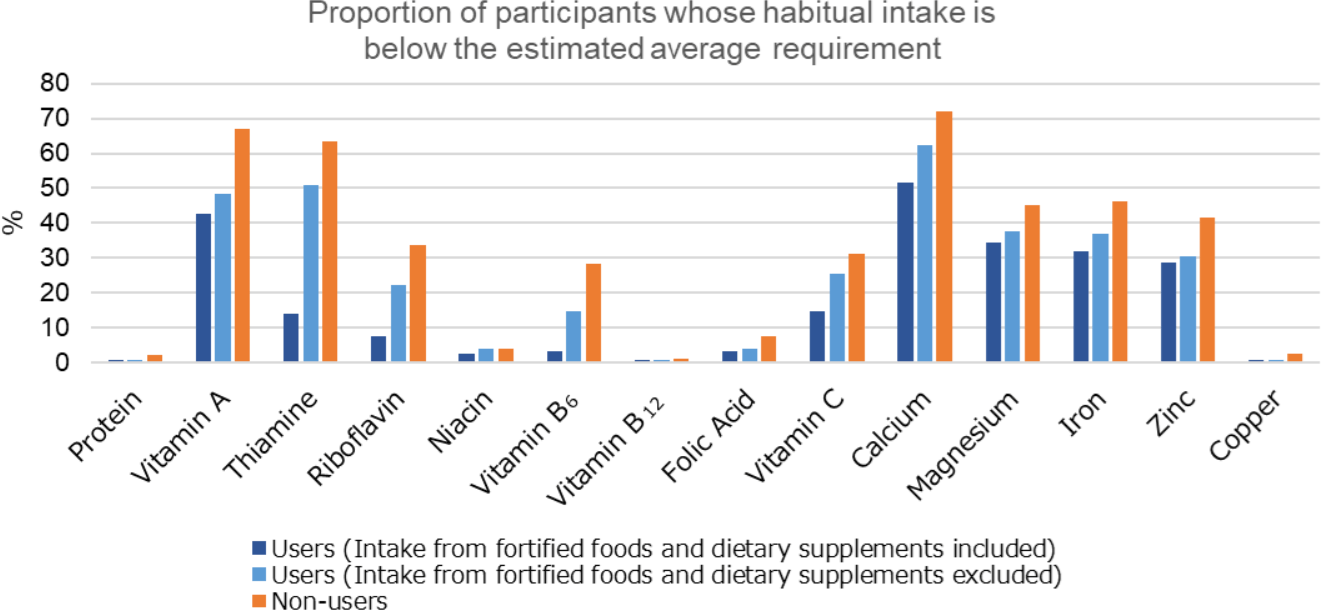
    Habitual Intake Below Estimated Average Requirement
    Proportion of participants whose habitual intakes is below the estimated average requirement among users (n=122) and non-users (n=270) of fortified foods and/or dietary supplements. Among 392 Japanese adults, 122 adults were classified as users if they used fortified foods or dietary supplements at least once on the four-day food record days, and otherwise were classified as non-users. Credit: Dr. Minami Sugimoto

    Reference: “Contribution of fortified foods and dietary supplements to total nutrient intakes and their adequacy in Japanese adults” by Minami Sugimoto, Keiko Asakura, Nana Shinozaki, Kentaro Murakami, Shizuko Masayasu and Satoshi Sasaki, 27 September 2024, BMC Nutrition.
    DOI: 10.1186/s40795-024-00935-w

    Never miss a breakthrough: Join the SciTechDaily newsletter.
    Follow us on Google and Google News.

    Food Science Nutrition Public Health Supplement
    Share. Facebook Twitter Pinterest LinkedIn Email Reddit

    Related Articles

    Cocoa Flavanol Supplement Shows Promise for Reducing Risk of Cardiovascular Disease

    Zinc Supplements May Help To Stave Off Respiratory Infections Such As Colds, Flu, and COVID-19

    Highly Processed Foods Harm Memory in the Aging Brain – But Omega-3 Supplements May Help

    New Nutrient Profiling System: Ranking Healthfulness of Foods From First to Worst

    18-Year Study: Americans Are Eating More Ultra-Processed Foods

    Color-Coded Nutrition Labels and Warnings Linked to Healthier Food Purchases

    Many Consumers Misinterpret Food (Best By / Use By) Expiration Date Labels

    Researchers Warn: Common Food Additive – Banned in France but Allowed in the U.S. – Causes Adverse Health Effects in Mice

    Child Deaths Significantly Reduced With Nutrient Supplements

    Leave A Reply Cancel Reply

    • Facebook
    • Twitter
    • Pinterest
    • YouTube

    Don't Miss a Discovery

    Subscribe for the Latest in Science & Tech!

    Trending News

    Why Popular Diabetes Drugs Like Ozempic Don’t Work for Everyone: The “Genetic Glitch”

    Scientists Stunned After Finding Plant Thought Extinct for 60 Years

    Scientists Discover Tiny New Spider That Hunts Prey 6x Its Size

    Natural Component From Licorice Shows Promise for Treating Inflammatory Bowel Disease

    Scientists Warn: Popular Sweetener Linked to Dangerous Metabolic Effects

    Monster Storms on Jupiter Unleash Lightning Beyond Anything on Earth

    Scientists Create “Liquid Gears” That Spin Without Touching

    The Simple Habit That Could Help Prevent Cancer

    Follow SciTechDaily
    • Facebook
    • Twitter
    • YouTube
    • Pinterest
    • Newsletter
    • RSS
    SciTech News
    • Biology News
    • Chemistry News
    • Earth News
    • Health News
    • Physics News
    • Science News
    • Space News
    • Technology News
    Recent Posts
    • Seeing the Invisible: Scientists Develop New Way To Track Particles in 3D
    • The Atomic Gap That Could Cost the Semiconductor Industry Billions
    • Earth’s Secret Advantage: Why Most Alien Worlds May Be Too Dry for Life
    • Ancient Bacteria Turned a DNA System Into a Cell Skeleton
    • Researchers Finally Solve 50-Year-Old Blood Group Mystery
    Copyright © 1998 - 2026 SciTechDaily. All Rights Reserved.
    • Science News
    • About
    • Contact
    • Editorial Board
    • Privacy Policy
    • Terms of Use

    Type above and press Enter to search. Press Esc to cancel.