
Close Menu
    Facebook X (Twitter) Instagram
    SciTechDaily
    • Biology
    • Chemistry
    • Earth
    • Health
    • Physics
    • Science
    • Space
    • Technology
    Facebook X (Twitter) Pinterest YouTube RSS
    SciTechDaily
    Home»Biology»Hidden Plant Stem Cells Could Hold the Key to Feeding the Future
    Biology

    Hidden Plant Stem Cells Could Hold the Key to Feeding the Future

    By Margaret Osborne, Cold Spring Harbor LaboratorySeptember 22, 2025No Comments3 Mins Read
    Facebook Twitter Pinterest Telegram LinkedIn WhatsApp Email Reddit
    Share
    Facebook Twitter LinkedIn Pinterest Telegram Email Reddit
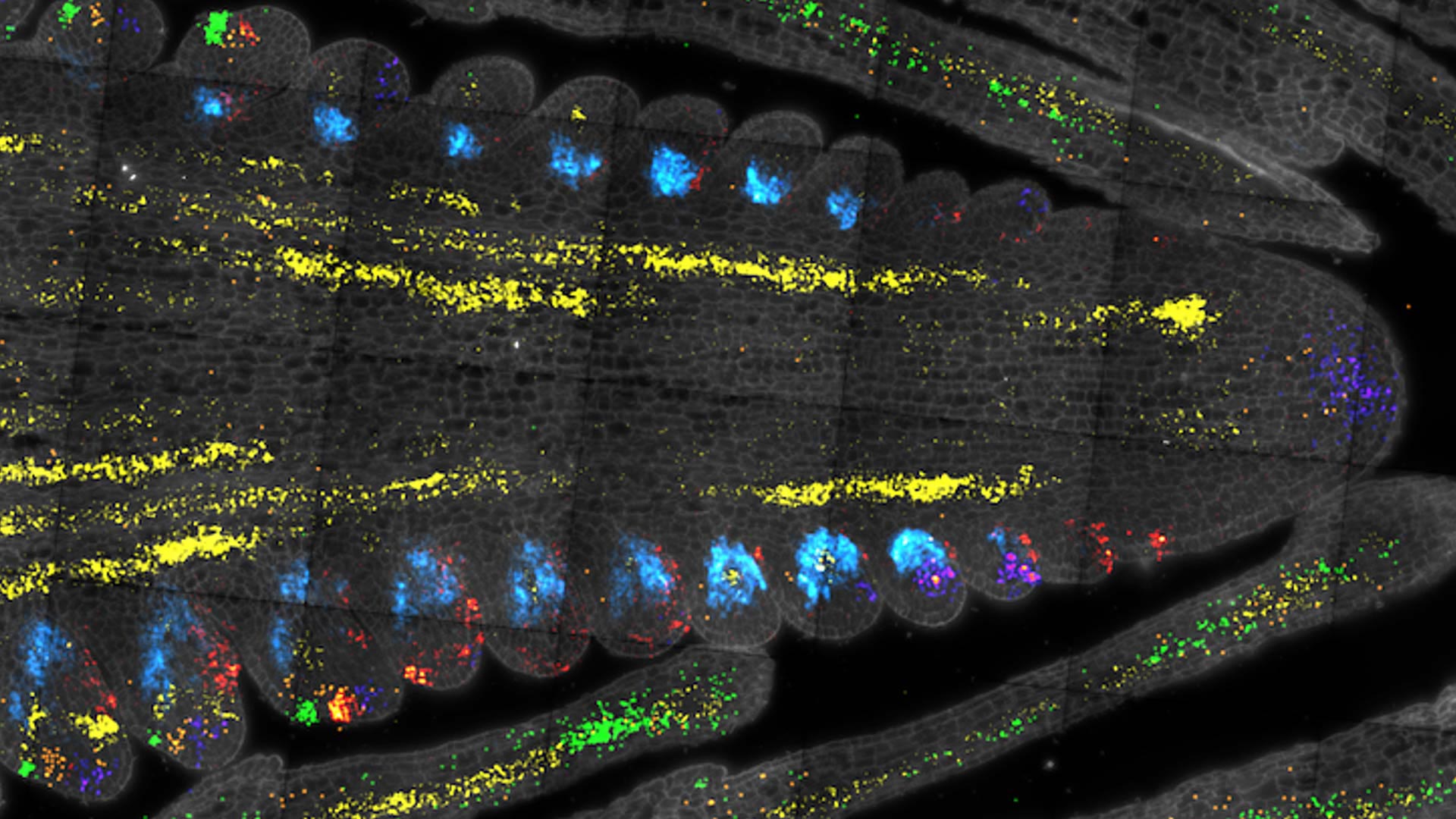
    Maize Stem Cells
    A thin section of a maize ear at a very early stage of development (about 3 millimeters long). Each color represents the expression of a different gene in stem cells and associated cells. Credit: Jackson lab/CSHL

    Plant scientists discovered hidden stem cell regulators tied to growth and crop size. Their breakthrough could transform how we grow food, fuel, and resilient harvests.

    Plant stem cells play a vital role in producing the world’s food, livestock feed, and renewable fuels. They are the foundation of plant growth, yet many aspects of how they work remain a mystery. Past studies have struggled to identify several of the key genes that govern stem cell activity.

    Mapping the Genetic Regulators of Growth

    For the first time, researchers at Cold Spring Harbor Laboratory (CSHL) have charted two well-known stem cell regulators across thousands of individual maize and Arabidopsis shoot cells. In the process, they also uncovered previously unknown regulators in both plants and connected some of them to size differences in maize. The technique they developed to recover rare stem cells could be applied broadly across many plant species.

    CSHL Professor David Jackson explains: “Ideally, we would like to know how to make a stem cell. It would enable us to regenerate plants better. It would allow us to understand plant diversity. One thing people are very excited about is breeding new crops that are more resilient or more productive. We don’t yet have a full list of regulators—the genes we need to do that.”

    Jackson’s team began by investigating two widely studied regulators, CLAVATA3 and WUSCHEL. To access the stem cells, former postdoctoral researcher Xiaosa Xu carefully removed small sections of maize and Arabidopsis shoots. The researchers then turned to a “microfluidics” device to separate the cells one by one, convert their RNA into DNA, and attach a tag showing the identity of each cell.

    Building a Gene Expression Atlas for All

    The process, called single-cell RNA sequencing, allows researchers to see how genes are expressed in thousands of cells at once. “The great thing is that you have this atlas of gene expression,” Jackson says. “When we publish that, the whole community can use it. Other people interested in maize or Arabidopsis stem cells don’t have to repeat the experiment. They will be able to use our data.”

    Single-cell RNA sequencing allowed the team to recover about 5,000 CLAVATA3 and 1,000 WUSCHEL-expressing cells. Next, they identified hundreds of genes that were preferentially expressed in both maize and Arabidopsis stem cells, suggesting they may be evolutionarily important across many plant species. From there, they were able to link certain stem cell regulators to productivity in maize. Such links could someday help breeders select specific strains for food, animal feed, or fuel production.

    A Foundation for the Future of Agriculture

    “It’s foundational knowledge that could guide research for the next decade,” Jackson says. “It can be used not only by developmental biologists, but physiologists, who think about how corn ears grow and how to improve productivity, and then breeders.”

    Reference: “Large-scale single-cell profiling of stem cells identifies redundant regulators of shoot development and yield trait variation” by Xiaosa Xu, Michael Passalacqua, Brian Rice, Edgar Demesa-Arevalo, Mikiko Kojima, Yumiko Takebayashi, Xingyao Yu, Benjamin Harris, Yuchen Liu, Andrea Gallavotti, Hitoshi Sakakibara, Jesse Gillis and David Jackson, 26 August 2025, Developmental Cell.
    DOI: 10.1016/j.devcel.2025.07.024

    Never miss a breakthrough: Join the SciTechDaily newsletter.
    Follow us on Google and Google News.

    Agriculture Cold Spring Harbor Laboratory Food Science Maize Stem Cells
    Share. Facebook Twitter Pinterest LinkedIn Email Reddit

    Related Articles

    Predicting Effects of Genetic Mutations: For Tomato Genes, One Plus One Doesn’t Always Make Two

    Yale Scientists Solve a Thorny Problem: Where Do Thorns Come From?

    Tomato’s Hidden DNA Mutations Revealed in Genetic Study of 100 Varieties

    ‘Bee’ Thankful for the Evolution of Pollen – Discovery Made With Highly Detailed Electron Scanning Microscope

    A Question for Almond Growers: To Bee, or Not to Bee?

    New Tomato Ideal for Urban Gardens and Even Outer Space Created Through Genetic Editing

    These Rat-Eating Monkeys Are Helping Protect Palm Oil Harvests

    Contagious Cancer in Shellfish Spreading Across the Atlantic Ocean and Into the Pacific

    Low Oxygen Levels Trigger the Formation of Plant Sex Cells

    Leave A Reply Cancel Reply

    • Facebook
    • Twitter
    • Pinterest
    • YouTube

    Don't Miss a Discovery

    Subscribe for the Latest in Science & Tech!

    Trending News

    Scientists Discover Game-Changing New Way To Treat High Cholesterol

    This Small Change to Your Exercise Routine Could Be the Secret to Living Longer

    Scientists Discover 430,000-Year-Old Wooden Tools, Rewriting Human History

    AI Could Detect Early Signs of Alzheimer’s in Under a Minute – Far Before Traditional Tests

    What if Dark Matter Has Two Forms? Bold New Hypothesis Could Explain a Cosmic Mystery

    This Metal Melts in Your Hand – and Scientists Just Discovered Something Strange

    Beef vs. Chicken: Surprising Results From New Prediabetes Study

    Alzheimer’s Breakthrough: Scientists Discover Key Protein May Prevent Toxic Protein Clumps in the Brain

    Follow SciTechDaily
    • Facebook
    • Twitter
    • YouTube
    • Pinterest
    • Newsletter
    • RSS
    SciTech News
    • Biology News
    • Chemistry News
    • Earth News
    • Health News
    • Physics News
    • Science News
    • Space News
    • Technology News
    Recent Posts
    • Milk Nanoparticles Could Revolutionize Treatment for Deadly Bile Duct Cancer
    • Largest-Ever Study Finds Medicinal Cannabis Ineffective for Anxiety, Depression, PTSD
    • Scientists Reveal Why a Common Drug Causes Birth Defects and Autism
    • A Medieval Japanese Diary Just Helped Scientists Detect a Dangerous Solar Event
    • Humans Returned to Britain 500 Years Earlier Than Scientists Thought
    Copyright © 1998 - 2026 SciTechDaily. All Rights Reserved.
    • Science News
    • About
    • Contact
    • Editorial Board
    • Privacy Policy
    • Terms of Use

    Type above and press Enter to search. Press Esc to cancel.