
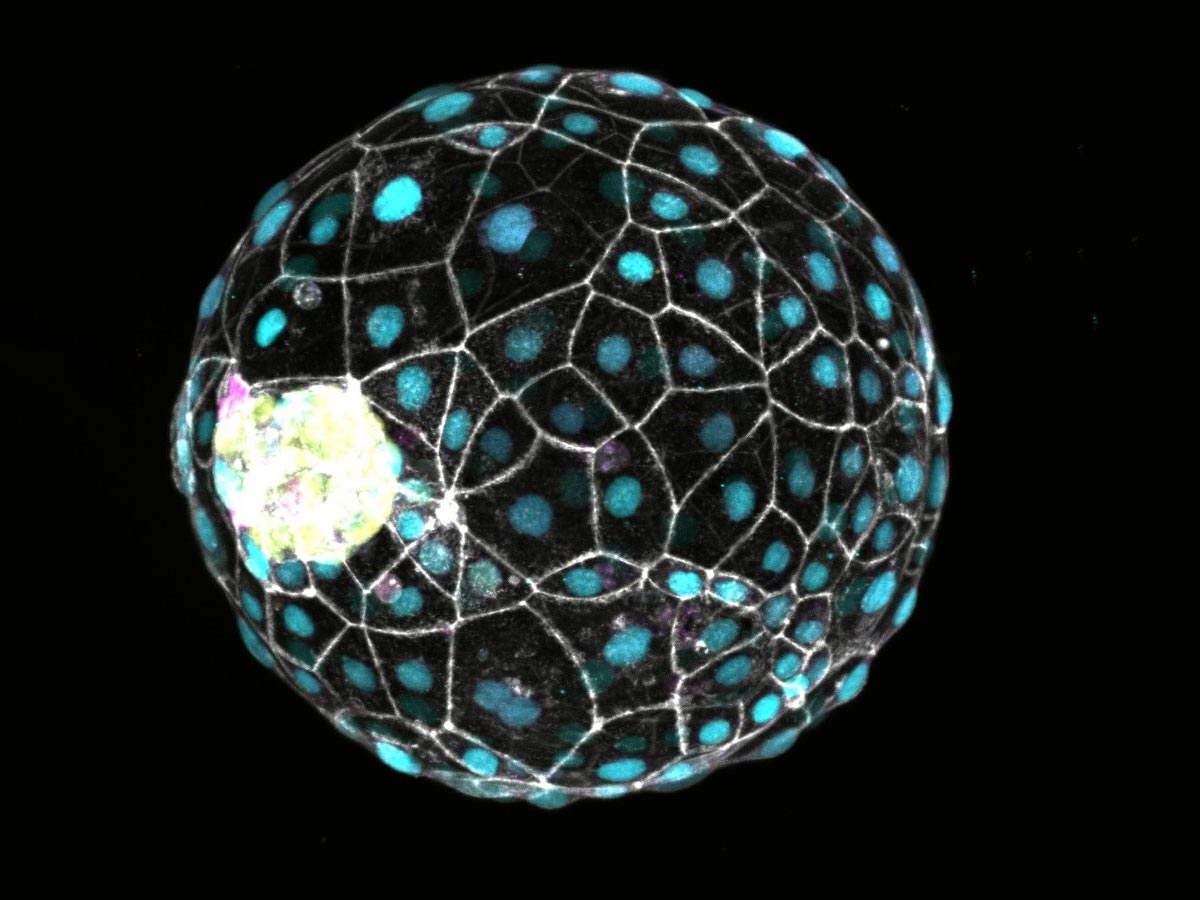
Researchers have discovered a potential “pause button” in the earliest stages of human development.
Whether humans can control the timing of their development has long been debated. This new study suggests humans might retain a dormant capacity for diapause despite not using it during pregnancy. The findings have profound implications for our understanding of early human life and may improve reproductive technologies like IVF.
Embryonic Diapause
In some mammals, the usually continuous embryonic development timing can be altered to improve the chances of survival for both the embryo and the mother. Known as embryonic diapause, this temporary developmental slowdown typically occurs at the blastocyst stage, right before the embryo attaches to the uterine wall. During this pause, the embryo stays free-floating, prolonging the pregnancy.
This dormant state can be maintained for weeks or months before development is resumed, when conditions are favorable. Although not all mammals use this reproductive strategy, the ability to pause development can be triggered experimentally. Whether human cells can respond to diapause triggers remained an open question.
Now, a study by the labs of Nicolas Rivron at the Institute of Molecular Biotechnology (IMBA) of the Austrian Academy of Sciences in Vienna, an ERC grantee, and of Aydan Bulut-Karslıoğlu at the Max Planck Institute for Molecular Genetics in Berlin has identified that the molecular mechanisms that control embryonic diapause also seem to be actionable in human cells. Their results were published on September 26th in the journal Cell.
Stem Cell-Based Models for Human Diapause
In their research, the scientists did not conduct experiments on human embryos and instead used human stem cells and stem cell-based blastocyst models called blastoids. These blastoids are a scientific and ethical alternative to using embryos for research. The researchers discovered that modulation of a specific molecular cascade, the mTOR signaling pathway, in these stem cell models induces a dormant state remarkably akin to diapause.
“The mTOR pathway is a major regulator of growth and developmental progression in mouse embryos,” says Aydan Bulut-Karslioglu. “When we treated human stem cells and blastoids with an mTOR inhibitor we observed a developmental delay, which means that human cells can deploy the molecular machinery to elicit a diapause-like response.”
This dormant state is characterized by reduced cell division, slower development, and a decreased ability to attach to the uterine lining. Importantly, the capacity to enter this dormant stage seems to be restricted to a brief developmental period.
“The developmental timing of blastoids can be stretched around the blastocyst stage, which is exactly the stage where diapause works in most mammals,” says co-first author Dhanur P. Iyer. Moreover, this dormancy is reversible, and blastoids resume normal development when the mTOR pathway is reactivated.
Implications for Reproductive Medicine
The authors concluded that humans, like other mammals, might possess an inherent mechanism to temporarily slow down their development, even though this mechanism may not be used during pregnancy. “This potential may be a vestige of the evolutionary process that we no longer make use of,” says Nicolas Rivron. “Although we have lost the ability to naturally enter dormancy, these experiments suggest that we have nevertheless retained this inner ability and could eventually unleash it.”
For basic research, the question arises as to whether human and other mammalian cells enter the dormant state via similar or alternative pathways and use it for the same purposes, for example either pausing or timing their development and implantation.
The team’s discoveries could have implications for reproductive medicine: “On the one hand, undergoing faster development is known to increase the success rate of in vitro fertilization (IVF), and enhancing mTOR activity could achieve this,” Nicolas Rivron explains. “On the other hand, triggering a dormant state during an IVF procedure could provide a larger time window to assess embryo health and to synchronize it with the mother for better implantation inside the uterus.”
Unveiling Potential in Reproductive Health
Overall, the new findings provide unforeseen insights into the processes governing our earliest development, which might open new avenues for enhancing reproductive health.
“This exciting collaboration is a testimony to how complex biological questions can be tackled by bringing together respective expertise,” says Heidar Heidari Khoei, postdoctoral fellow in the lab of Nicolas Rivron and the study’s co-first author.
“I believe this work not only underscores the importance of collaboration in advancing science but also opens up further possibilities for understanding how various signals are perceived by cells as they prepare for their developmental journey.”
Reference: “mTOR activity paces human blastocyst stage developmental progression” by Dhanur P. Iyer, Heidar Heidari Khoei, Vera A. van der Weijden, Harunobu Kagawa, Saurabh J. Pradhan, Maria Novatchkova, Afshan McCarthy, Teresa Rayon, Claire S. Simon, Ilona Dunkel, Sissy E. Wamaitha, Kay Elder, Phil Snell, Leila Christie, Edda G. Schulz, Kathy K. Niakan, Nicolas Rivron and Aydan Bulut-Karslioğlu, 26 September 2024, Cell.
DOI: 10.1016/j.cell.2024.08.048
Nicolas Rivron is a group leader at IMBA and funded by an ERC Consolidator Grant.
Aydan Bulut-Karslıoğlu is a group leader at the MPIMG and an EMBO Young Investigator. Her research is funded by an ERC Starting Grant.
Never miss a breakthrough: Join the SciTechDaily newsletter.
Follow us on Google and Google News.
2 Comments
More wisdom? More messing with created design? Look for disastrous results.
okay Boomer