
Close Menu
    Facebook X (Twitter) Instagram
    SciTechDaily
    • Biology
    • Chemistry
    • Earth
    • Health
    • Physics
    • Science
    • Space
    • Technology
    Facebook X (Twitter) Pinterest YouTube RSS
    SciTechDaily
    Home»Space»Hubble Spots Turquoise Seas in the Large Magellanic Cloud
    Space

    Hubble Spots Turquoise Seas in the Large Magellanic Cloud

    By NASAJuly 1, 20221 Comment2 Mins Read
    Facebook Twitter Pinterest Telegram LinkedIn WhatsApp Email Reddit
    Share
    Facebook Twitter LinkedIn Pinterest Telegram Email Reddit
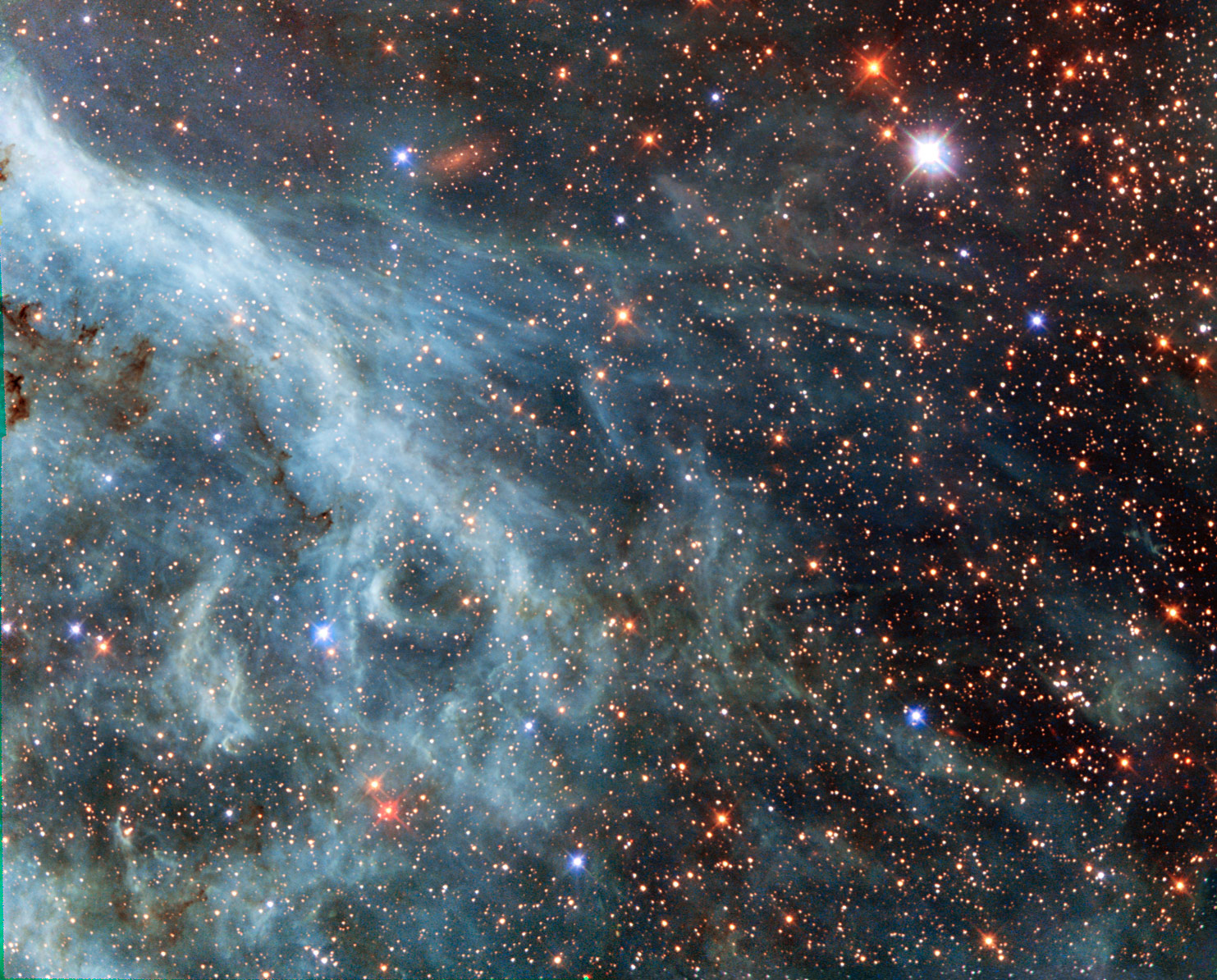
    New Hubble Image of Part of the Large Magellanic Cloud
    Hubble Space Telescope image shows part of the Tarantula Nebula’s outskirts. This famously beautiful nebula, located within the Large Magellanic Cloud, is a frequent target for Hubble. Credit: ESA/Hubble & NASA, Acknowledgement: Josh Barrington

    In this Hubble Space Telescope image from 2014, brightly glowing plumes of the Large Magellanic Cloud (LMC) appear almost like an ocean current with turquoise-tinted currents and nebulous strands reaching out into the surroundings.

    This stunning image shows part of the Tarantula Nebula’s outskirts located within the LMC, a small nearby galaxy that orbits the Milky Way and appears as a hazy blob in our skies. Hubble has peered into this galaxy many times, releasing stunning images of the sparkling stars and whirling clouds of gas.

    The color in most images of the LMC is completely different from that seen here. For this image, researchers substituted the customary R filter, which selects the red light, and replaced it with a filter letting through the near-infrared light. In traditional images, the hydrogen gas appears pink because it shines most brightly in the red. Here, however, other less prominent emission lines dominate in the blue and green filters.

    This data is part of the Archival Pure Parallel Project (APPP), which gathered together and processed over 1,000 images taken using Hubble’s Wide Field Planetary Camera 2, obtained in parallel with other Hubble instruments. Much of the project’s data could be used to study a wide range of astronomical topics, such as gravitational lensing and cosmic shear, exploring distant star-forming galaxies, supplementing observations in other wavelength ranges with optical data, and examining star populations from stellar heavyweights ranging all the way down to solar-mass stars.

    Never miss a breakthrough: Join the SciTechDaily newsletter.
    Follow us on Google and Google News.

    Astronomy NASA
    Share. Facebook Twitter Pinterest LinkedIn Email Reddit

    Related Articles

    Chunk of Moon Rock? NASA Tracks Asteroid 2024 PT5 During Close Earth Flyby

    Webb’s “Weird” Discovery: Meet the Galaxy Where Gas Outshines the Stars

    Don’t Miss the Comet: Witness Tsuchinshan-ATLAS Before It Disappears for 80,000 Years

    Webb Telescope’s Encounter With a Time-Bending Supernova: Rewriting Cosmic Rules

    Sun Unleashes Monumental X9.0 Solar Flare – Most Intense in 7 Years – Captured by NASA Observatory

    Skywatching Magic: October’s Spectacular Comet Lights Up the Night Sky

    Monster X7.1 Solar Flare Unleashed: Intense Blast Captured by NASA’s Solar Dynamics Observatory

    Astronomers Baffled by Black Hole Jets Igniting Star Explosions

    Webb’s Unprecedented Discovery: Potential Missing Link to First Stars in the Universe

    1 Comment

    1. TallRabbit on July 3, 2022 9:56 pm

      Love all these wonderful gorgeous photos! More please!!!

      Reply
    Leave A Reply Cancel Reply

    • Facebook
    • Twitter
    • Pinterest
    • YouTube

    Don't Miss a Discovery

    Subscribe for the Latest in Science & Tech!

    Trending News

    Why Popular Diabetes Drugs Like Ozempic Don’t Work for Everyone: The “Genetic Glitch”

    Scientists Stunned After Finding Plant Thought Extinct for 60 Years

    Scientists Discover Tiny New Spider That Hunts Prey 6x Its Size

    Natural Component From Licorice Shows Promise for Treating Inflammatory Bowel Disease

    Scientists Warn: Popular Sweetener Linked to Dangerous Metabolic Effects

    Monster Storms on Jupiter Unleash Lightning Beyond Anything on Earth

    Scientists Create “Liquid Gears” That Spin Without Touching

    The Simple Habit That Could Help Prevent Cancer

    Follow SciTechDaily
    • Facebook
    • Twitter
    • YouTube
    • Pinterest
    • Newsletter
    • RSS
    SciTech News
    • Biology News
    • Chemistry News
    • Earth News
    • Health News
    • Physics News
    • Science News
    • Space News
    • Technology News
    Recent Posts
    • Hidden Ocean Currents Revealed in Stunning Detail by AI
    • Trees Emit Tiny Lightning Flashes During Storms and Scientists Finally Prove It
    • Forget Chemicals. This Plant Removes Microplastics From Water
    • Breakthrough Crystal Lets Scientists “Write” Nanoscale Patterns With Light
    • Pomegranate Compound Could Help Protect Against Heart Disease
    Copyright © 1998 - 2026 SciTechDaily. All Rights Reserved.
    • Science News
    • About
    • Contact
    • Editorial Board
    • Privacy Policy
    • Terms of Use

    Type above and press Enter to search. Press Esc to cancel.