
Close Menu
    Facebook X (Twitter) Instagram
    SciTechDaily
    • Biology
    • Chemistry
    • Earth
    • Health
    • Physics
    • Science
    • Space
    • Technology
    Facebook X (Twitter) Pinterest YouTube RSS
    SciTechDaily
    Home»Space»Hubble Views a Protostar in a Very Early Evolutionary Stage
    Space

    Hubble Views a Protostar in a Very Early Evolutionary Stage

    By NASAAugust 30, 2013No Comments2 Mins Read
    Facebook Twitter Pinterest Telegram LinkedIn WhatsApp Email Reddit
    Share
    Facebook Twitter LinkedIn Pinterest Telegram Email Reddit
    Hubble Views a Protostar in a Very Early Evolutionary Stage
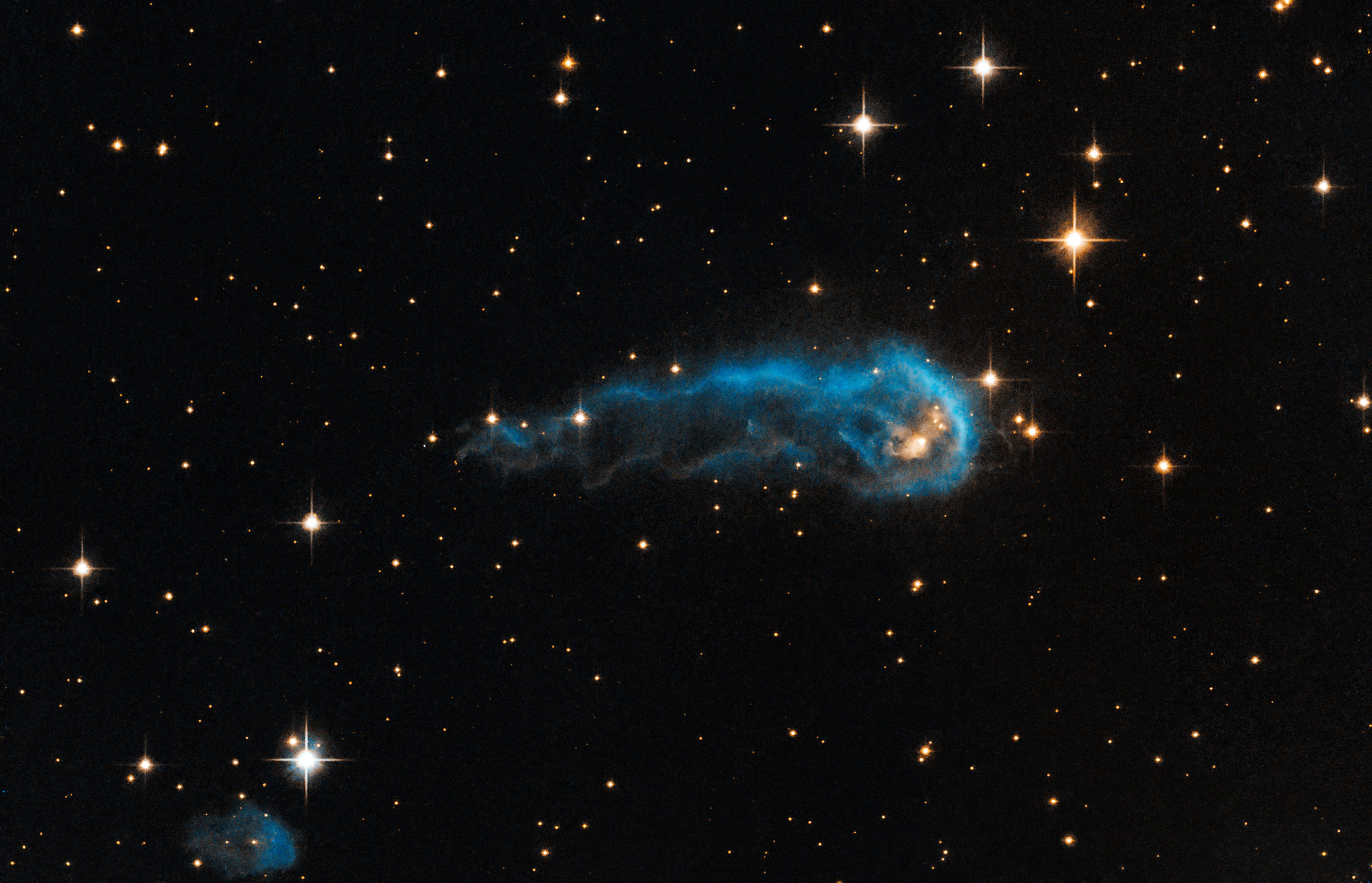
    This composite Hubble image displays IRAS 20324+4057, a protostar in its initial evolutionary stage. Credit: NASA, ESA, and the Hubble Heritage Team (STScI/AURA)

    This composite Hubble image shows IRAS 20324+4057, a protostar in a very early evolutionary stage.

    This light-year-long knot of interstellar gas and dust resembles a caterpillar on its way to a feast. But the meat of the story is not only what this cosmic caterpillar eats for lunch, but also what’s eating it. Harsh winds from extremely bright stars are blasting ultraviolet radiation at this “wanna-be” star and sculpting the gas and dust into its long shape.

    The culprits are 65 of the hottest, brightest known stars, classified as O-type stars, located 15 light-years away from the knot, towards the right edge of the image. These stars, along with 500 less bright, but still highly luminous B-type stars make up what is called the Cygnus OB2 association. Collectively, the association is thought to have a mass more than 30,000 times that of our sun.

    The caterpillar-shaped knot, called IRAS 20324+4057, is a protostar in a very early evolutionary stage. It is still in the process of collecting material from an envelope of gas surrounding it. However, that envelope is being eroded by the radiation from Cygnus OB2. Protostars in this region should eventually become young stars with final masses about one to ten times that of our sun, but if the eroding radiation from the nearby bright stars destroys the gas envelope before the protostars finish collecting mass, their final masses may be reduced.

    Spectroscopic observations of the central star within IRAS 20324+4057 show that it is still collecting material quite heavily from its outer envelope, hoping to bulk up in mass. Only time will tell if the formed star will be a “heavy-weight” or a “light-weight” with respect to its mass.

    This image of IRAS 20324+4057 is a composite of Hubble Advanced Camera for Surveys data taken in green and infrared light in 2006, and ground-based hydrogen data from the Isaac Newton Telescope in 2003. The object lies 4,500 light-years away in the constellation Cygnus.


    Never miss a breakthrough: Join the SciTechDaily newsletter.
    Follow us on Google and Google News.

    Astronomy Hubble Space Telescope NASA Protostar
    Share. Facebook Twitter Pinterest LinkedIn Email Reddit

    Related Articles

    Mysterious Infant Star Unleashes Strobe-Like Flashes of Light

    Hubble Image Shows Chance Alignment Between Galaxies

    Hubble Captures Image of Compact Blue Dwarf Galaxy UGC 5497

    A Spiral Within a Spiral, Galaxy ESO 498-G5

    Hubble to Test Technique of Using the Moon as a Mirror

    Hubble Captures New Image of Messier 9

    Quasars Acting as Gravitational Lenses Viewed by Hubble

    Hubble Discovers NGC 1073, A Barred Spiral Galaxy Similar to Milky Way

    Hubble Observes Rare Blue Stars in Andromeda’s Core

    Leave A Reply Cancel Reply

    • Facebook
    • Twitter
    • Pinterest
    • YouTube

    Don't Miss a Discovery

    Subscribe for the Latest in Science & Tech!

    Trending News

    One of the Universe’s Largest Stars May Be Getting Ready To Explode

    Scientists Discover Enzyme That Could Supercharge Ozempic-Like Weight Loss Drugs

    Popular Sweetener Linked to DNA Damage – “It’s Something You Should Not Be Eating”

    Ancient “Rock” Microbes May Reveal How Complex Life Began

    Researchers Capture Quantum Interference in One of Nature’s Rarest Atoms

    “A Plague Is Upon Us”: The Mass Death That Changed an Ancient City Forever

    Scientists Discover Game-Changing New Way To Treat High Cholesterol

    This Small Change to Your Exercise Routine Could Be the Secret to Living Longer

    Follow SciTechDaily
    • Facebook
    • Twitter
    • YouTube
    • Pinterest
    • Newsletter
    • RSS
    SciTech News
    • Biology News
    • Chemistry News
    • Earth News
    • Health News
    • Physics News
    • Science News
    • Space News
    • Technology News
    Recent Posts
    • Scientists Rethink Extreme Warming After Surprising Ocean Discovery
    • The Surprising Role of Asteroids in the Origin of Life
    • Scientists Raise Concerns Over Newly Recognized Pollutant Found Everywhere in the Air
    • New Study Challenges 40-Year Puzzle About Childhood Body Fat
    • 20-Year Study Finds Daily Multivitamins Don’t Extend Lifespan
    Copyright © 1998 - 2026 SciTechDaily. All Rights Reserved.
    • Science News
    • About
    • Contact
    • Editorial Board
    • Privacy Policy
    • Terms of Use

    Type above and press Enter to search. Press Esc to cancel.