
Potential Model for New Studies of Depression, Anxiety, Alzheimer’s Disease
- Rhesus macaques showed ability to perceive their own heartbeat
- Interoception an important marker in neuropsychiatric disease
- Potential animal model for studies in depression, Alzheimer’s disease
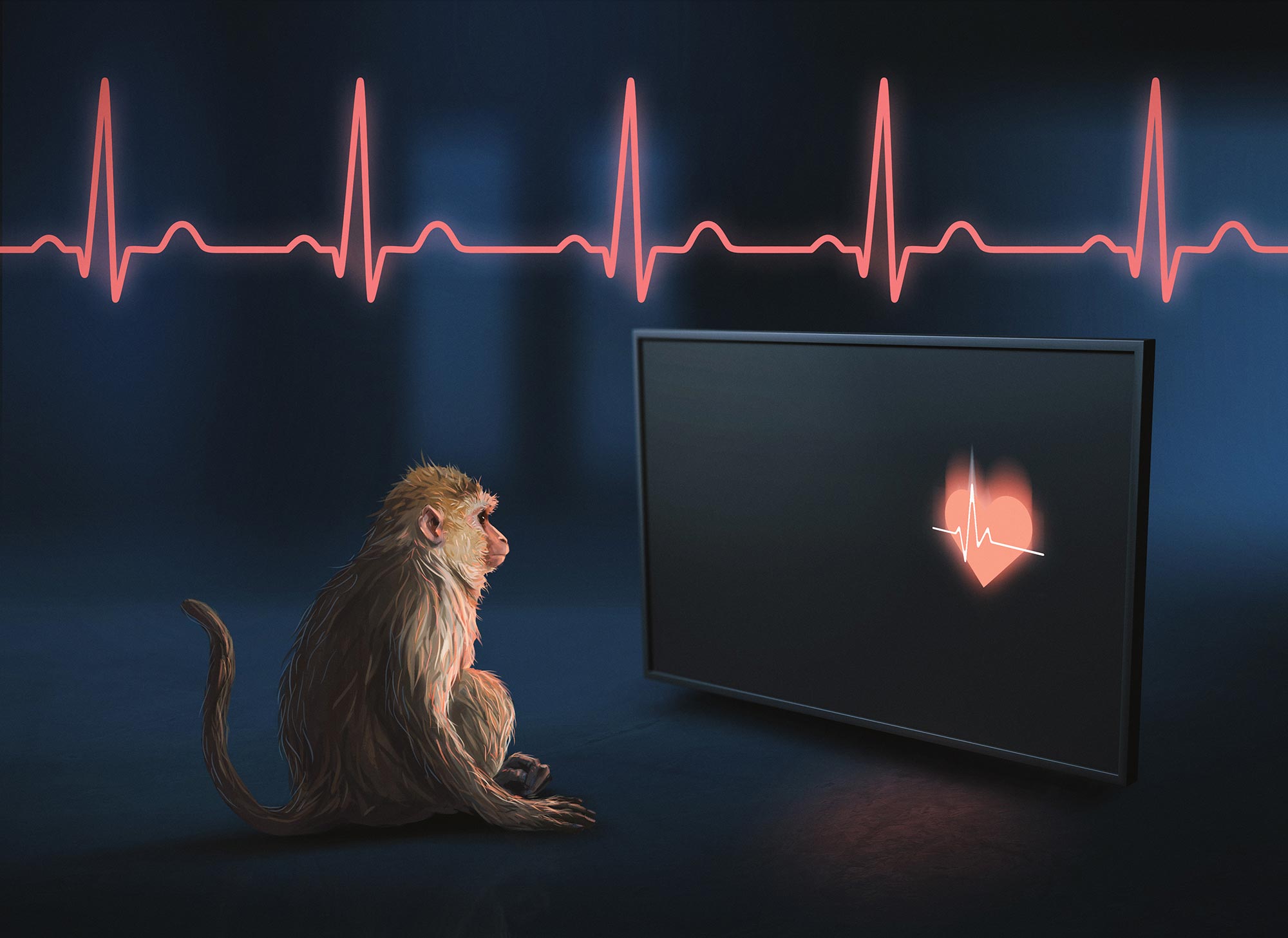
Rhesus macaques are able to perceive their own heartbeats, according to a new study from the California National Primate Research Center at the University of California, Davis, and Royal Holloway, University of London. The research, published April 11 in Proceedings of the National Academy of Sciences, creates a first-of-its-kind animal model of interoception. Interoception refers to the ability to sense the internal state of one’s body, such as observing when your heart races or breathing quickens. The findings provide an important model for future psychiatric and neuropsychiatric research as dysfunctions in interoception are associated with anxiety, depression, and Alzheimer’s disease.
Interoception: The Sense of Internal Body States
The study is part of a collaboration between Eliza Bliss-Moreau, associate professor of psychology at UC Davis and core scientist at the CNPRC, and affective scientist Manos Tsakiris, from the Department of Psychology at Royal Holloway, led by Joey Charbonneau, doctoral student in the Neuroscience Graduate Group at UC Davis, and including Lara Maister, from Bangor University, Wales.
The team monitored four rhesus monkeys that sat in front of an infrared eye tracker displaying stimuli that bounced and generated a sound either synchronously or asynchronously (faster and slower) with the monkeys’ heartbeats. Such an experiment capitalizes on the fact that monkeys and human babies look for longer at things that they find surprising or are unexpected.
All four monkeys spent more time looking at the stimuli presented out of rhythm with their heartbeats compared to stimuli in rhythm with their heartbeats — suggesting that they sensed that the out-of-rhythm stimuli were surprising based on the expected rhythm of their heartbeats. The results are consistent with evidence previously shown in human infants using a similar method. This provides the first behavioral evidence that rhesus monkeys have a humanlike capacity to perceive their heartbeats and have an interoceptive sense.
“Why do we care? Interoception, or the self-monitoring of your physiological systems, is involved in all aspects of human life,” Bliss-Moreau said.
The ability to sense our internal state can indicate issues within the body that require our attention. Impaired interoceptive awareness is associated with less capacity to regulate emotions and increased susceptibility to mental health issues such as anxiety and depression.
“Interoception is hugely important for emotion regulation and mental health in adults, and yet we know very little about how it develops in early infancy or comes to be across evolutionary time,” Tsakiris said. “The work we present here represents a first successful attempt to fill these gaps.”
Deficits Linked to Alzheimer’s Disease
Deficits in interoception have also been linked to neurodegenerative diseases like Alzheimer’s disease.
“This model will be used in future translational studies of neurodegenerative diseases, including Alzheimer’s,” Bliss-Moreau said. “If we can measure interoception, we can track it as a behavioral biomarker of disease progression.”
The study provides insights into how the rhesus macaque model may be used to further our understanding of brain and body function.
“A next step is to study the mechanism by which interoception may be involved in different psychiatric and neuropsychiatric conditions,” Tsakiris said.
Reference: “Rhesus monkeys have an interoceptive sense of their beating hearts” by Joey A. Charbonneau, Lara Maister, Manos Tsakiris and Eliza Bliss-Moreau, 11 April 2022, Proceedings of the National Academy of Sciences.
DOI: 10.1073/pnas.2119868119
The project was supported by a UC Davis Chancellor’s Fellowship to Bliss-Moreau and grants from the European Research Council and NOMIS Foundation. The California National Primate Research Center is supported by NIH Office of the Director.
Never miss a breakthrough: Join the SciTechDaily newsletter.
Follow us on Google and Google News.