
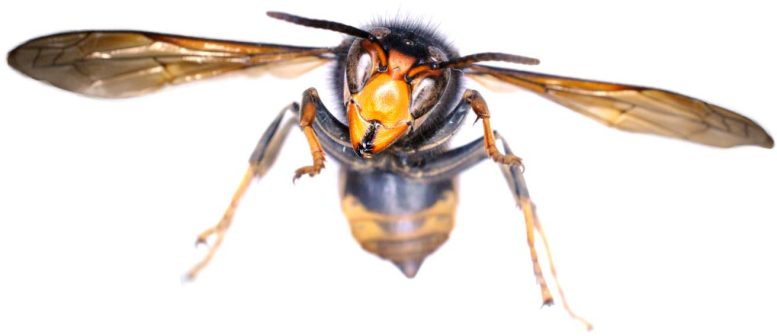
The Ongoing Asian Hornet Invasion: Traced Back to a Single Source in Europe
In Europe, the Asian (or “Yellow-legged”) Hornet (Vespa velutina) is a predator of insects such as honeybees, hoverflies, and other wasps, and poses serious risks to apiculture, biodiversity, and pollination services. This hornet can measure up to 1.6 inches (4 cm) in length. Although it is not aggressive by nature, like all other social wasps it is capable of delivering a painful sting.
Thought to have been introduced into Europe from China in 2004, the Asian Hornet has rapidly spread across the continent. While it has been thus far controlled in Britain, the hornet is well established across mainland Europe and the Channel Islands. In April 2021, the Irish National Parks and Wildlife Service confirmed that a single specimen had been found, ‘alive but dying’ in a private dwelling in Dublin, marking the first Irish record of this species.
The circumstances of how the specimen arrived in the Irish capital are not known, but with the area’s extensive regional, national and international connectivity, there can be many possible pathways of introduction. In an Irish context, it was of particular interest to determine whether this individual originated in Europe/Britain or represented a potential new invasion source from within its native range in Southeast Asia.
Genetic Analysis and Collaboration
The specimen was deposited in the National Museum of Ireland and identified by Dr. Aidan O’Hanlon, who suggested performing genetic analysis to determine its provenance. In collaboration with scientists from the School of Biological, Earth and Environmental Sciences (BEES), University College Cork, and partners on the EU Atlantic Positive Project (which aims to establish Europe-wide methodologies for the control of the Asian hornet), genetic analysis was performed and data were compared with those from specimens provided from several other locations across Europe. The researchers then published their findings in the Journal of Hymenoptera Research.
“Earlier work had demonstrated that Asian hornets in Europe apparently shared the same genetic lineage, based on studies of a single gene. We took this a step further and looked at two additional genes which would be more sensitive in detecting variation within the invasive population,” explains Dr. Eileen Dillane of BEES.
Data from all three genetic markers confirmed that not only are Asian hornets in Europe of a single pedigree, but are likely descended from a single mated queen hornet that somehow arrived in France in 2004. Furthermore, this lineage has not yet been described within the native range.
Implications for Control Efforts
“Our research has revealed the remarkable potential for population expansion of eusocial insects in invaded areas, even when original genetic diversity is extremely low,” says Dr. Simon Harrison, who is part of the research team.
These findings are both bad news and good news for the control of the Asian hornet in Europe. Whilst single-mated queens can evidently rapidly re-colonize areas from where hornets have been eradicated (for example, where intensive efforts have destroyed all nests in an area), the close relatedness of all individuals of the Asian hornet in Europe offers hope for eradication methods based on biological control.
In the Irish context, it is unlikely that this is the beginning of a larger-scale invasion, as the climate and habitat landscape of Ireland is likely less than ideal for the Asian hornet, which requires higher summer temperatures and a greater supply of energy-rich food. “Nonetheless, climate change is likely to increase the threat of a successful invasion in the future, so vigilance against this species must be maintained,” the authors of the study advise.
Reference: “The first recorded occurrence of the Asian hornet (Vespa velutina) in Ireland, genetic evidence for a continued single invasion across Europe” by Eileen Dillane, Rachel Hayden, Aidan O’Hanlon, Fidelma Butler, Simon Harrison, 31 October 2022, Journal of Hymenoptera Research.
DOI: 10.3897/jhr.93.91209
Never miss a breakthrough: Join the SciTechDaily newsletter.
Follow us on Google and Google News.
2 Comments
Nope. Not happening in North America. Not happening anywhere else. Stop spreading panic.
Similar to the African Killer Bees. Some fool just had to bring them to Brazil and then some idiot attendant allowed a queen to “escape.” People just can’t resist inserting flora and fauna in places they don’t belong – it’s fun to play God.