

The highest recorded elevations of Jeffrey pines provide new evidence of a warming climate in the High Sierra.
UC Davis Professor Hugh Safford was hiking for enjoyment in California’s High Sierra when he unexpectedly documented a new elevation record for the Jeffrey pine. His discovery, which may represent the highest-altitude tree in the state, is detailed in Madroño, a journal of the California Botanical Society.
Last September, while exploring the south slopes of Mount Kaweah in Sequoia National Park, Safford stopped to admire familiar high-elevation species like foxtail and lodgepole pines.
“Then I thought, ‘What’s that?’” said Safford, a forest ecologist with the UC Davis Department of Environmental Science and Policy. “I walk over, and it’s a Jeffrey pine! It made no sense. What is a Jeffrey pine doing above 11,500 feet?”
Typically found in upper montane forests across the Sierra Nevada, the Jeffrey pine is most common around areas like Lake Tahoe and Mammoth Lakes. It is not usually considered a subalpine species, which grow at the highest, most extreme elevations. Yet, Safford recorded Jeffrey pines growing as high as 12,657 feet—1,860 feet higher than the previous elevation record for the species and higher than known occurrences of lodgepole, limber, and even foxtail pines.
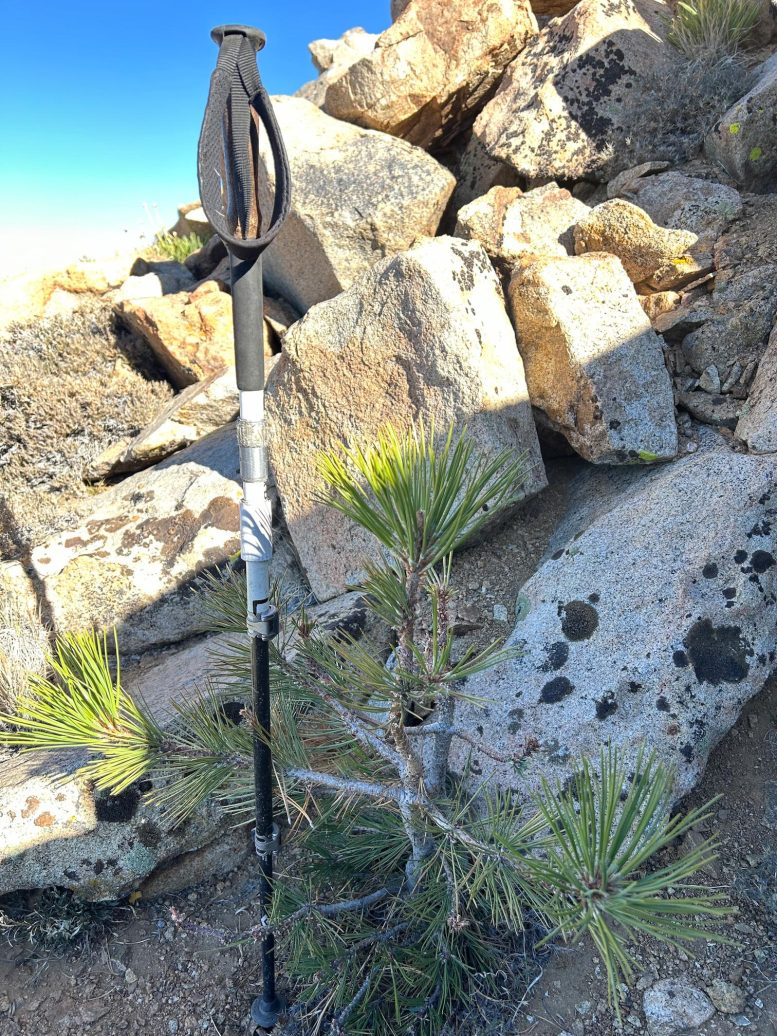
To date, none of the six traditional subalpine forest species have been collected above 12,034 feet. This suggests the Jeffrey pine is California’s highest tree — at least for the moment. Safford’s work indicates that other species are growing higher than commonly used databases suggest.
The discovery signifies a changing climate amid California’s highest peaks. As snow melts earlier and air temperatures rise, Jeffrey pine seeds are germinating on land they previously found frozen and inhospitable.
Moving on up
During his hike-turned-science-expedition, Safford found and examined 14 Jeffrey pines above 11,800 feet elevation, some of which were at least 20 years old. At least a dozen others were visible, but he was unable to visit them. He and researchers from his lab will return to the southern Sierra Nevada this summer to further research Jeffrey pines in the subalpine zone and what is driving their movement.
For now, Safford strongly suspects a bird — the Clark’s nutcracker — is lending its well-known, high alpine gardening skills to the task of planting Jeffrey pine trees in the area. Much as this nutcracker does for whitebark pine trees, preliminary evidence suggests the bird carries fleshy Jeffrey pine seeds up the mountain from thousands of feet below, storing them in the High Sierra’s “refrigerator” for an early summer snack.
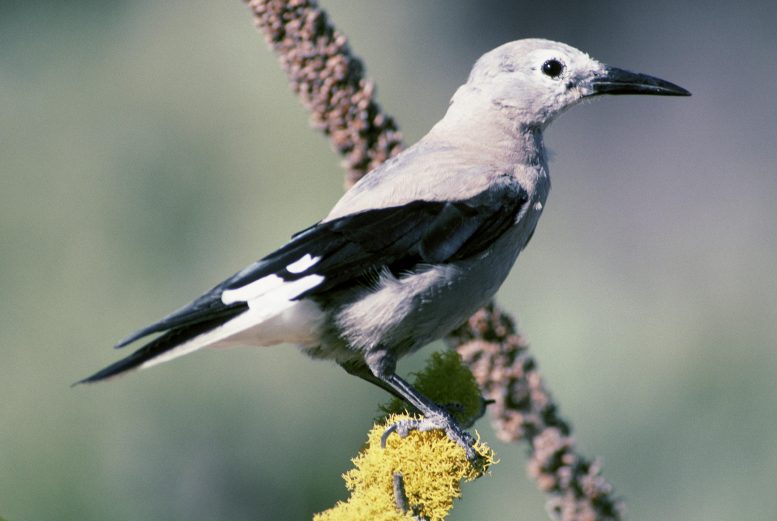
Earlier snowmelt and warmer temperatures enable some of these Jeffrey pine seeds to not only germinate but to establish themselves as a new population on the mountain.
Leapfrogging trees
Species attempting to stay ahead of climate changes by moving uphill are doing so far too slowly to keep pace, climate modeling literature suggests. Yet the models do not account for the role of seed dispersal by birds and other species amid shifting windows of ecological opportunity.
“I’m looking at trees surviving in habitats where they couldn’t before, but they’re also dying in places they used to live before,” Safford said. “They’re not just holding hands and walking uphill. This crazy leapfrogging of species challenges what we think we know about these systems reacting as the climate warms.”
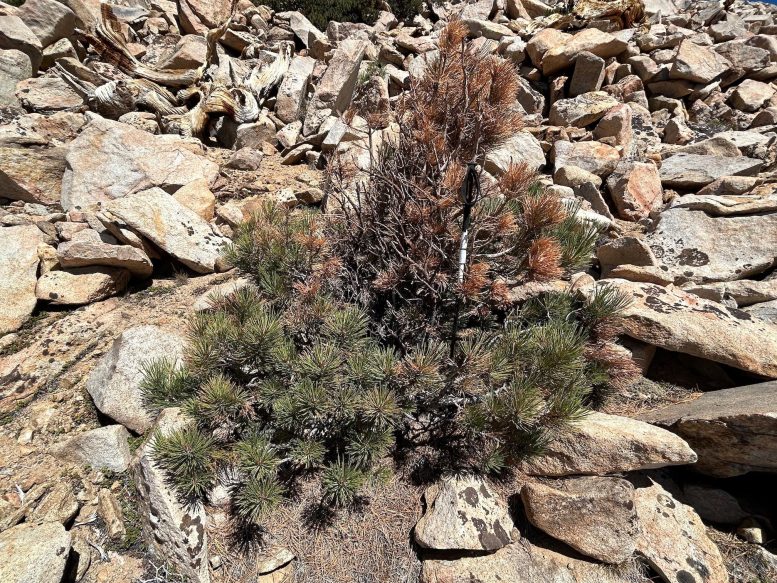
Jeffrey pine trees are tolerant of both cold and drought, so while their lives along the slopes of Mount Kaweah are harsh and somewhat unexpected, their persistence is promising, Safford said.
Trees in real life
The discovery underscores a need for scientists to couple powerful technologies with direct observation. The trees Safford encountered were not detected by any available database, artificial intelligence platform, satellite, or remote sensing technology.
“People aren’t marching to the tops of the mountains to see where the trees really are,” Safford said. “Instead, they are relying on satellite imagery, which can’t see most small trees. What science does is help us understand how the world functions. In this case, where you see the impacts of climate change most dramatically, are at high elevations and high latitudes. If we want our finger on the pulse of how the climate is warming and what the impacts are, that’s where it will be happening first. We just need to get people out there.”
This summer, Safford and his students will be out there, hiking along Mount Whitney, Mount Kaweah, and Sequoia-Kings Canyon National Parks, identifying seedlings, measuring and identifying trees, and helping to develop models of accurate elevations to better understand the changing landscape of the High Sierra.
Reference: “New Elevation Records for Jeffrey Pine” by Hugh D. Safford, 4 March 2025, Madroño.
DOI: 10.3120/0024-9637-72.1.a7
Never miss a breakthrough: Join the SciTechDaily newsletter.
Follow us on Google and Google News.
25 Comments
“What is a Jeffrey pine doing above 11,500 feet?”
It could be pioneers taking advantage of differences in local microclimates. However, whether or not Earth is experiencing warming is not particularly contentious. The Spring planting guides support the claim. The important questions are, 1) “How much warming is occurring?”; 2) “What is the geographic variation, such as differences in the Köppen–Geiger climate zones?”; and 3) “What is the relative contribution from humans, particularly from activities that can be curtailed readily?”
That man made global climate warming is happening isn\t particularly contentious – an oft quoted number is that over 99 % of climate science papers show it is happening.
The percentage of papers published on a particular topic is not necessarily proof of reality. It is more likely what is popular at the moment or a reflection of the biases of the reviewers and editors.
“Why one hundred? If I were wrong, one would have been enough.” — Einstein
Questionable. Should wait to see if the tree can survive another 15 years and be of more mature age. If it is alive then, then perhaps it is worth scientific mention.
The professor states in the article that he saw trees that were 20 years old.
Yes. Science waits. Very prudent. Don’t take or make any data points, comrade. It’s way too early for nature to have made up her mind.
The experts disagree. It is in the article: “In this case, where you see the impacts of climate change most dramatically, are at high elevations and high latitudes. If we want our finger on the pulse of how the climate is warming and what the impacts are, that’s where it will be happening first.”
It is not contentious that the Earth is experiencing some warming currently. What is NOT proven is your claim that humans are responsible.
We definitely are facing some of our worst problems with environmental health of the planet. Our experience with ozone eating chemicals. The measures implemented to curb it. Global warming is going to take sacrifices of every human on earth. If we don’t reverse these adverse effects we’ll suffer the extreme consequences.
And yet, we are not in the midst of another Great Dying, or the instantaneous extinction of the type that caused all dinosaurs and many other orders of life to disappear, nor do there seem to be abundant unfilled ecological niches, suggesting that things are relatively stable. It is well to be concerned about things which we might have some control, but your level of concern is borderline paranoia. It is an expression of the Chicken Little syndrome, based on personal perspective alone.
Look at the acidification of the oceans caused by the raise in co2 levels. It’s real, it’s all over the planet, and threatens the very base of the oceanic food chain.
Yes, we should look at ‘acidification.’ First off, it is a corruption of the definition of acids and bases and ignores the common chemical reaction of “neutralization.” Secondly, even the claim that the oceans are experiencing a reduction in pH is poorly supported. It is based on a computer model that concluded that the average ocean pH was about 8.2 before the Industrial Revolution. The empirical data for ocean pH was ignored in favor of a model. Why would that be? Probably because there was no support for the claim based on actual measurements. Why else would someone go to the trouble to build a model if there were measurements available to support the thesis?
As to threatening “the very base of the oceanic food chain,” where is the support for that claim? A pH, currently, of 8.1 is not much of a threat. Seasonal and diurnal changes greater than 0.1 are common. The famous Stanford geochemist, Konrad Krauskopf, has gone on record to say in his textbook that the oceans are not acidic and probably never will be, and will probably only reach a pH of 7 (neutral) in stagnant pools rich in hydrogen sulfide, not a typical situation. Try reading textbooks instead of MSM exaggerations.
We are definitely in the midst of another Great Dying, and that is not a personal perspective:
“The Holocene extinction, also referred to as the Anthropocene extinction[3][4] or the sixth mass extinction,[5][6] is an ongoing extinction event caused exclusively by human activities during the Holocene epoch.[7][8] This extinction event spans numerous families of plants[9][10][11] and animals, including mammals, birds, reptiles, amphibians, fish, and invertebrates, impacting both terrestrial and marine species.[12]” – Wikipedia
Do you actually trust Wikipedia? The Anthropocene is not an officially accepted epoch. It speaks to the bias of the person editing the Wiki’ entry. The quote makes it sound like the normal course of events is stasis and therefore any extirpations or extinctions must be man made. It is an assumption without support. Even the role of humans in the extinction of Pleistocene megafauna has been debated for decades and we probably have not seen the last of the studies on the question. It certainly has nothing to do anthropogenic warming, which is the topic of the article.
The Earth has been far hotter and far cooler than it is today. Your hubris that we could control the global climate is arrogant.
Whsts with the Nihilist, viewpoint That the ever changing climate is a bad. You overlook all of positive outcomes. Such as the planet being 30% greener, primarily in arid areas. Or the substantial boost in food production worldwide. Or the fact that the cold kills far more people than heat ever has.
The acidification of the oceans due to the higher levels of dissolved co2 that is provided by us. Read one article regarding this and then cry nihilist, comrade.
The issue is that we are (too rapidly) changing the climate outside of “control”. It is the change and its unprecedented speed which is problematic, not the temperature as such. C.f. the quote on the now ongoing sixth mass extinction that we humans are causing.
How do you establish that the rate of change is “unprecedented” when time acts like a low-pass filter, suppressing and broadening peaks and valleys of empirical measurements? It is a claim that, at best, should only be stated as being true for recent measurements where the accuracy and calibration of measuring instruments is known. Proxies need not apply.
Agree with most comments.
Which ones do you disagree with and why?
What are Clark’s nutcrackers doing above 11,500 feet, or even 12,000 feet? Perhaps the trees could always survive at these altitudes as immature non reproducing plants, they just needed a bird to take them there and global warming has allowed the birds to do so?
The birds are terrible judges of altitude. They’re lost.
It is easy to see that despite almost all of the global population thinks that too little is done to combat the ongoing man made global warming, some people have to deflect that by claiming it isn’t happening – which used to be popular – or recently that it is happening but humans are somehow not responsible despite all the evidence to the contrary.
“Mitigating climate change necessitates global cooperation, yet global data on individuals’ willingness to act remain scarce. In this study, we conducted a representative survey across 125 countries, interviewing nearly 130,000 individuals. Our findings reveal widespread support for climate action. Notably, 69% of the global population expresses a willingness to contribute 1% of their personal income, 86% endorse pro-climate social norms and 89% demand intensified political action. Countries facing heightened vulnerability to climate change show a particularly high willingness to contribute.”
[Andre, P., Boneva, T., Chopra, F. et al. Globally representative evidence on the actual and perceived support for climate action. Nat. Clim. Chang. 14, 253–259 (2024).]
Opinions are like belly buttons.
Are we not in an interglacial period? Humans may be amplifying and/or accelerating warming effects, but ice-age flora and fauna were going to go extinct nonetheless. I see many organisms taking great advantage of humans being on the planet, and evolving into habitats that simply never existed prior to a few decades or centuries ago. Coyotes have adapted marvelously to cities and suburbia, and new species of bacteria have evolved that can digest petrochemicals. Sorry to burst the bubble of the NeoMillenialists (eg chicken littles with a little education and very limited foresight), but this planet and Life in general are under no more evolutionary pressure than any other point in history. It’s done to keep an open mind and make efforts to preserve the planet for human habitation, but don’t drag the sorry hysteria of “ we need to save the planet now or everything dies” into the conversation.
I’m a career restoration ecologist, btw.